

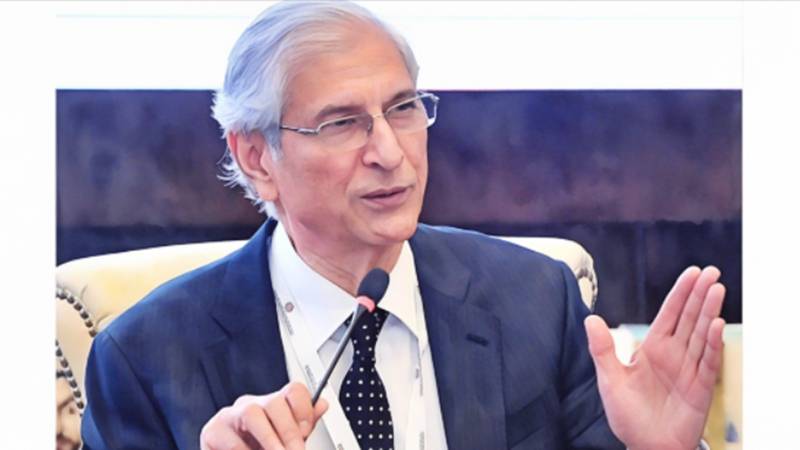
A career in international development banking is one of authority, glamour and responsibility. Only the best and dedicated minds in finance and corporate management attain the position of Country Managers while serving for the International Finance Corporation (IFC).
The book under review is the story of such a son of our soil, whose intellect, hard work and education enabled him to serve in IFC and make a positive difference in the lives of countless people. The book is titled Impacting Lives: My journey as an International Development Banker, authored by Dr Kaiser Naseem, who spent 26 years working with IFC, one of the five constituent components of the World Bank Group (WBG), and was the founder president of the Small and Medium Enterprise (SME) Bank in Pakistan.
Dr Kaiser Naseem is a graduate of the PAF Public School Sargodha, where he was this author’s classmate. He completed his MS is Metallurgical Engineering from Moscow Institute of Steel and Alloys and attained an MBA from the Asian Institute of Management, Manilla, in the Philippines. Fluent in English, Russian and Urdu, he was uniquely positioned to serve on both sides of the Cold War divide. Due to his meritorious services, he was named one of the Top 50 Fintech (Financial Technologies) influencers in the Middle East in 2018 and placed amongst the Top 100 Global Fintech influencers for Sustainable Development Goals in 2019. In recognition of his immense contribution to the development of private sector, especially in Uzbekistan and Kazakhstan, he was awarded an honorary doctorate in Development Finance and Economics in 2022 by European International University, Paris. During his career, Dr Naseem has worked across the Middle East, North Africa, Eastern and Southern Europe, Central and South Asia and North America.
International Financial Institutions (IFIs) like the World Bank, Asian Development Bank, Inter-American Development Bank, etc primarily aim to reduce poverty and promote sustainable economic growth in developing countries. They do this by providing financial support, such as loans and grants for sectors including infrastructure, education, healthcare, and social services. They also provide policy advice to help these countries implement reforms and projects, manage debt relief, encourage private investment in development projects and support environmentally sustainable practices.
These objectives are laudable. IFIs have achieved important milestones in development. Where IFC officials have acted diligently, the results have been amazing. Financing of solar plants in Ethiopia, Madagascar, Senegal, Uzbekistan, and Zambia, with a total of 1.2 gigawatts power generation, achieved a substantial reduction in local solar energy prices. IFC advice and monitoring ensured that in these projects, from technical and economic analysis to plant commissioning and operation took only two yeaRs Other successful power projects include a 1.3 GW liquified natural gas plant in Brazil and 360 MW wind and solar plants in Vietnam.
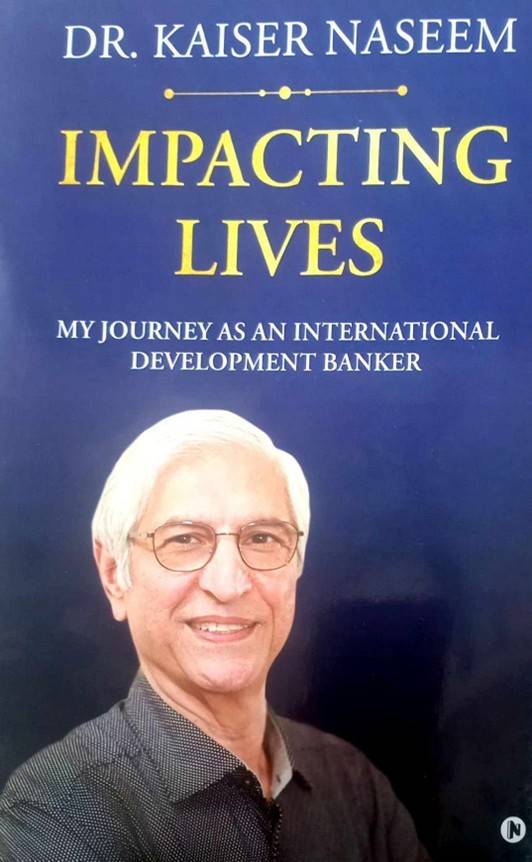
Title: Impacting Lives: My Journey As An International Development Banker
Author: Dr Kaiser Naseem
Publishers: Notion Press (India, Singapore, Malaysia)
ISBN: 9798895883716
Pages: 153
Price: Rs 1,350.00
The diabetes treatment program in Mexico, healthcare in Egypt, infrastructure development on five campuses of a university in Colombia, strengthening operations of an Argentina based citrus company, expansion of a sugarcane industry in UP, India, and growth of a fruit exporting company in South Africa, are some of the IFC programs that ‘impact the lives of the people’; a phrase that forms part of the title of the book under review.
However, at times or perhaps always, these objectives have been politically motivated by the WB stakeholdeRs That is not surprising. For example, as the largest shareholder of the WBG, and the only one with a veto power over its structure and operations, the United States, plays a unique role in influencing and shaping global development priorities. Translated into ordinary English, and as Kaiser notes (pp 83), it means that it is the US that gets to decide who receives the development funds. When nations play to the global strategies of US, they get approval for their projects, and, as a result, their leaders feel entitled to pilfer these funds.
It is well known, and as Kaiser points out in chapter 6 of this book, IFC infiltrated the Central Asian nations only after the breakup of Soviet Union, when the US saw a strategic opportunity as well as the hydrocarbon reserves potential in this land-locked region. Kaiser speaks of great success due to WBG's support in Uzbekistan, one of the only two double landlocked countries of the world, where he served for the most part of his career with IFC. He quotes a 5% growth of the economy over the years in Uzbekistan, with current forex reserves of $40 billion (pp 50). This is true as the per capita income of the country, in terms of purchasing power parity has increased from $3,000 in 1990 to $10,000 today. Yet statistics also speak of a distorted distribution of wealth and a continuous rule by usurpers, that Kaiser, despite his intimate knowledge of the country but exercising a banker's discretion, has not highlighted.
The fact is that Uzbekistan has been ruled for the thirty-five years since independence by Islam Karimov and Shavkat Mirziyoyev, both holdovers of the defunct Soviet Communist Party who have won elections or referendums with above 80% of approval ratings and have run a kleptocracy in the guise of democracy. The Asian Development Bank reported in 2023 that a large part of its population has been left behind in abject poverty, with 11% people living below poverty line, 18.7% employed at only $2.17 per day and a child mortality rate of 13 per 1,000 live births. Uzbekistan has been plagued with persistent and wide spread corruption including abuse of power. Although IFC raised the national wealth there, it also widened the income gap, making the rich richer and pushing down the poor to despondency. This has been true for the most part of IFI’s operations, including in Pakistan.
IFC identified (2020) the quantum of Non-Performing Loans (NPL) in Pakistan at about a trillion rupees with corporate sector contributing 70% of this infection, and cement, power and agriculture as the top defaulting sectors NPL is a technical term for a loan that has not been paid back. Sindh Bank Ltd, wholly owned by the Sindh government, had the highest infection ratio of 46% in the banking industry. It also had the highest NPL to equity ratio of 185%, which means that for every Rs 100 worth of its assets, its defaulting loans were Rs 185. That is a bad joke. Kaiser also mentions without naming the case of a private bank in Pakistan, that had an IFC appointed director on its board but ended up with similar difficulties. In any decent society, that director should have landed in jail with his assets confiscated. Similarly, HASCOL Petroleum Limited scam involving National Bank of Pakistan amounted to 54 billion rupees with no serious accountability. Yet the IFIs including IMF have continued to invest in Pakistan without asking for putting accountability and legal safeguards against such staggering corruption.
Dr Naseem established the Small and Medium Enterprise Bank (SME) in 2002 as its founding president. However, he soon got discouraged by the government’s non-professional attitude
Other nations have faced similar challenges. Ironically, a WB site story dated 2021 quotes Mustafa Kamal, the then Bangladesh Finance Minister for the success of the its programs in that country. That gentleman has now been charged with money laundering and amassing an illegal fortune of Tk167 crore through corrupt practices. The Bank has yet to clarify whether any and if so, then how much of this wealth came from its own loans and aids. In any case, WB couldn’t have been ignorant of the massive corruption in Bangladesh under the then Prime Minister Hasina Wajid by her party loyalists and family members, yet it continued to do business with them as if there was no wrong doing.
These defaulters are some of the most politically influential and financially deviant players in their nations but IFC, or IMF, never carried out, or revealed, complete and transparent audit of the defaulting entities. As Kaiser points out (pp 29) that IMF has given false testimonials of Pakistan's "sound economic policies" during each of its 25 bail out packages. There is, therefore, a need to investigate the role of this and other international funding institutions in promoting corrupt practices, policies and, as a direct result, failure in alleviating poverty in third world nations. In chapter 10 of the book, Kaiser suggests ways to reform the WBG.
Being an experienced development banker, and having worked for NDFC in Pakistan, Kaiser knows that loans provided by international financial institutions are not always wisely or honestly spent. Alongside Pakistan's leaders, who, for the most part, indulge in corrupt and wasteful practices, Kaiser rightly blames international organisations like the IMF and the WBG for continuing to lend money to Pakistan despite knowing that the funds were not always used wisely, and instead of helping the economy grow with a positive impact on the lives of ordinary people, these loans often end up being mismanaged and misused (pp 29-30). The sole aim of development banking should, therefore, be alleviation of poverty through education, skill development and improved infrastructure. Any other proposal for loans forwarded by third world leaders or institutions should be suspected as a stratagem for plunder. In Chapter 9 of the book, Kaiser has candidly admitted the failures of WBG in fighting corruption, maintaining good corporate practices and dealing with climate change.
In early 2000, Musharraf’s martial law regime took Kaiser on secondment from IFC to help in revitalising Small Business Finance Corporation (SMFC) and Reginal Development Finance Corporation (RDFC). He became CEO of both organisations but found them burdened with non-performing loans (pp 61). Unable to rejuvenate these organisations, he decided to create a new one. He established the Small and Medium Enterprise Bank (SME) in 2002 with himself as its founding president. It was a good initiative to help energise small businesses. However, he soon got discouraged by the government’s non-professional attitude and decided to leave Pakistan yet again.
Impacting Lives is a highly readable book written in lucid language with a flowing narrative. Its contents are instructive in understanding the workings of the IFIs in general and WBG/IFC in particular. It is the success story of a young man who wanted to find a purpose in his life and make a difference in the lives of the others.