

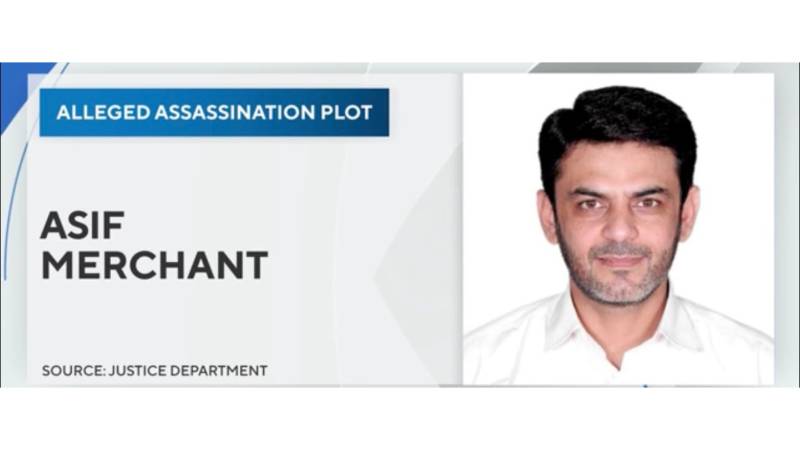
WASHINGTON, D.C., November 17, 2026 — A Pakistani national convicted of terrorism-related offenses and orchestrating a murder-for-hire conspiracy allegedly directed by Iran’s Islamic Revolutionary Guard Corps (IRGC) has been sentenced to 27 years and six months in federal prison for plotting to assassinate prominent American political figures, potentially including President Donald Trump, former President Joe Biden and former U.S. Ambassador to the United Nations Nikki Haley.
Asif Merchant, who was convicted in March 2026, faced a possible life sentence. However, U.S. District Judge Eric R. Komitee handed down a 27½-year prison term during a sentencing hearing Tuesday in Brooklyn, New York.
According to CBS News, Merchant appeared in court wearing a tan prison uniform, with his ankles shackled, and listened to the proceedings through an Urdu interpreter.
Federal Judge Calls Assassination Plot an Extremely Serious Crime
During sentencing, Judge Komitee described the conspiracy as an exceptionally serious act of terrorism, emphasizing the gravity of plotting to assassinate a sitting or former American president or other senior government officials.
The judge also cited the alleged involvement of Iran as an aggravating factor, pointing to what he described as a broader pattern of Iranian-linked activities targeting American interests.
Komitee concluded that the evidence demonstrated Merchant’s personal motivation to harm the United States, rejecting the defense’s argument that he acted solely out of fear for his family’s safety.
Trump, Biden and Nikki Haley Identified as Potential Targets
Federal prosecutors alleged that Merchant traveled to the United States to recruit individuals capable of carrying out politically motivated assassinations.
Court documents outlined a broader conspiracy involving the assassination of a political figure, the theft of sensitive documents from a target’s residence and the organization of a protest intended to distract authorities following the killing.
During his trial, Merchant acknowledged that he had been recruited by a member of Iran’s Revolutionary Guard Corps.
He testified that Trump, Biden and Haley were among the potential targets discussed in connection with the alleged operation.
FBI Undercover Operation Exposed the Conspiracy
According to federal prosecutors, Merchant contacted an individual in the United States seeking assistance with his plans.
Unknown to him, the individual was a confidential source cooperating with American law enforcement authorities.
The informant, identified in court under the pseudonym Nadeem Ali, subsequently introduced Merchant to two individuals presented as professional assassins.
Both were actually undercover FBI agents.
Prosecutors said Merchant provided $5,000 to each of the two supposed hitmen as advance payments toward the planned assassinations.
The undercover operation ultimately helped federal authorities gather evidence against Merchant before the alleged plot could be carried out.
Clothing Business Allegedly Used to Conceal Assassination Plans
During the trial, prosecutors presented evidence that Merchant established a garment business allegedly intended to facilitate communications and financial transactions associated with the conspiracy.
Investigators said clothing-related terminology was used as coded language for different elements of the operation.
According to court testimony, the term “tee-shirt” referred to organizing a protest, “flannel shirt” represented stealing documents, and “fleece jacket” was used to describe carrying out an assassination.
Merchant’s defense attorney, Christopher Neff, disputed the prosecution’s characterization of the business as a front, maintaining that it was a legitimate commercial operation.
However, prosecutors presented a recorded conversation in which Merchant allegedly explained that the business was intended to move money for the IRGC-linked assassination operation rather than generate profits.
Merchant Claims He Acted Under Threats Against His Family in Iran
Testifying in his own defense, Merchant claimed that he participated in the conspiracy under duress because he feared Iranian authorities could harm his wife and child living in Iran if he refused to cooperate.
Court proceedings also established that Merchant has another wife and children in Pakistan.
Federal prosecutors rejected his explanation, arguing that there was insufficient evidence to support the claim that threats against his relatives were the primary reason for his actions.
Judge Komitee acknowledged the possibility that Merchant had genuine concerns about his family’s safety but concluded that those concerns did not fully explain his involvement in the assassination conspiracy.
Prosecutors Reveal Searches for Trump’s 2024 Campaign Rallies
Evidence presented during the trial showed that Merchant searched online for locations associated with Donald Trump’s 2024 presidential campaign rallies.
Prosecutors said he also used Google Maps to examine the address of at least one campaign event.
Investigators introduced social media material allegedly associated with Merchant, including an image depicting Trump’s severed head accompanied by threatening language referencing revenge.
Merchant was arrested on July 12, 2024, one day before an assassination attempt against Trump during a campaign rally in Butler, Pennsylvania.
According to prosecutors, when Merchant subsequently learned about the Butler shooting, he reportedly indicated that the incident resembled the type of operation he had been sent to the United States to conduct.
However, the CBS News report did not establish any operational connection between Merchant’s conspiracy and the Butler assassination attempt.
Defense Argues Assassination Plot Was Unlikely to Succeed
During sentencing, defense attorney Christopher Neff argued that Merchant’s alleged assassination plans were unrealistic and had little chance of success.
Neff questioned how Iranian operatives could reasonably expect Merchant to assassinate a political figure protected by the U.S. Secret Service without providing him with substantial resources or operational support.
The attorney also challenged the government’s portrayal of Merchant as an exceptionally dangerous individual, describing him as an ordinary person rather than the figure presented by prosecutors.
Federal prosecutors rejected that characterization, arguing that the conspiracy reflected methods associated with Iranian Revolutionary Guard operations.
U.S. Justice Department Warns Against Foreign Terrorist Plots
Following the sentencing, U.S. Attorney General Todd Blanche issued a statement emphasizing that the Justice Department would not tolerate foreign-backed terrorist conspiracies targeting American political leaders.
He pledged continued efforts to identify and prosecute individuals responsible for such operations.
Meanwhile, Merchant’s attorney announced plans to appeal the conviction and sentence.
Neff expressed disappointment with the outcome but welcomed the judge’s decision not to impose the life sentence sought by prosecutors.
He also described the decision by a Trump-appointed federal judge to reject a life sentence in a case potentially involving Trump as evidence of judicial independence.
Iran Denies Involvement in Assassination Plots
Iran has previously denied allegations that it orchestrated assassination plots targeting Donald Trump or other senior American officials.
The sentencing represents a significant development in a case that has drawn attention to alleged Iranian intelligence activities on American soil and security threats involving senior U.S. political figures.
Although Merchant received a lengthy federal prison sentence, his legal team has indicated that the case will continue through the appeals process.