

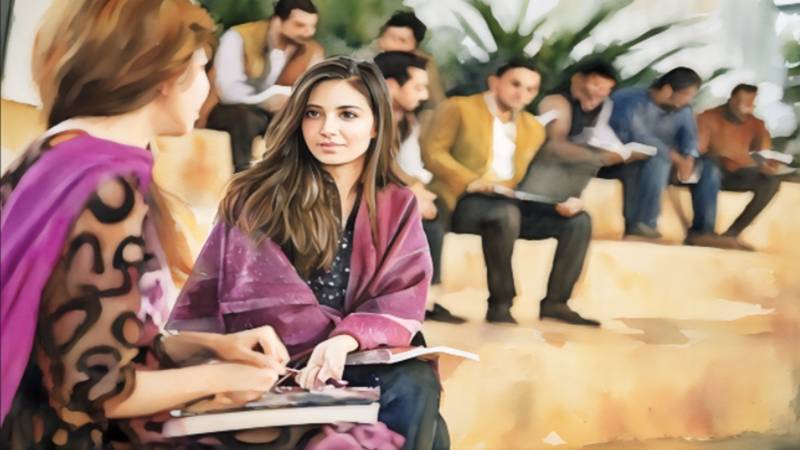
We talk a lot about education. Whenever we turn the first page of the newspaper, we open any social media platform or switch to television. The most debatable issue that we come across is education. For some, it is the problem of less funding to universities and stagnated infrastructural development in schools, and for some, it is the minimal focus on women's education. No one raises any concern about the people who are subject to educational institutions, students, particularly university students.
There are two important queries that need to be addressed. The first query is about the formation of apolitical classrooms in educational institutes, and the second concerns students' docility. Both queries revolve around students who are subject to educational institutes.
Gayatri Spivak asserted, ‘knowledge is not innocent’. Primarily, the sentence makes one obnoxious because the remark is heavy on the whole tradition of education and transmission of knowledge, but on digging into the matter, one can understand the relation of power/knowledge matrix. Though criticism of knowledge resides in Plato’s cave and in the discourse of post-structuralism, with the extensive soft means of education and knowledge, it has become a delirium to think of something – in terms of knowledge – to be apolitical. Even classrooms once considered pioneers of politics, have become an apolitical landscape.
It is understandable when we look at Plato's dialogues, read about Aristotle’s academy, and investigate the development of political thoughts. However, political discussions in Pakistani classrooms have become an objectional activity where teachers or institutional mechanisms try to hold political voices. The problem with holding political voices within educational institutes is all about the process of depoliticisation. It is a kind of depoliticisation that affects students' thinking in terms of politics, and when a student stops thinking politically, the development of smooth democracy becomes challenging in a nation. We even see posters in various shops that state siyasi or mashable guftago s ijtenab kre (Please avoid political and religious discussions).
What is happening to students in educational institutes seems like a far-fetched struggle to make them docile, soft, and indissociable unity.
The Pakistani education system needs to address the suppression of dissent and non-conformist political voices so that democracy can flourish and be sustained at the grassroots level
The philosophy of education is based on two fundamental things: the anatomico-metaphysical register written by the philosopher and policy practitioners and the techno-political register formulated by the state apparatus. In Pakistan, we have a problem with these two registers, which turns our students into docile bodies, soft entities, and amorphous subjects. The anatomico-metaphysical register refers to the exercise of government power over the bodies of students. The interesting point is the formation of these bodies into docile; for example, the HEC dress code policy refers to avoiding particular dress as it may not be appropriate for educational institutes, and we are not talking about shorts but a pair of jeans. A recent example is the ban on Bollywood songs at educational institutions in Punjab. The exercise of power over the microelements, such as students’ bodies, contributes more to formulating discipline. Discipline makes students docile, and the institute can mold them into whatever shape they want to have in a conformist way. It leads to the suppression of non-conformist voices, and to deal with these voices, the Pakistani education system has altered the techno-political register. To deal with the non-conformist voices, the state apparatus changed the political body of student organisations and eventually banned them.
In the 1950s, the Muslim Student Federation played an active role in student politics and continued to pose questions in mainstream politics until it started to crumble. It was a time when Pakistani universities and colleges used to have elections to elect student leaders who were members of syndicates to decide the administrative regularities. Student political leaders played a vital role in paying attention to the irregularities in educational institutions. During the 1960s, Islami Jamait e Taleba rose, and many of its fragments still exist. In the 1950s and 1960s, Pakistan saw many ideological drifts where we experienced liberal pull and Marxist push in student politics. In Bhutto’s regime, a student collective named the People's Student Federation popped into mainstream politics with the help of state power. Many of the student leaders managed to negotiate the exemption of fares and other student subsidies. Many student organisations came and went until Zia banned student politics and organisations in the country. Ban on student organisation was a gradual process.
Non-coercive power altered students' thoughts by exerting power over their bodies and suppressing non-conformist voices. Regurgitation, rote memorisation, and indoctrination are imperious investments that handle and mold the students in whatever way the state apparatus wants. The Pakistani education system needs to address the suppression of dissent and non-conformist political voices so that democracy can flourish and be sustained at the grassroots level.