

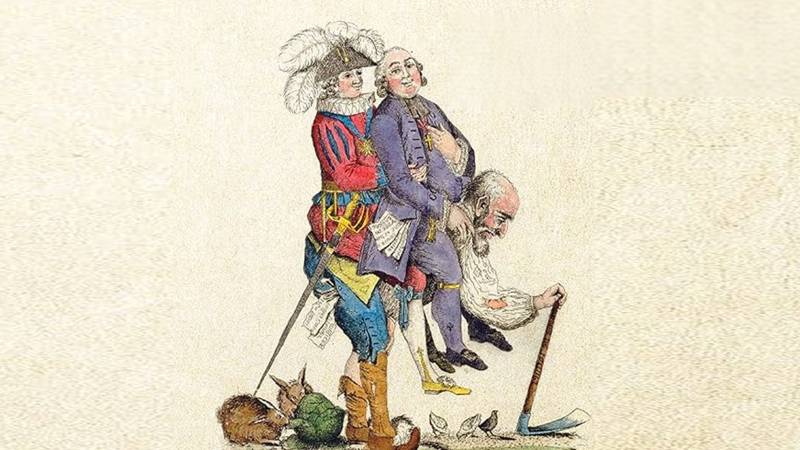
In his book The Coming of Neo-Feudalism: A Warning to the Global Middle Class, Joel Kotkin expresses concern on inequality, which has been widened by the pandemic and backsliding democracy. He argues that globalisation has mainly served the elite, the middle class is in debt due to housing costs, and the working class is turning into medieval serfs. This leads to the rise of autocrats that invoke historical grievances and imagined past glory to achieve power. While his thesis pertains to the US and advanced economies, the rise of inequality and populist leaders is not unique to the developed world.

Kotkin’s main argument is that democracy is based on a property-owning middle class. He argues that the future of democracy is contingent on upward social mobility and property ownership. Therefore, he laments that youth today are less likely to have property. His support for property ownership and communities built around families may be deemed as conservative, but such conservative voices are welcome in an extremely polarised world. Conservatives sorely need able leadership that can wrest their spaces from the far right.
The tech elite depend on lower paid foreign workers, some of whom are like 'indentured servants', prefer 'workaholic employees' and rely on a 'childless workforce'
Kotkin argues that the economy is based on extracting data for Big Tech. This data is used for advertising that shapes our behaviour. Data extraction imbues Big Tech with power and enhances the wealth of the tech elite, who increasingly undermine working class labour. Increasing economic power translates into political power. Thus, Kotkin warns that the “technocratic future” will neither need working-class labour nor democracy.
Kotkin states that the tech elite depend on lower paid foreign workers, some of whom are like “indentured servants”, prefer “workaholic employees” and rely on a “childless workforce”. He notes that the labour policies of Big Tech are exploitative. This is true in the case of Tesla that did not pay overtime and deprived workers of breaks, Amazon where workers rely on food stamps and urinate in bottles, as their movements are tracked through wristbands, and Apple where workers claim they are treated like robots.
The tech elite success stories are projected as the triumph of sheer hard work and talent over adversity. However, Kotkin argues that the tech elite come from the upper middle class, whose parents have a scientific background, who attended elite colleges, and are “short on hardship”. He adds that the tech elite favour universal basic income to prevent the working class from revolting and to let the middle-class foot the bill.
Kotkin argues that economic power is concentrated with giant tech companies that acquire competitors, which has roughly resulted in Google with 90% of advertising, Amazon with 40% of cloud business, and Facebook with 80% of social traffic. Such concentration of power with Big Tech, which controls industries of the future like self-driving cars, drones, space exploration, and AI, undermines democracy. This is because surveillance technology by Big Tech is being used to control populations and spy on political opponents, which makes it “dangerous to express dissent”.
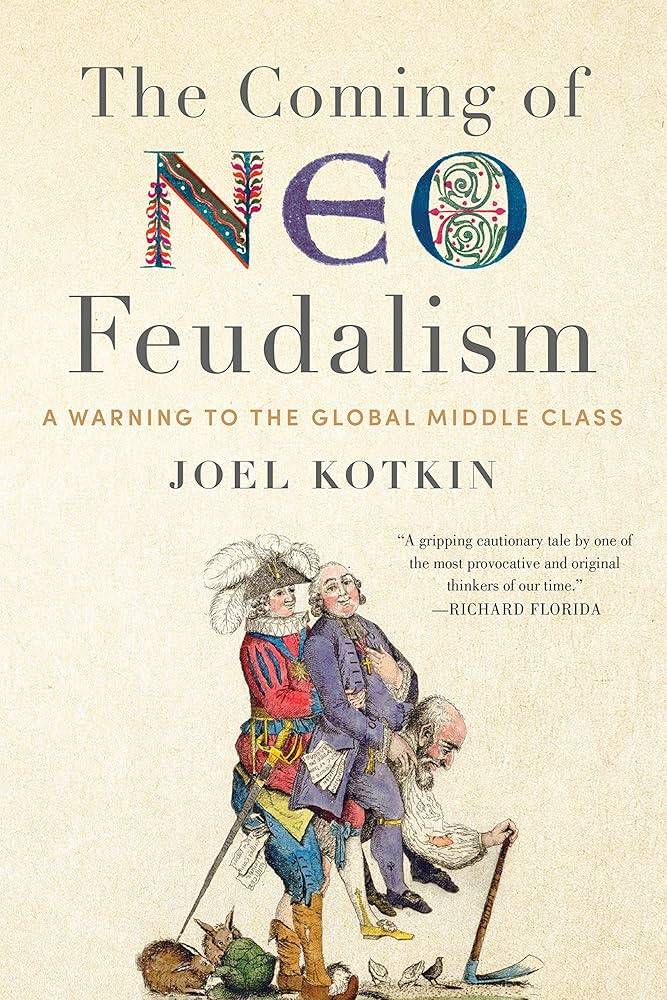
Kotkin reiterates that globalisation and deindustrialisation have destroyed stable jobs and undermined the middle class in advanced economies. He argues that automation inhibits upward social mobility and contributes to social divisions, as the working classes have been polarised with support for the far-left or the far-right. This is not healthy for a stable democracy, as illustrated by the case of the working-class support for Donald Trump.
Overall, Kotkin highlights the rise of populism with globalisation and automation. He expresses concern on the power of Big Tech, its exploitation of the working class and undermining of democracy. However, Kotkin’s solutions of property ownership and family-based communities are different from Yanis Varoufakis’ solutions in Technofeudalism (2023) that emphasise employee ownership of companies, consumer data protection, and collective action to limit the rent of Big Tech. Nonetheless, his book on Neo-feudalism provides an excellent complement to Varoufakis’ Technofeudalism.