

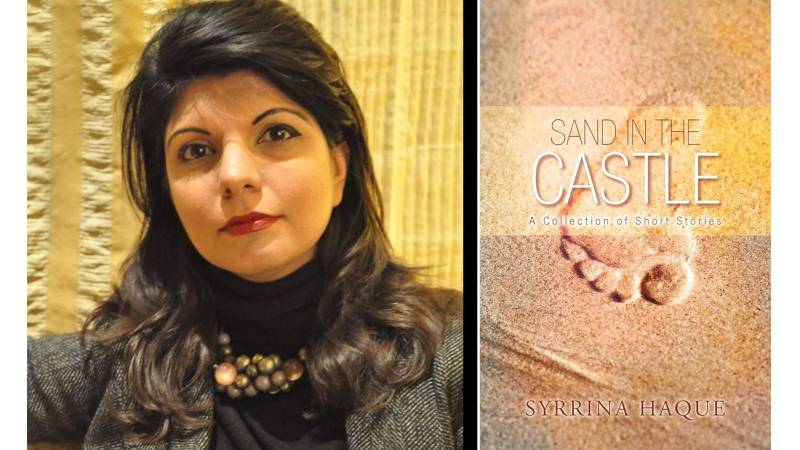
Stories make us who we are, and this is particularly true in the case of fictional narratives. Although we tend to assume that they are based on imaginary characters and worlds, they play a pivotal role in shaping our personalities, our modes of thinking, and our attitudes towards life and fellow humans . Being an avid reader myself, I can safely assert that there comes a time when, given the maturity and dexterity of the author, we begin to drift into the realm of the story, as though the events are unfolding before our very eyes, or as if we ourselves have become an integral part of the narrative.
Of late, I have been reading Syrrina Haque's collection of short stories, Sand in the Castle. Haque is an assistant professor of English at Kinnaird College for Women University and teaches creative writing to students and aspiring writers. Her book comprises eleven stories with multifarious themes, but the underlying motifs of home and violence against women reign supreme. The protagonists are predominantly female. They go through the depravity of the world and suffer the ill treatment meted out to them at the hands of men.
I have observed that some things do not change even with the rotation of days and nights, and one of them is the fate of women in third-world countries. But, like Santiago’s character in Paulo Coelho’s novel The Alchemist, the characters in Haque’s stories learn to listen to their hearts and act accordingly, sans worrying about the consequences. They are bold, brave and a bit quirky.
Her collection of eleven short stories places female protagonists at the forefront, forcing them to navigate deep-seated themes of home and systemic violence
The book opens with the story “From Boundaries to Boundaries,” in which the 39-year-old Sabeen, a mother of three children, flees Pakistan and decides to settle in Canada to evade an abusive spouse and a tense family environment. Her husband’s newfound interest in theology compels Sabeen to take this step and find a new life for herself and her children. But soon she realises that her degrees and fifteen years of teaching experience amount to nothing in the foreign land, and that she has to start her life from scratch. Haque writes, “Canada had been hope for a new beginning, rather any beginning, as she had felt herself living in a tomb for the last nineteen years. The graves of many Sabeens at each stage in her marital life had formed a graveyard within her.” In between, she falls for her husband’s friend, which helps her turn over a new leaf, though momentarily.
The other riveting and haunting story is Burka. Gulbano, a thirteen-year-old girl, is forced to wear a burka as her Amman (mother) explains its importance to her inquisitive yet docile child. Amman says, “This is going to protect you, just like a house protects you—your shelter, your refuge.” She continues, “You don’t know what’s out there, beti, my little girl. There are wolves, ferocious wolves, out there.” Gulbano tries to digest this philosophy because it is meant to protect her from “wolves,” but she aptly questions her mother, innocently asking, “Well, then, shouldn’t they be kept in a cage, with a muzzle? Why me? Why do I have to be trapped because of the wolves?” There is an uncanny resemblance between the characters of Gulbano and Mariam Jo from Khaled Hosseini’s novel A Thousand Splendid Suns. Both children are doomed to suffer at the hands of a ruthless patriarchal society and their lives are defined by an unending vortex of violence. In her futile attempt to escape a forced marriage with an aged man, Gulbano meets a tragic end—something a child her age might not have even heard of.
The third story that I found particularly compelling is Still Alive, which evinces the altruistic and unconventional love of a woman. Shehla, a professional model, is in a live-in relationship with Babar, who belongs to a conservative family that prioritizes people’s opinions over their child’s happiness. As a result, Babar’s father and mother disapprove of their son’s choice until he meets with an accident and goes into a state of coma. When he regains consciousness, he finds Shehla at his bedside, wailing in tears and relentlessly praying for his speedy recovery. Haque encapsulates Babar’s feelings in the following words: “She burst into a wailing sound, clearly unknown to her. I had heard her cry and pray while I was comatose, but this was different. This was a sheer emotional outburst.” Babar believes that, “The union of minds was marriage, and no one on earth was truly married, but I had been married.” He had already married Shehla in his mind, and only a formal name was left to be given to their relationship. Owing to Shehla’s devotion, Babar’s mother also gives in. She says, “I have a manat, a kind of deal where I have decided that I will get them married as soon as he is okay, if Allah Mian makes him well again.” Unfortunately, Babar does not live long enough to give his and Shehla’s relationship a marital shape, leaving her heartbroken and longing for his presence forevermore.
The other stories are equally poignant and powerful. The book was published one and a half decades ago, but its themes remain relevant and moving. By the time I finished reading it, I wondered whether the fate of women would ever begin to look optimistic, or whether they would ever get a chance to live their lives on their own terms. The recent killing of Khalida in the name of honour, at the behest of a reprehensible jirga in Khairpur, paints a gloomy picture vis-à-vis women’s rights in Pakistan. In a land where loving someone becomes a crime, what hope is left for change or betterment?