

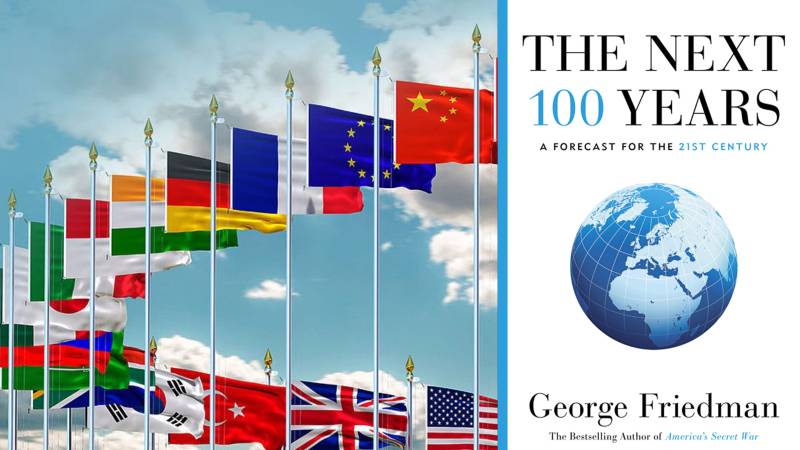
“To him who looks upon the world rationally, the world in turn presents a rational aspect. The relation is mutual.” The Next 100 Years: A Forecast for the 21st Century, first published in 2009, is a true manifestation of Hegelian ideals of rationality. George Friedman, a US-based geopolitical scientist, has no “crystal balls” in his hands, as he holds in the introduction. He presents an objective perspective of the twentieth century and applies it to the twenty-first century. Geopolitical, technological, demographic and militaristic criteria are set to analyse and deduce the future course of action. His method is simple; his language is comprehensive and scans international politics of the past and presents a futuristic approach.
Europe dominated the eighteenth and nineteenth centuries, and the twentieth century witnessed the bipolar struggle of the USA and USSR in the Cold War and the unipolar dominance of the USA post-Cold War. Its main theme hinges on the unparalleled preponderance of the USA and its preeminence to date. It contains thirteen chapters and three configurable sections. The first section focuses on the decade that has passed (2010–2020). The second section delineates thirty years (2020–2050). The third section includes the years from 2050 to 2100.
This magnum opus covers geopolitical, geo-economic and geo-strategic factors of the previous and next century. He states that “inherent geostrategic power of the United States”, coupled with its geo-economic position, makes it pivotal in the twenty-first century. He analyses global changes drastically in cycles of twenty years. He declares them impersonal “Forces of Geopolitics”, which cause unlikely events. In 1900, no one could have imagined that powerful Europe would no longer dominate the Eastern Hemisphere. Similarly, it was not expected that Germany, the USSR and the Ottoman Empire would be disintegrated by 1920.
He applies the same twenty-year observation cycle to the supremacy of the USA in the twenty-first century against many regional powers, including Russia, China, Western Europe and Turkey. He attributes geohistorical factors to the political economy of a country. Numerous factors make the international political system inherently unstable. However, continual geopolitical shifts transferred intercontinental power to the USA post-World War I and World War II.
Friedman has thoroughly discussed global power structures and identified the USA, Russia, Mexico, Germany, France, Poland, Turkey, China, Japan, and regions like the Caucasus, Baltics, Central Asia and the Balkans as the main actors on the global chessboard. The US preponderance would remain intact due to its geopolitical and geo-economic position, supplemented by its technological, social and economic developments. Europe and Japan declined post-World War II.
Despite its spuriousness, it specialises in a sound understanding of history. Hence, “order” is underneath the disorder of history
Accordingly, the USA assumed global leadership by monopolising economic corridors and geostrategic waterways. Since the dissolution of the USSR, Russia has been trying to neutralise the USA in Eastern Europe, the Baltic and the Caucasus. However, Russia would conduct these states as satellite states. Russia’s centralised system would make it collapse from within. Lack of German dynamism and previous acrimony between Poland and Russia would push the US and Poland closer.
Russo-American conflagration would steer Russian cleavage, and a brief and less intense Cold War II would occur in the 2010s. Chinese politico-cultural fragmentation in the 2020s would cause mainland China to become Taiwan’s extension, and the US, mainland Europe and Japan would reassert themselves. Tibet would gain independence with covert Indian assistance. In the 2020s and 2030s, the USA would be allies with Japan and Turkey. Japan, known for its militarism, would re-emerge. The search for raw materials and new military advances would create a Japanese-American coalition. Turkey's rising military and economic influence and unique geography would make it a key regional stakeholder.
From the 2010s to the 2050s, socio-cultural occurrences like the one-child policy and ageing population would lead to a reduced workforce and a declining economy. It would ease immigration controls in the USA, Japan and China to seek a new workforce. Labour-surplus countries would restrict immigrants. By the 2050s, World War III would be fought between the US, the Warsaw Pact, Russia and others. Post–World War III, Americans would re-emerge due to their intrinsic resilience, innovations and entrepreneurship. Earlier, a reactive nation still in its adolescence would bounce back. Space-based precise weaponry and existing enmity between the USA, Turkey, Japan and Russia would wage a space war and claim fifty thousand lives.
The irreversibility of demographic transformations in the southwest of the USA, close to Mexico, would bar Mexicans’ assimilation into US culture. By the 2070s, substantial economic, military and demographic power would lead to a full-blown war with the USA. Besides, genetic engineering and robotics would revolutionise food sufficiency and labour productivity.
China would encounter the USA with its expanding economy, military power and technological innovation. Yet, its isolated geography, limited naval power and inherent political instability would make it only a challenge for the US. China has limited energy reservoirs with rapid economic growth and a large population. The authoritarianism of the Communist Party restricting innovation, the internet and the media would seclude China.
Challenges for the US would be scarcity of oil, energy shortages and price shocks. Conclusively, imports would make the USA vulnerable to OPEC countries. Notwithstanding, the US would remain a superpower because of its monopoly on transpacific and transatlantic trade routes.
Since 1991, many states have tried, but they are unable to beat the US due to its all-encompassing historical paramountcy in areas like excessive land, raw power, naval supremacy, space domination, sustainable economy, fibre-space predominance, management of international financial institutions, pragmatic diplomacy, and ideals of liberalism, democracy and free markets. Regional powers like China, Russia, Mexico, Turkey, Poland, Japan and India would challenge US supremacy unsuccessfully.
This book integrates complex geopolitical trends and synthesises concrete predictions. It is written with scholarly confidence and clarity. His predictions withstood the test of time regarding the Russo-Chinese rise and Islamic fundamentalism in the post-9/11 scenario. He is influenced by classical idealists such as Plato, Aristotle, Ibn Khaldun and realists like Hans J. Morgenthau, Alfred Mahan and Halford Mackinder. Instead of focusing on a certain issue or region, it has an all-inclusive analysis.
Since it was published in 2009, some of its scenarios have suffered from accuracy, some are becoming true, and others are being challenged by the astronomical rise of India, China and Russia. He underestimates numerous factors like the impacts of climate change, the repercussions of deindustrialisation and over-financialisation, and Indo-Chinese rivalry. Factually, he does not mention secondary powers such as Singapore, South Korea and Malaysia because of their nominal geostrategic and geo-economic significance.
To conclude, The Next 100 Years is a ground-breaking work. It is an invaluable academic and practical resource to comprehend the complex international system. Conclusions are drawn on the nature and centuries-old patterns of geopolitics and geostrategy. Despite its spuriousness, it specialises in a sound understanding of history. Hence, “order” is underneath the disorder of history. Relationships between intricate phenomena such as demography, knowledge, economy and statesmanship are supported by experimentalism to predict events of the twenty-first century. It actually discusses countries and regions where the new world order and global power contestation are being shaped.