

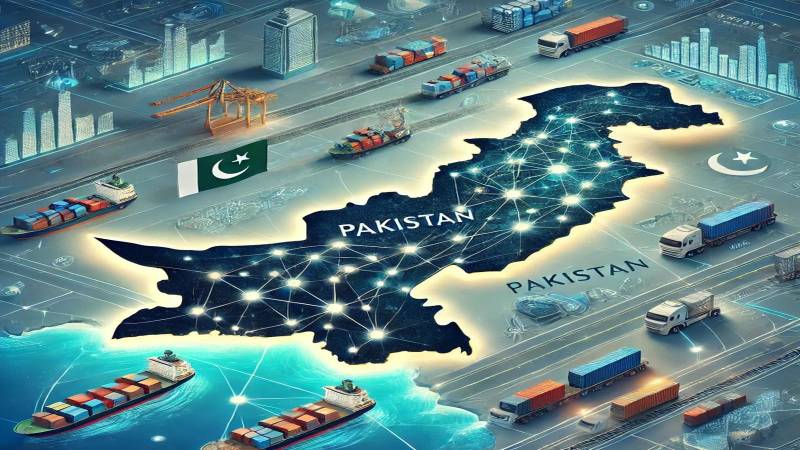
Unequivocally, the geographic factors of a particular region play a significant role in defining the strategic importance of that region in the global arena, impacting its foreign and domestic policies. Many states and regions gained limelight due to their location on the world map, changing their fates in terms of economy and national standing on the global stage. Panama, for instance, is known for trade facilitation, which boosts international trade volume, the economy, and global cooperation. According to the World Bank Report, Panama’s GDP has grown from 1 billion dollars to 66 billion dollars from the year 1960 to 2020. In this century, the idea of a transit-based economy has successfully been leveraged by many states, transforming their GDPs. Singapore, Hong Kong, the United Arab Emirates (UAE), and the Netherlands are classical examples of transit economies.
In line with this, Pakistan is among the lowest GDP states of South Asia. It has been grappling with the issue of economic deficit since its inception due to multifarious reasons. However, there are many pathways to scale up the financial volume of the state, addressing the current account and fiscal deficit of the nation. Amazingly, one of such ways includes a transit-centric economy backed by the geographical position of that state. Shedding light on the geography of Pakistan, it is located at the crossroads of Asia. Further, it is the heart of the Central Asian states and also lies in close proximity to energy-rich regions like Iran and the Middle East.
Moreover, it also possesses maritime significance in terms of the Arabian Sea, which is situated in the south of Pakistan, facilitating maritime trade with the Middle East, Africa, and European continents. Additionally, favourable topography, wide ranges of mountainous terrains including the Karakoram and Himalayan ranges, with the presence of strategic passes like Khunjerab and Bolan Pass, connect the nation with the Central Asian region, China, and Afghanistan, increasing the strategic importance of the state. Further, it also has the blessing of an extensive network of waterways, rivers like Chenab, Jhelum, and Indus, offering the opportunity for trade of goods via water transportation with regional players.
The presence of strategic deep, warm-water ports like Gwadar and Karachi Port is serving as trade linkages between China and the Middle East, acting as the best alternative to the Strait of Malacca. In addition to the aforementioned geographical factors, Pakistan has the potential to drive almost 10 billion dollars of economic revenue by 2025 through trade routes, connecting regional actors with each other in terms of trade expansion, as per the World Bank Report 2020. Even the World Economic Forum (WEF) 2019 report highlighted that the strategic location of Pakistan would make it a key player in the South Asian region.
Pakistan’s geography is not just a map feature—it is a gateway to economic transformation through transit trade
With the addition of economic gains, Pakistan would have the opportunity to diversify its economic means in addition to agriculture and industrial sectors. Further, it would enhance ways to attract Foreign Direct Investment into the state by cooperating with multiple investors. Moreover, the South Asian region has always been vulnerable to instability, and these transit-led initiatives of Pakistan would bring peace to the region by inculcating interdependence within the region through the tool of trade routes, promoting an environment of coordination.
Additionally, this regional cooperation would bring technology exchange, technocratic exchange, job creation, cultural exchange, and many other avenues to Pakistan, strengthening its national standing globally. With this, global markets would connect to Pakistan to navigate their goods via transit routes, affiliating it with major powers of the globe. Such transit trade routes would also create balance in the South Asian region by neutralising the hegemony of the Indian factor in the region, fostering the economic and trade roots of Pakistan. Also, the domestic fabric of the nation would be fortified via sufficient finance and employment opportunities, eradicating poverty and grievances from the country. Moreover, both Pakistan and India can address their security dilemma via this prospect of transit facilitation, mending their ties with each other. Hence, this initiative would act as a game changer for Pakistan.
At present, under the China-Pakistan Economic Corridor (CPEC), many railway lines, roads, logistics systems, and other supply chain mediums are being developed. The development of Gwadar is also in the phase of completion under CPEC 2.0. With that, five new corridors have also been added to this programme. Addressing climate issues and infrastructure advancement are part of these five new corridors. Additionally, the Uraan Pakistan initiative 2025 is also focusing on the transit economy sector in the light of the 5 Es mechanism. Moreover, the Special Investment Facilitation Council (SIFC) is eradicating bureaucratic hurdles from the paths of projects and developmental programmes.
However, Pakistan is surrounded by various challenges while offering this transit facility. First, the surge in terrorist incidents, particularly after the regime change in Afghanistan, is barricading the propagation of transit trade in the region. Further, poor transportation routes, including inadequate roads, railway lines, and airports, are hindering the growth of such transit-driven initiatives. Moreover, political instability in Pakistan, coupled with weak democracy, is not allowing the government to efficiently work on infrastructure development, which would smoothen the supply chain of the entire trade system.
The evil of red-tapism within the state's machinery is adding fuel to the fire by causing delays in the implementation of such transit-oriented opportunities. Furthermore, instigators using tools of misinformation and propaganda are also putting obstacles in the path of the state, which is endeavouring to promote transit-led schemes. Besides, the stark reality of climate change is also impacting the development and infrastructure of the nation, engendering hurdles in the promotion of transit-focused economic programmes. Last but not least, the tentacles of corruption in transit-led plans are one of the stumbling blocks to the success of the transit economy.
Owing to the aforementioned prevalent concerns, Pakistan is still struggling to promote transit trade facilities in the region, necessitating a consolidated plan of action to counter those barriers. Despite the number of setbacks, there are many ways to wrestle against the aforementioned challenges. First, to counter new waves of terrorism, reform in the National Security Policy is the need of the hour. Also, in Afghanistan, commercial terrorism is prevalent; thus, joint efforts with Afghanistan and new methods using diplomacy to counter non-traditional terrorism would mitigate the issue. In addition, more infrastructure development projects would connect the region with Pakistan via trade.
A transparent electoral process with peaceful transfer of power would address political instability, strengthening democracy. Digitalisation of governance would reduce red-tapism, preventing unnecessary delays in developmental projects. Moreover, investment in cybersecurity and the promotion of education would lessen the impact of propaganda, a tool of fifth-generation warfare. Also, to curb the damage of climate change, technological exchange initiatives with international communities must be considered. Lastly, to combat corruption in transit-led projects, stringent audit measures must be implemented to ensure transparency.
To conclude, Pakistan has recently availed itself of an International Monetary Fund (IMF) loan scheme, highlighting its dependence on external financial assistance. However, Pakistan’s geography is not just a map feature—it is a gateway to economic transformation through transit trade. Although this opportunity comes with multiple challenges, the suggested solutions can help the nation capitalise on its strategic location. These threats can be mitigated and managed if timely and effective actions are taken; otherwise, Pakistan risks plunging into dire straits.