

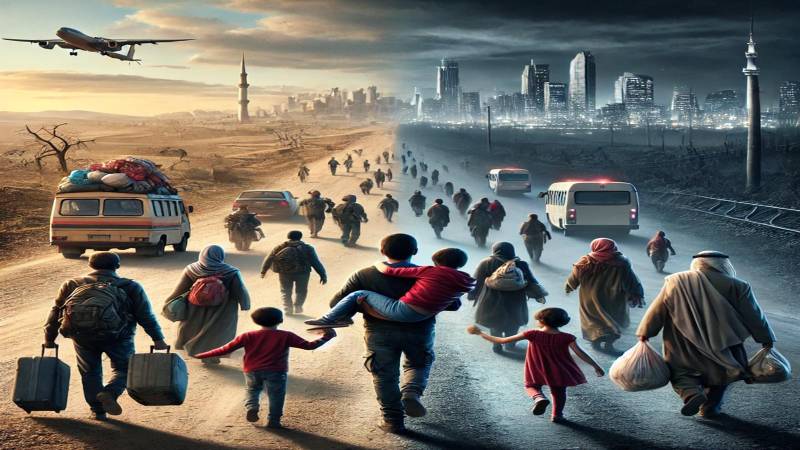
Asylum seekers are people who have left their country and crossed borders. They leave their country to seek greater protection from abuse. To escape violence or threats to their lives or freedoms, many must leave at a moment’s notice, carrying little more than the clothes on their backs. They also experience serious human rights violations in other countries but are still awaiting recognition as refugees and the acceptance of their asylum claims. Seeking asylum is considered a human right, and people have the right to seek asylum if they wish, as stated under the 1951 Refugee Convention.
Now, we will discuss the significance of asylum seekers. According to the United Nations High Commissioner for Refugees (UNHCR), the UN Refugee Agency works to protect asylum seekers. They ensure that asylum seekers can reach safety and have their asylum claims heard fairly and efficiently. UNHCR stands for their rights, including access to education and healthcare. At the end of June 2024, approximately 8 million people worldwide were waiting for a decision on their asylum claims.
However, people seeking asylum should not be restricted simply for entering a country improperly, and authorities should not detain them while they wait for their claim to be processed. Instead, governments should work to find alternative options, such as community care or housing in private or government shelters. Authorities should also take action against those who detain children, as this forces them to grow up in cramped prisons or immigration facilities, which can lead to trauma. Helping them regain a sense of normalcy becomes extremely difficult.
Moreover, when asylum seekers are detained, the conditions of their detention must meet international standards, ensuring that detainees have access to asylum procedures. It is important to assess how many people are housed together, whether they have privacy, and what kind of food, clothing, and medical care they receive. If any issues arise, they should be resolved with the assistance of the government.
The proportion of immigrants in advanced economies has risen from 7 percent to 12 percent, while in emerging market and developing economies, it has remained at around 2 percent
UNHCR works diligently to ensure that governments provide ships to rescue refugees and asylum seekers, allowing them to disembark safely and receive medical care and food. They also train coast guards to improve the chances that rescued individuals have the opportunity to file an asylum claim.
In the long term, discussions are held with different countries to create and improve national asylum laws and systems. Countries with strong asylum systems can efficiently identify people in need of international protection as well as those who are not, facilitating prompt returns.
In 2021, the top ten refugee-producing countries all had poor human rights records. People sought asylum and fled from conflicts and abuses, searching for safety. Moreover, in 2021, more than two-thirds of the world’s refugees came from just five countries: Syria (6.8 million), Venezuela (4.6 million), Afghanistan (2.7 million), South Sudan (2.4 million), and Myanmar (1.2 million).
As we have discussed the significance of seeking asylum, we shall now move on to the challenges faced by asylum seekers. The main challenge for a person seeking asylum is that they have left behind friends, family, photographs, jobs, homes, clothes, sentimental gifts—the list goes on. This is an extremely emotional experience for asylum seekers.
People seeking asylum often struggle financially while waiting for a decision on their asylum claim, which can take years, sometimes even decades. They are often restricted from working and dependent on limited government support, making their lives even harder before receiving a successful asylum claim. Many individuals, without access to public funds, housing, or employment, are at high risk of homelessness, abuse, and exploitation.
Now, we will discuss economic migrants, the significance of migrating from one’s home country for business purposes, and the challenges faced by economic migrants.
Economic migrants are individuals who leave their country of origin purely for economic reasons that are unrelated to refugee status, seeking better material living conditions and employment opportunities in another country.
In 2019, approximately 270 million people worldwide were migrants, meaning they were not living in their country of birth. The global migrant population has increased by 120 million since 1990. However, the share of migrants in the world’s population has remained around 3 percent over the past 60 years. The proportion of immigrants in advanced economies has risen from 7 percent to 12 percent, while in emerging market and developing economies, it has remained at around 2 percent.
The most significant challenge economic migrants face is leaving their families behind. This often leads to emotional distress, and reuniting with family is difficult due to strict immigration rules, as discussed in the first paragraph of the challenges faced by economic migrants
In the long term, both high- and low-skilled migrant workers benefit their host countries by increasing income per capita and improving living standards. High-skilled migrants bring talent and expertise, whereas low-skilled migrants fill essential roles in sectors with labour shortages, enabling natives to take on higher-skilled jobs. Moreover, these benefits are broadly shared across society. It may therefore be worthwhile to bear short-term costs to help integrate these new workers.
Regarding migrants in the labour market, migrants have accounted for 47 percent of workforce growth in the United States and 70 percent in Europe over the past decade. Migrants fill important roles in both expanding and declining economic sectors. Like native-born workers, young migrants tend to be better educated than those nearing retirement. Migrants contribute significantly to labour market flexibility, particularly in Europe.
More recently, the fiscal impact of migration in all European OECD countries, as well as Australia, Canada, and the United States, has been analysed in comparative studies such as Liebig and Mo (2013). This study explores the effect of cumulative migration waves over the last 50 years. It found that, on average, migration’s impact on GDP is close to zero, rarely exceeding 0.5 percent in either positive or negative terms. However, the effect is highest in Switzerland and Luxembourg, where immigrants contribute an estimated net benefit of about 2 percent of GDP to public finances.
As we have discussed the significance of economic migrants, we shall now examine the challenges they face.
The first issue economic migrants encounter is obtaining a visa to enter their destination country. If they lack proper documentation, strict immigration laws and policies can be overwhelming. Secondly, securing employment quickly can be difficult. If they do find work, it is often low-paying, and they may have to wait at least two years to gain experience before securing a promotion or a better job.
Thirdly, upon arriving in their destination country, migrants face high living costs. Due to their low income, many struggle to send money back home. Fourthly, language and cultural barriers make it difficult for them to adapt. Poor working conditions can lead to workplace injuries, and migrants may be vulnerable to theft and unsafe environments. Fifthly, those with incomplete documentation have limited access to healthcare and are at higher risk of experiencing depression, stress, and anxiety.
The most significant challenge economic migrants face is leaving their families behind. This often leads to emotional distress, and reuniting with family is difficult due to strict immigration rules, as discussed in the first paragraph of the challenges faced by economic migrants.
In conclusion, distinguishing between asylum seekers and economic migrants is crucial for developing fair and effective immigration policies. While both groups contribute to society in different ways, their needs and legal statuses differ significantly. Governments must balance humanitarian responsibilities with economic and social stability. Addressing these issues requires international cooperation, clear policies, and public awareness to ensure a fair and sustainable approach to migration.