

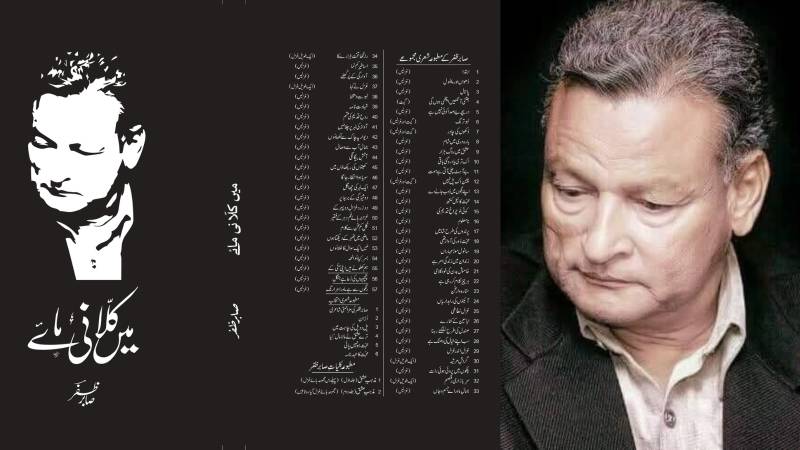
Some losses arrive as events, and some losses arrive as conditions. The former can be narrated, dated, enclosed within the grammar of before and after. The latter precede narration itself; they shape the very capacity to remember, to attach, to expect. When loss occurs before consciousness has fully formed, it does not lodge itself as memory but as structure. It becomes an orientation towards the world: a way of standing within time marked by contingency rather than continuity.
There is a haunting refrain in one of the celebrated kāfīs of the classical Punjabi poet Shah Husain: Māe nī main kinū̃ ākẖā̃? (O mother, to whom shall I speak?) Within the Sufi tradition, the line carries devotional and metaphysical resonances. It does not surface in Sabir Zafar’s book, yet the emotional temperament of his long meditation seems to move within its horizon. The cry to the absent mother becomes less an utterance than a structure of address. The question is not rhetorical but existential: when the primary addressee has vanished, what becomes of speech itself?
The earliest maternal bond occupies a singular place in human life because it is not merely relational but ontological. It mediates the infant’s first experience of safety, rhythm, recognition, and embodied trust. To lose that bond before it is fully apprehended is not simply to suffer grief; it is to inherit an altered metaphysics. The world appears early on as something that can withdraw without warning, without explanation, without moral logic. Attachment becomes tentative, belonging provisional, permanence suspect.
Such a beginning does not necessarily condemn a life to despair. But it does reconfigure its ethical and emotional economy. Where others assume endurance, this subject anticipates rupture. Where others find reassurance in collectivity, this subject remains watchful. Love, authority, nation, ideology: all are approached with a reserve that is not cynicism but historical awareness at the level of the self.
To reflect on such an origin late in life is not an act of nostalgia. It is an inquiry into causality: how an early absence hardens into perception, how deprivation becomes attentiveness, how solitude becomes a mode of thought. The voice that emerges from this inquiry is neither confessional nor consolatory. It does not seek to heal the wound. It seeks to understand what kind of life and what kind of responsibility emerge around a wound that never closes.
Remembering Without Memory
In Main Kallā Nī Māe (Mother, I Am All Alone), Sabir Zafar constructs a poetics animated by a profound paradox: remembering what was never fully known. Even the title carries layered implications. By foregrounding “mother,” it establishes the absent figure as the gravitational centre of the work. The vocative particle “nī” signals intimate address to a female presence. And kallā in Punjabi denotes both being alone and the condition of loneliness. Thus, Main Kallā Nī Māe means not merely “I am alone, O mother,” but evokes an existential solitude, an aloneness that is structural rather than circumstantial.
The mother at the centre of this Punjabi long poem does not appear as an image retrieved from childhood scenes, nor as a figure recalled through sensory detail. She is constituted instead through absence. There are no anecdotal reconstructions, no lyrical attempts to reanimate a lost presence. Remembrance proceeds negatively, through the articulation of what never occurred: gestures never witnessed, words never heard, reassurances never given.
The figure of the father does appear occasionally, sometimes stern, at times affectionate, but always peripheral, always overshadowed by the absent mother
At one point, the poet writes:
Akẖīā̃ agge nehrā
Mukh na takyā terā
Ik vāri kar chānan
Mukh partā nī māe
Darkness before my eyes.
I never beheld your face.
Illuminate once, just once.
Turn your face towards me, O mother.
The repeated invocation, nī māe (O mother), forms every fourth line of the poem’s recurring quatrain structure. Each unit comprises four lines, the last carrying the refrain. The effect is incantatory, yet restrained. The address does not expect an answer; it insists on articulation despite silence.
This mode of remembering refuses the sentimental logic of recovery that so often governs literary treatments of maternal loss. Zafar does not attempt to rebuild the mother through imagination, nor elevate her into an idealised emblem of unconditional love. The absence remains irreducible. In this refusal of aesthetic consolation, the poetry attains its severity.
The Mother as Image
More than once, the poet refers to the mother’s face. Yet this is not portraiture in any ordinary sense. The face appears as an imago, an archetypal psychic image in the Jungian sense. For Carl Jung, the “imago” is not a memory-image but a formative psychic structure. The mother’s face in this poetry operates precisely in that register: not recollection, but inner configuration. It is a presence that shapes perception without ever being fully seen.
The figure of the father does appear occasionally, sometimes stern, at times affectionate, but always peripheral, always overshadowed by the absent mother. The emotional architecture of the book leaves no doubt as to which absence defines the horizon.
Structure and Surreal Narrative
The long poem unfolds in narrative form, yet it diverges sharply from the conventions of the classical masnavī. Traditional narrative poems in Urdu and Punjabi typically proceed linearly, advancing through sequential episodes. Here, however, the narrative is non-linear. It moves associatively, through memory fragments and temporal leaps, producing a subtle, surreal dimension.
Self-evidently, the narrative bears an autobiographical character. It traces stations of the poet’s life: birth, education, hometown, migration, wanderings, marriage, and employment. These are not elaborated in laborious detail; they appear in fleeting yet telling gestures. Personalities and places surface as constellations of meaning: Baba Nanak, Dulle Bhatti, Mian Muhammad Bakhsh, Ahmad Rahi, Kahuta, Zafarwal, Nankana, Kartarpur. These references anchor the poet within a cultural and spiritual geography even as he experiences existential dislocation.
The cumulative effect of this long Punjabi poem is quietly devastating. An early absence reverberates across a lifetime, shaping love, politics, perception, and responsibility
At the same time, the poem registers the socio-political turbulence of its era. The country appears as a virtual battlefield. Figures such as Yahya Khan, Zulfikar Ali Bhutto, and Zia-ul-Haq are invoked not as biographical subjects but as markers of upheaval: military excess, state impotence, execution, plane crash, ethnic crisis, enforced disappearances, and resistance in Balochistan. Political history filters through the consciousness of one trained early in loss. Scepticism towards authority arises not from ideology but from experience.
Yet alongside these histories, the poem tenderly records rural Punjabi life: spinning wheels, handlooms, Persian wheels lifting water, churning milk, baking bread in open clay ovens, kite flying, fields of grain and corn. In reanimating these vanishing textures, the poet resurrects a disappearing Punjab, not nostalgically, but as a lived environment.
Gendered Voice and Sufi Inheritance
Although the protagonist is recognisably the poet himself, a male autobiographical voice, there are moments when this identity shifts. At times, the speaker adopts a female persona, echoing the long-standing convention of Punjabi Sufi poetry in which male poets voiced the feminine seeker longing for the divine beloved. By allowing male and female subject positions to overlap, the poem deepens its emotional register. Solitude is not gendered; longing exceeds biography.
Language and Return
Punjabi is the poet’s mother tongue, yet most of his substantial literary production, nearly sixty collections, has been in Urdu, particularly the ghazal, alongside his celebrated work as a lyricist. Why, then, turn decisively to Punjabi? The answer emerges within the poem itself. Addressing his mother, who did not know Urdu, he intimates that this tearful story could only be written in the language she understood. Language here becomes relational rather than strategic. To write in Punjabi is not merely an aesthetic choice; it is an act of return.
Transience and the Pressure of Time
A recurrent motif throughout the book is the unbearable rush of time. Transience presses almost crushingly upon consciousness. Death appears in manifold forms, not only in the early loss of the mother, but in anticipations of the poet’s own mortality, in the metaphorical experience of “death-in-life,” in the imagined sound of approaching footsteps. Time is not a backdrop; it is a force.
Yet narration here does not imply that the book is a simple or insipid story. It remains, fundamentally, a book of poetry. At several moments, the long poem rises to an intensity of sheer poetic aesthetics, throbbing with luminous imagery and symbolic resonance. Even as it recounts the stations of a life, it does so through condensation, metaphor, and tonal depth rather than through prosaic sequencing.
One brief yet luminous image captures this symbolic density:
Baithā kol kabūtar
Sat rangā nī māe
Na kardā gal koī
Na uḍdā nī māe
A pigeon sits beside me.
Seven-coloured, O mother.
It speaks not a word.
Nor does it fly, O mother.
The pigeon, multicoloured yet silent, grounded yet capable of flight, becomes emblematic of suspended movement within time itself. It is presence without communication, possibility without departure. In the context of the poem’s meditation on mortality and transience, the image suggests a being poised between stillness and disappearance, between colour and silence. The refrain once more gathers the image into address, drawing the temporal moment back into the orbit of the absent mother.
The Mother as Ethical Horizon
Although the mother is absent as lived presence, she remains the ethical horizon of the work. She is neither reconstructed nor idealised. Even in old age, the poet does not claim knowledge of who she was. Certain relationships shape a life most decisively through irrevocable incompletion.
The refusal of closure is among the book’s most consequential gestures. In an era oriented towards therapeutic resolution, the work insists that some losses are not to be cured but borne. To live well is not to transcend such loss but to allow it to sharpen attentiveness. Loss, carried honestly, becomes ethical clarity.
The Dignity of Unrepaired Loss
The cumulative effect of this long Punjabi poem is quietly devastating. An early absence reverberates across a lifetime, shaping love, politics, perception, and responsibility. Loss is not an episode but a formative pressure.
Yet the work affirms something austere: dignity does not depend on consolation. There is no sentimental redemption, no aesthetic compensation. What remains is lucidity.
In speaking to the mother who is not there, the poet ultimately speaks to the world as it is: fragile, contingent, unjust, yet demanding care. That demand arises not from hope of reward but from exposure itself, from knowing what it means to stand alone and still speak.