

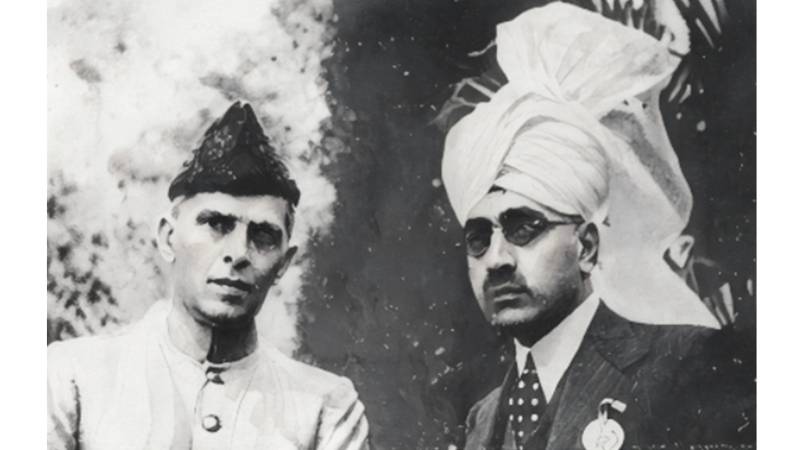
I spent the last several years compiling the primary papers of the premier of united Punjab pre-partition, Sikander Hyat-Khan. One of the first democratically elected Muslim leaders on the sub-continent, he served from 1937 until his untimely death in December 1942.
Among this collection is a treasure trove of correspondence between Hyat-Khan and Quaid-e-Azam, Muhammad Ali Jinnah.
Their correspondence offers a rare window into both their political interactions and personal dynamics – revealing bonds of respect, strategic cooperation and, at times, deep disagreement. As Pakistan approaches its 78th anniversary, this correspondence also provides valuable lessons about political leadership, unity, and the painful costs of division on the eve of independence.
The letters stretch from the early 1930s to Hyat-Khan’s death in 1942, capturing pivotal moments in the subcontinent’s tumultuous history through the eyes of two men who were at the centre of it. Among the several critical themes that emerge are the following.
Personal Bonds Amidst Political Storms
Among the collections almost fifty letters are some early exchanges that reveal courteous formality gradually giving way to genuine friendship. In the letters from 1930, for instance, Jinnah addresses Hyat-Khan by his military title – writing “Dear Captain Sikander-Hyat-Khan.” Over time, however, a deeper personal connection develops, with frequent mentions of personal health, family matters, mutual acquaintances, and even details like travel and accommodations. At one-point, Hyat-Khan invites Jinnah and his sister, “Miss Jinnah,” to stay with him at his family’s home during their visit to Lahore.
Despite these close personal ties, their relationship was never simple. As their roles grew in prominence, their correspondence began reflecting underlying tensions.
In the summer of 1939, for instance, they exchanged telegrams regarding an electoral issue that conclude with Jinnah expressing “regret” over Hyat-Khan’s suggestion that he was “guided by communications behind [Hyat-Khan’s] back by political adventurers.”
Likewise, the following year, Hyat-Khan sent a telegram from Bombay seeking Jinnah’s support to meet with Hindu nationalist leader V.D. Savarkar if the “opportunity arises.” Jinnah responded the same day saying he could not “agree” to Hyat-Khan acting as a “go-between.” He subsequently made their exchange public; a move which Hyat-Khan said in a subsequent and sharply worded letter, was an unconscionable breach:
“When I received this message I refused to believe that it could have been sent by you and I suspected it to be a hoax... But I was soon disillusioned... I am writing this letter to convey my protest and indignation on the tone and wording of your reply as also against the most unusual step of releasing the correspondence to the press without my permission. Believe me that it has caused me immense pain.”
That is only the beginning of a letter which runs three pages and ends with Hyat-Khan suggesting his old friend “do a little heart-searching and see whether there is not room for self-correction or self-improvement.” Jinnah’s response, sent more than two weeks later, is equally provocative. He writes that he was “not able to attend” to the letter which he described as a “bundle of contradictions and self-condemnatory” because he “did not think it was a matter of urgency.”
Shared Strategic Interests
Notwithstanding these tensions, their strong political alliance, anchored by the historic Sikander-Jinnah Pact of 1937, marked a crucial turning point for Muslim unity on the subcontinent. Hyat-Khan, whose Unionist Party had secured an overwhelming victory in the Punjab, provided essential support at a critical moment, helping Jinnah revive the League’s political fortunes after its dismal showing in the 1936-37 elections. Their letters during this period express mutual satisfaction, emphasizing collaboration to protect Muslim rights nationally. In a November 1937 letter, Hyat-Khan informs Jinnah that despite some challenges, “enrollment of the League members is going apace and we hope to be able to set up district Leagues throughout the province in a short space of time.” He also confirms that, “the development at Lucknow which brought about the solidarity of the Muslims throughout India has been welcomed by the Muslim masses.”
Later scholars, such as Stanley Wolpert, say that this pact “made Pakistan possible.” Similarly, Syed Amjad Ali wrote, “Thanks to the agreement reached between Jinnah and Sir Sikander in Lucknow, the dream of Pakistan became real. All Pakistanis today should be thankful to these two great Muslim leaders and their wisdom.”
Differences Over the Vision for Independence
As independence approached, however, their correspondence also revealed fundamental differences about India’s post-colonial future. In 1939 Hyat-Khan became the second Indian and Muslim leader of note to issue a written proposal for post-colonial governance. He attached his “Outlines of a Scheme of Indian Federation,” to a letter to Jinnah, seeking his endorsement. Jinnah’s responded days later declining to endorse the “Outlines” and vowing to maintain neutrality while the League subcommittee considered all proposals.
WWII further complicated their relationship. Hyat-Khan, deeply committed to the war effort, urged Jinnah to support active Indian participation
These tensions intensified around the Lahore Resolution of 1940. Initially tasked with jointly drafting the resolution, Hyat-Khan found himself authoring it alone due to Jinnah’s absence. Hyat-Khan’s original draft, which is still available for review, echoed elements of his federation plan, emphasizing minority rights and unity. When the final resolution adopted by the League differed from his original draft, Hyat-Khan expressed his disappointment publicly. This surprised Jinnah, who said as much in a letter to Hyat-Khan:
"If the report is correct then I must say it is very harmful as it clearly gives the impression that you are against the Lahore Resolution, popularly known as Pakistan."
This divergence in vision represented a profound disagreement between the two as it pertained to the nature of political sovereignty, governance, and the best strategy for securing Muslim interests in post-colonial India.
WWII: Competing Priorities
WWII further complicated their relationship. Hyat-Khan, deeply committed to the war effort, urged Jinnah to support active Indian participation. For Hyat-Khan, this was more than politics; as a decorated veteran and leader of Punjab, often referred to as the ‘sword-arm of India,’ loyalty to the war effort was non-negotiable. He further argued that any indecision on the issue would harm India’s Muslims by weakening their global standing and domestic stability. He made this clear in one of the numerous correspondence on the issue, writing in a March 1940 telegram to Jinnah:
“International and internal situation extremely grave. Earnestly beseech clear lead to community and country by declaring wholehearted Muslim collaboration for successful prosecution of war and defence and safety of country. Authoritative pronouncement from you forthwith essential in the interests of community here and abroad.
Delay would be suicidal.”
Jinnah remained cautious, balancing support for the Allies with demands for greater autonomy and independence; he was concerned that unconditional support might be detrimental to the goal of complete sovereignty. Ultimately, however, Hyat-Khan was successful in persuading Jinnah and the League to support the Allies in the war effort.
In a letter to Jinnah in late December 1941, just a year before he passed, Hyat-Khan informed him of a secret trip he was taking to Cairo to visit the troops. In the end, because of their efforts to support the war effort, more than 2.5 million Indian soldiers fought and more than 87,000 died in battle.
Legacy and Historical Reflection
This correspondence reflects not just the personalities and passions of two leaders, but also the complexities of governance, leadership and identity during a period of immense upheaval. Their relationship – simultaneously cooperative, contentious, personal, and political – offers deep insights into the foundational challenges of nation-building.
It reminds us of the enormous stakes involved in leadership decisions and the importance of preserving historical records for future generations. While these letters shed a good deal of light on their relationship, holes in the correspondence remain – there are, for instance, numerous references in the letters to other documents that have yet to be collected, collated, and preserved. This is always a challenge, but even more so in the case of Pakistan and India given that there were three partitions in the mid-20th Century: the subcontinent, Bengal, and Hyat-Khan’s beloved Punjab; divisions which resulted in not only enormous human cost and suffering, but the destruction of critical documents and other aspects of the historical record.
Mark Twain is often mistakenly quoted as saying "the two most important days in your life are the day you are born and the day you find out why." While there is no evidence Twain said this, the point is well-taken, not only as it pertains to individuals but nation-states as well.
One way for nations to understand ‘why’ is to revisit the debates that were going on among respected leaders in the Founding period. These letters between Jinnah and Hyat-Khan, yet incomplete, offer one such window into the ‘why’ as it concerns the birth of a nation not yet a century old.