

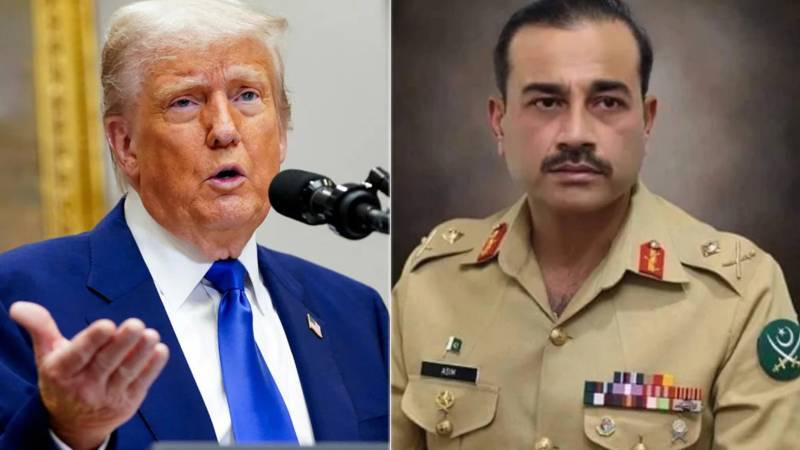
Within the short span of a few months, Pakistan’s powerful Army Chief, Field Marshal Asim Munir, has made two visits to Washington. There are clear benefits that Pakistan gained from the visits at the diplomatic and military levels. The visits brought clear diplomatic disadvantages for India when the US State Department declared Baloch separatist militant groups — which have received material and propaganda support from Indian intelligence and media — as global terrorist networks. This is a clear blow to the Indian position, which portrayed these militant groups as freedom fighters. Now, Indian intelligence will be aiding groups which have been declared terrorists by the United States. This appears as a major jolt to India’s diplomatic position on international terrorism. Till this declaration by the US State Department, Indians used to boast their position to be aligned with the global war against terrorism as all the groups which were targeting India had been declared terrorists by the US. Now India is facing a very difficult position when it and its intelligence agencies would be perceived as supporters of an international terrorist organisation, dubbed a terrorist by its closest ally, the United States.
But Pakistan has no reason to be complacent. US–India military ties have deep institutional and geopolitical bases. The United States and the military assistance it provided to India during the past ten years were the major reasons behind India's confidence and belligerence in its attitude, which led to the 7 May 2025 attack on Pakistani territory. We should remain aware of the fact that the conventional military balance between the Pakistani and Indian militaries is widening with each passing day to Pakistan’s disadvantage. The threat of Indians acting on the impulse — originating in the current trend of militarily powerful states browbeating relatively weaker states in the international system — of devastating weaker neighbours could not be ruled out. The US, Russia, Israel and France are supplying modern armament into the Indian inventory, India is flirting with dangerous military doctrines, and India's attempts to tamper with the nuclear deterrence relationship are not good signs for South Asian peace. US military assistance to India during the last ten years has played no small part in widening the conventional military gap between Pakistan and India.
The idea that India should play a larger role in the Indo-Pacific region, as a counter to China, is not simply an American idea. This idea has the backing of countries like Japan, Australia, the Philippines, South Korea and several Western European countries. Interestingly, the foreign policy documents of Japanese, Australian and American foreign and security policy-making institutions all refer to this oceanic region as Indo-Pacific, in deference to the fantasies of Indian foreign policy makers, whereas it was previously referred to as Asia-Pacific. For this, American strategic thinkers have coined a new term — “integrated deterrence” — to refer to the collective military and defence capabilities of littoral states of this region, which are also democracies. As part of this concept, there is a collective and massive joint effort by Western democracies and their allies to bolster the military capabilities of India. The military capabilities of India and the concept of “integrated deterrence” are directed against the rising military power of China. But as the May 2025 war made obvious, Pakistan could become a victim of this capability in the future.
American friendship and hospitality always carry a geopolitical cost, though what cost we will pay this time remains unclear
In such a situation, gloating about the American President giving importance to our Chief of the Army Staff (COAS), Field Marshal Asim Munir, is naïve in the extreme. Pakistan’s relations with Washington cannot match India’s relations with Washington in the institutional depth that the latter set of relations enjoy over the former. Over the last 20 years Washington has propped up New Delhi in every field, from business, commerce and trade to technology transfer, intelligence sharing and supply of state-of-the-art military equipment. The Indian expatriate professional middle class has a burgeoning and very influential presence in American society, and this class provides the social and institutional backing to strong India–US relations. Compare this with an erratic American President praising a single individual, that is our COAS, and hosting him for lunch at the White House: it is an isolated incident and lacks the bases of strong institutional depth.
What explains this sudden change in the direction of South Asian diplomacy? Firstly, the Americans need Pakistani military and intelligence services in Afghanistan, where the rise of ISIS and other groups more radical than the Taliban and Al-Qaeda (which is a dead force according to many western estimates) is a cause of concern for the West. Secondly, Washington seems to be genuinely perturbed over Indian foolhardiness in launching an attack on Pakistan on 7 May 2025, which in its assessment could disturb the precarious regional balance — Pakistan could have more clearly joined the Iran–China–Russia club, Pakistan could have more clearly been a rallying point for regional Muslim powers like Iran, Turkey and Saudi Arabia, and if Indians had really succeeded Pakistan could have become a regional security nightmare.
Field Marshal Asim Munir is not the first military man from Rawalpindi who has attracted the attention and praises of the American security establishment and American Presidents. Before him Field Marshal Ayub Khan was no less a darling of the American security apparatus. The dashing Pakistani General became the apple of American eyes in the 1950s. Following that, General Zia and General Musharraf were no less darlings of the Americans. At the end of American courtships with Pakistani generals, Pakistan’s story was the same: “Americans use us and throw us away like filth when we are of no use.” As they say in American slang, there is no such thing as a free lunch.
During the last 15 years, India has purchased weapons worth $20 billion from Washington
American friendship and hospitality always carry a geopolitical cost, though what cost we will pay this time remains unclear. But jumping into Afghanistan’s hell could prove to be our undoing. Pakistan cannot afford a prolonged war on our western border.
What are the lessons for Pakistan? Firstly, this is an anarchic international system, and every state must fend for itself; nobody will come to our rescue. Secondly, militarily powerful states during the last two years have crushed weaker states like Gaza and Ukraine, and this could become a trend under the logic of powerful states using the pretext of combating terrorism and militancy to devastate weaker neighbours. Thirdly, international norms and laws will be of no help in such situations. Pakistan must therefore develop a political response rooted in diplomatic initiative, making world powers such as the USA and Japan aware that their military ambitions in the Indo-Pacific region are endangering Pakistan’s security and destabilising the region.
At the same time, our response to this challenge must not excessively strengthen institutions within the state machinery. We should never lose sight of the fact that people are the most essential element that form the state, alongside law and territory. National security, in essence, means the security of these people; it cannot be valued above them. This new wave of military pressure comes at a time when Pakistan is already face-to-face with financial insolvency, making it all the more critical to keep our priorities clear.
Pakistan needs to be watchful about the possibility of the concept of “integrated deterrence” taking concrete shape during Modi’s last visit to Washington. The concept gives India greater military capability and role in deterring Chinese assertiveness and alleged and possible military aggression. An American expert has described US plans to equip India with state-of-the-art military weapons systems and equipment as part of the plan for making the concept of “integrated deterrence” functional. During the last 15 years, India has purchased weapons worth $20 billion from Washington.
Sameer P. Lalwani and Vikram J. Singh of the United States Institute of Peace, in a recent analysis, have pointed out that Washington is expecting:
“A more effective collaborative deterrence (with India) requires more complex military exercises, more frequent use of logistics arrangements, more presence in different theatres, and greater access and overflight, all of which keep China guessing. More frequent employment of already signed logistics arrangements — such as ship-to-ship underway replenishment or US maritime patrol aircraft refuelling in Port Blair — can add to this uncertainty. What the United States seeks from India is greater operational cooperation to share the burden of deterring aggression by any major power, including China. Indigenous Indian capabilities help, but the key is more effective deterrence activity that complicates adversary planning, increases their uncertainty and creates hesitation. Sowing doubt is key to convincing your foe to delay military aggression for another day.”
All this will come with a comprehensive package of transfer of military technology, surveillance equipment, joint production and state-of-the-art weapons systems.
Pakistan’s options are clear: We can trust an erratic American President and build a foreign policy based on the one-to-one relations between the American President and our COAS, and use these relations to consolidate the hold of one man and an institution on the power structure of the country. This is a mistake that every military ruler in our history has made over the last seven decades.
The second option is to take the White House lunch as just another diplomatic event. We should not link this diplomatic event with the power struggle within our society. We must put our house in order by resolving all the political conflicts that are causing fissures in our society. These political conflicts are the real cause of the weakness of our national power. And we must prepare for the moment when the erratic nature of US foreign policy under Trump takes another turn for the worse.