

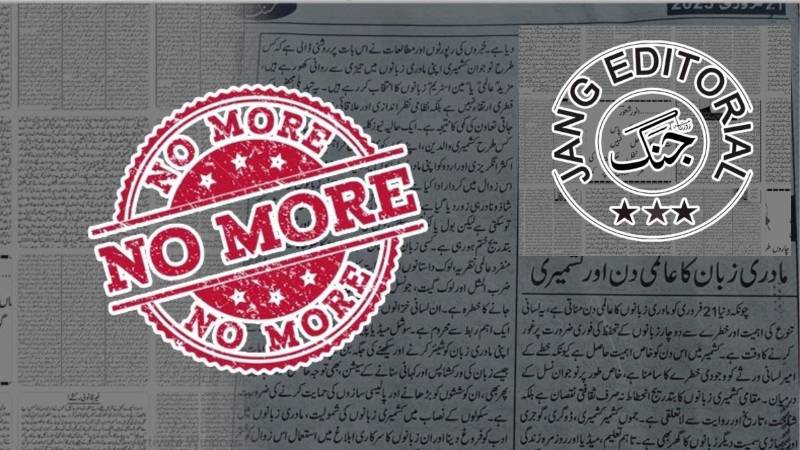
In 2025, Jang, Pakistan’s oldest and one of its most widely circulated Urdu newspapers, did something unthinkable: it stopped publishing its daily editorial. A space that had, for decades, reflected the newspaper’s institutional conscience went quiet abruptly, symbolically, and without explanation.
What does it mean when a paper that has survived dictators, censorship, and the digital deluge decides it no longer has anything to say — not as a reporter, but as an institution?
A newspaper’s editorial is not a byline. It is a mirror of the collective judgment of a newsroom. That voice has now gone silent.
In conversations with seasoned journalists, the tone was not of shock, but of quiet dismay, a kind of professional mourning. Hafiz Tahir Khalil called it na qabil-e-yaqeen, unimaginable in 150 years of Urdu journalism. “Yes, opinion columns will continue,” he said, “but editorials are different. They are neutral, policy-reflective. This absence will be felt.”
Aoun Sahi pointed to the shrinking space for institutional opinion. “This could be commercial. But it’s also political. The role of the gatekeeper is shrinking, and so is the office of the editor. I fear others will follow,” he said. Pervez Bashir drew parallels with international media houses that have trimmed their editorial presence. “Globally, it’s a discernible shift,” he noted.
A former Secretary of Information recalled a time when official advice under the Press and Publications Order 1962 would land at the editor’s desk later disguised as “unofficial suggestions.” Editors of that era, he said, “would write what they wanted subtly, skilfully.” He now sees Jang’s silence as a form of quiet protest: either society no longer wants to listen, or the editor no longer sees value in speaking. “When you can’t say what you mean, or what you say doesn’t matter, maybe silence becomes the only statement.”
When a case of injustice needed amplification, or when public policy required scrutiny, it was often the editorial page that stepped forward
He further reflected on how readers have grown impatient, institutions feel irrelevant, and editors, once shielded by the sanctity of editorial independence, have lost both autonomy and audience.
Indeed, there was a time when editors held real power and their words carried weight with policymakers. It was an era when editorial boards set the tone, not marketing departments or analytics dashboards. Today, many editors have been reduced to figureheads, their authority eroded by ownership interests, political interference, and audience indifference.
In such a landscape, it’s possible that Jang didn’t make a choice; he made a calculation.
But the real tragedy isn’t in the decision. It’s in the silence. No announcement. No farewell. A quiet erasure of a tradition that once helped shape public thought.
Even if we accept that the age of print is fading and that the utility of daily editorials has declined in a media landscape dominated by metrics and digital noise, we cannot forget what that space once offered. The editorial often framed issues in ways the common man could not. It lent language to frustration, dignity to dissent, and structure to scattered emotion. Many social concerns, long ignored or unarticulated, first found coherent voice through those few careful paragraphs, not always loud, but always clear.
This retreat, of course, isn’t uniquely Pakistani. Around the world, newspapers are grappling with distrust, digital fatigue, and shrinking attention spans. In an age of reels and rants, institutional opinion pages often feel too careful, too slow and too quiet.
Society now chases personalities, not principles. It follows influencers, not institutions. Editorials — once read with morning tea are now lost in a feed where trending hashtags dictate relevance. Serious differences of opinion, once aired through reasoned discourse and reflective prose, are now reduced to trolling and mockery. Yet in Pakistan, editorials were never mere tradition. They were one of the last remaining spaces where civil society could speak with dignity and reason.
When a case of injustice needed amplification, or when public policy required scrutiny, it was often the editorial page that stepped forward. Can a tweet do that? Can a podcast replace that gravitas?
So what happens now? If society begins to rely solely on trends, emotional and short-lived, how will social media shoulder the weight of national and civil concerns? Will the deep, structural issues that demand continuity and conscience survive in a landscape ruled by “virality”? Can causes that require collective memory and moral pressure endure in an environment measured only in clicks, shares, and momentary outrage?
A polarised society loses one more tool of cohesion.
Some might say this is not death only migration. That the soul of editorial opinion will find new homes, more agile formats, and more interactive forums. Maybe. But for that to happen, we must first acknowledge the weight of what we have lost.
Jang’s silence is not just a corporate decision. It is a cultural pause. A moment of reckoning.
As Ghalib once wrote:
"Hai kuch aisi hi baat jo chup hoon / Warna kya baat kar nahi aati."
There is something of such nature that I remain silent — otherwise, it's not that I don't know how to speak.