

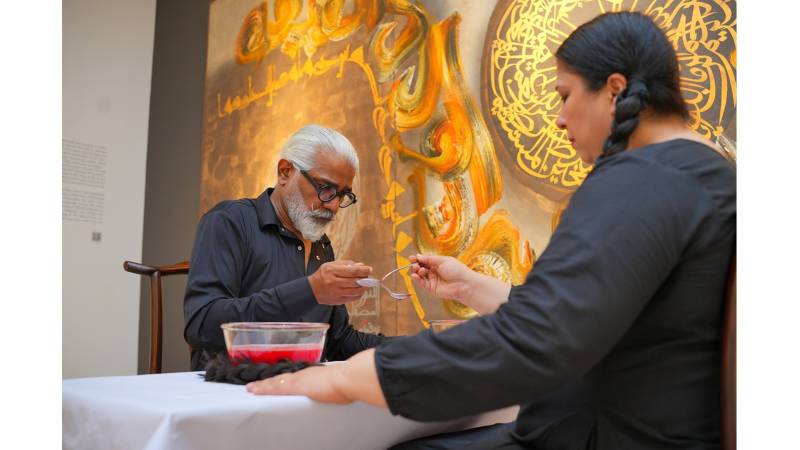
Aaj aur Kal (Yesterday, Today, Tomorrow) was not an “event” in the ordinary sense of Karachi’s art calendar. It was a wager on time itself—compressed into a single evening and yet refusing the finitude of an evening. Staged at the Gulgee Museum in early 2026, curated by Amin Gulgee with Noor Ahmed, and framed as a landmark moment marking a decade of the Karachi Biennale Trust, the exhibition gathered an unusually large constellation of participants—reportedly around seventy-two international artists. Yet its true scale was never numerical. Its scale was temporal.
The Gulgee Museum is not a neutral white cube. It is a domestic archive, a memorial architecture, a house that learned to speak as history. To place performance, new media, and installation inside that house is to stage an argument: museum-time—conservation, permanence, inheritance—does not simply host performance-time; it is interrupted by it, unsettled by it, made vulnerable to the vanishing present. A durational work like I Am Neem makes endurance itself into form, while a phrase such as “in the name of love I cut” hints at ritual action in which the body becomes both instrument and inscription.
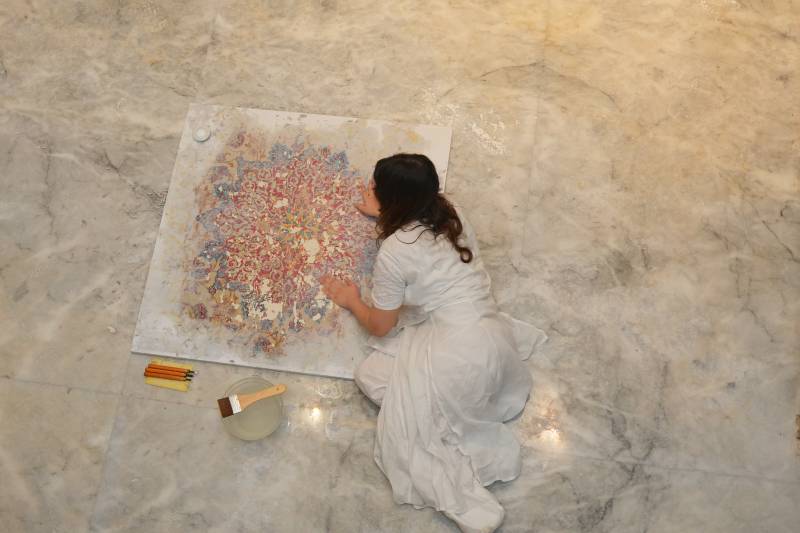
Then there is the title, deceptively simple Urdu doing heavy philosophical work. Aaj and kal are not points on a line but pressures in a loop: the archive hidden inside the present, and the present already archiving itself into a future that is never merely “tomorrow.” The past is not absent here; it saturates the walls and furniture, withheld from view yet constantly leaking into perception. The present is not a neutral now; it is a scene of interpretation under pressure, where inherited histories demand to be read and political futures press in as claim rather than prediction. Even the missing “yesterday” hovers as a haunting remainder: unspoken, everywhere. This is why performance is the only honest genre for such a title—because in performance, time is not the theme; it is the material.
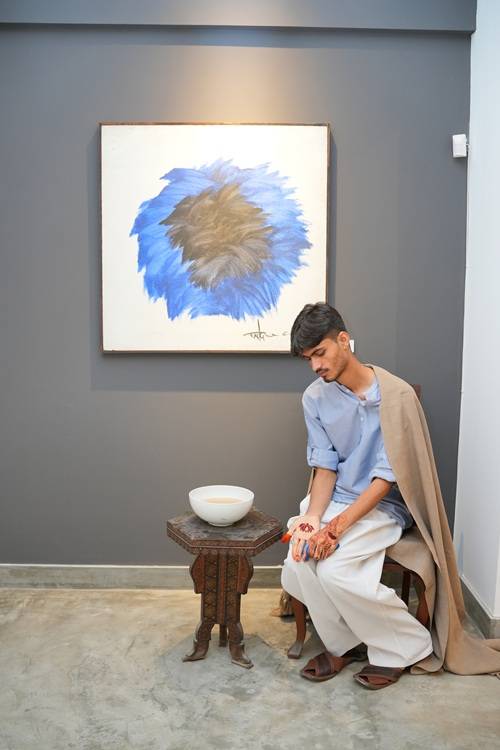
Amin Gulgee exposes time itself as one of the most effective instruments of governance, and then—briefly, violently, beautifully—sets it free
One-night scheduling makes witnesses of us, not collectors. Durational acts turn attention into ethics. New media folds time into loops, replay, algorithm, and mediated return. Amin Gulgee’s genius, as ever, is to capture the infinite within a finite frame without pretending the frame can contain it. To read him through a tidy Aristotelian line is to miss the surrealist premise governing his practice: reality is not a thing but a perspective among perspectives. In this sense, Aaj aur Kal enters the great debate bequeathed by post-Impressionist and surrealist art: whether art should refine perception within the world as given, or break the frame of the given itself so that other times, other subjectivities, and other realities may become thinkable. His work is not reducible to a Rorschach, yet it dares the viewer to project meaning—because Gulgee’s performance has never been confined to the body on a given night; it has always lived in his sculpture, his surfaces, his provocations. Aaj aur Kal thus arrived like a manifesto disguised as an evening: stop treating time as backdrop; confront it as the medium through which memory, identity, politics—and the very possibility of tomorrow—are produced.
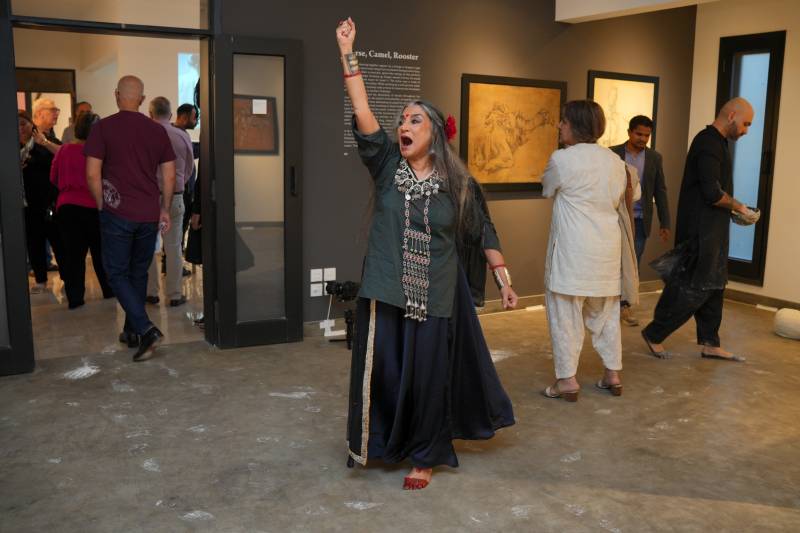
What the exhibition achieved was to make time stop behaving like a neutral background and start acting like the medium of power and possibility. In Bergson’s sense, it refused clock-time and restored duration—a lived, viscous flow in which memory is not behind us but inside perception. The museum thickened the past into atmosphere, while performance dragged that archive into the body as felt time rather than curated chronology. In Heidegger’s sense, “today” was never self-sufficient: it became intelligible only as what we are thrown into—inheritance, history, the weight of what has been made—and what we project, tomorrow as demand rather than prediction. And in Benjamin’s sense, the one-evening event became Jetztzeit: a charged now-time that interrupts museum continuity, refuses heritage as a smooth narrative, and produces a present that does not merely remember the past but puts it on trial, insisting that “tomorrow” is not the sequel of “today” but a rupture wrested from it.
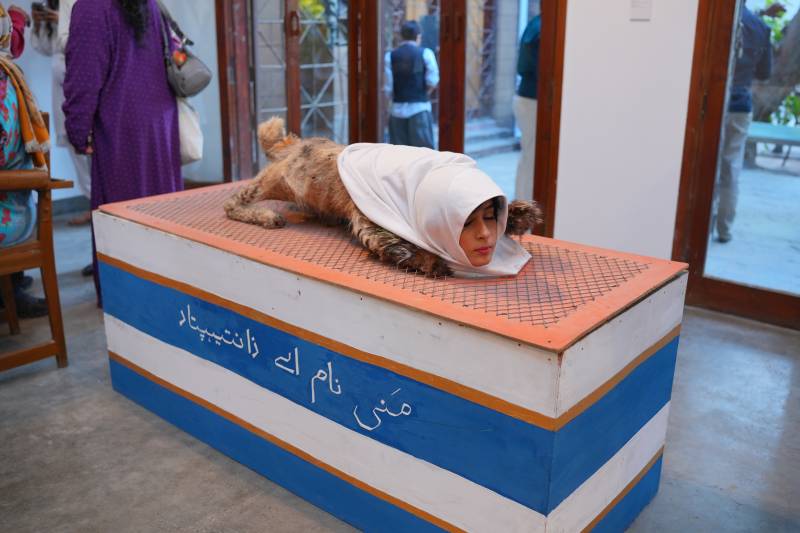
This is why the exhibition’s treatment of time cannot be reduced to theme or motif. Aaj aur Kal positioned time not as subject matter but as the very condition of meaning. Staged inside the Gulgee Museum—an archive-space built to hold Gulgee’s artistic past—an evening of performance and new media made the present unstable and unownable. The program’s emphasis on live and durational action foregrounded the now as an event that cannot be fully stored, while the museum’s rooms insisted on the persistence of yesterday. In that collision, “today” became an ethical pressure—how one lives with inherited forms—and “tomorrow” became a wager: not what will happen, but what must be made possible.
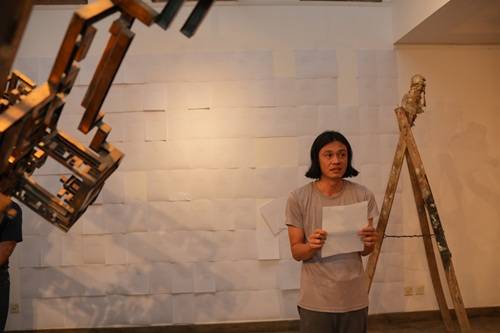
If one translates this philosophical insight into the political-theoretical vocabulary that animates my broader work, Aaj aur Kal reads as an argument about epistemic capture and the struggle to reopen what the dominant order keeps trying to close. The title—Today, Tomorrow—names not two points on a calendar but two operations of power: the way “today” is stabilised as common sense, and the way “tomorrow” is foreclosed as the only imaginable future. The museum becomes, in this sense, a laboratory of epistemic crisis: inherited knowledge-forms—archive, heritage, canon, the museum’s promise of permanence—colliding with performative forms that refuse permanence and insist on the fragility of presence. What looks like art programming becomes a contest over reality’s grammar: what can count as truth, what can be remembered, what can be anticipated, and what can be made politically thinkable.
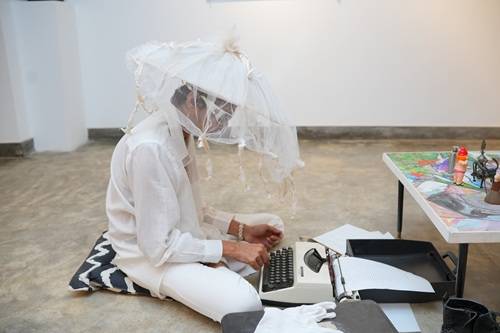
Read this way, “today” is the regime of intelligibility that the world imposes on subjects: the classifications, securitisations, and aesthetic canons through which life is made manageable. “Tomorrow” is the horizon this regime promises while quietly controlling—an authorised future, already formatted by the same closures that dominate the present. A performative exhibition inside a museum interrupts this by exposing the closures that masquerade as neutral. It reveals how meaning is produced by institutional frames and by the audience’s learned habits of recognition. Performance and new media reinsert volatility into this field: they stage meaning as an event rather than a possession, forcing the viewer to confront how easily the present is closed into “what everyone knows,” and how easily the future is reduced to “what the system allows.”
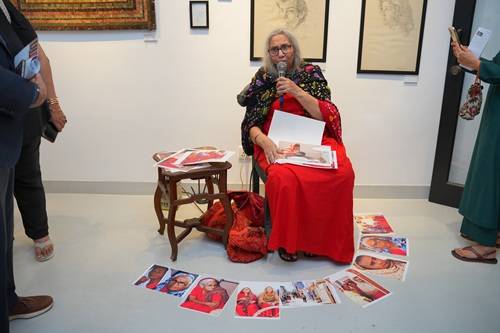
In the language of closure, then, the show can be understood as an encounter between two closure-machines. The museum stabilises art into durable objects, legible histories, curated lineages; it performs the comforting work of turning the open, unruly past into a governable narrative. Performance, particularly when it makes its durational nature explicit, resists this comfort by making time itself the medium: the work cannot be fully stored, owned, or repeated, and therefore cannot be fully domesticated by the archive. The point is not to reject closure—life and institutions require it—but to reveal closure as closure: a contingent stabilisation that becomes tyrannical when it claims finality. “Today” is precisely that claim of finality—the insistence that the present order is reality itself. “Tomorrow” names the remainder that closure cannot contain, the surplus of possibility that the present tries to pre-empt.
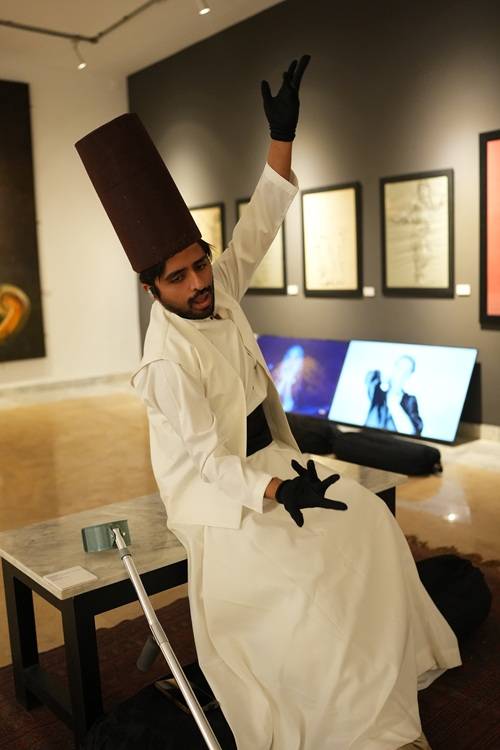
What follows is not simply the need to critique colonial subjectivity as an inherited structure, but the urgency of de-subjectifying the subject that colonial modernity produced through the meanings of difference. Colonial rule did not merely dominate populations materially; it fashioned subjects through classificatory regimes—native and civilised, backward and modern, loyal and suspect, authentic and derivative—so that difference itself became the grammar through which one was made intelligible to power and often to oneself. In postcolonial times, it is therefore not enough merely to challenge this subjectivity at the level of discourse. The more difficult task is to undergo the experience of that challenge: to feel one’s habits of recognition unsettled, to sense the instability of the positions through which one has been taught to see and inhabit the world. This, I think, is what Amin Gulgee offers here. His work does not simply argue against colonial closures; it stages an encounter in which those closures loosen their grip and the subject is made to experience, however briefly, the disorientation and possibility of becoming otherwise.
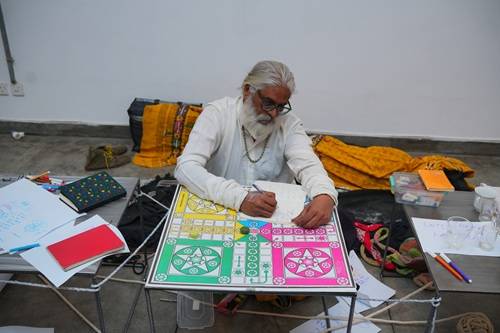
This is where de-subjectification becomes the ethical thrust of the work. A dominant epistemic order produces subjects by assigning them stable positions—spectator, citizen, believer, threat, victim, connoisseur—each with a prescribed relation to time: nostalgia, fear, urgency, resignation. A performative exhibition can de-subjectify by unsettling those positions. It withdraws the viewer from the comfort of recognition—“I know what this is”—and from the passivity of consumption—“I can take this with me”—and instead makes the subject confront their own participation in meaning-making. De-subjectification here is not the abolition of identity, but the loosening of identity’s grip as destiny: a refusal to remain fully captured by the closures that define what the present is and what the future may be.
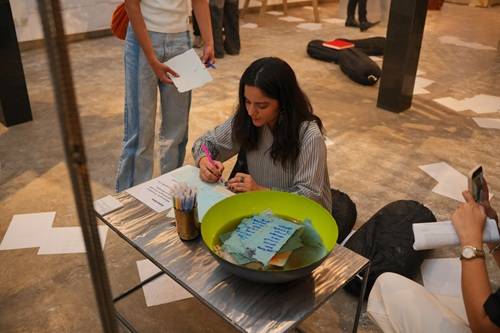
The significance of time in Aaj aur Kal, then, is that time becomes the site where epistemic power operates. The present is a closure that polices what counts as real; the future is a closure that polices what counts as possible. By staging live, ephemeral, and durational practices inside an archival space, the exhibition performs a small epistemic rupture: it reopens the present as contestable and the future as unowned. In that reopening lies the political promise of the aesthetic—an invitation to think and feel “tomorrow” beyond the closures through which “today” governs.
If Aaj aur Kal were merely an exhibition, it would have ended when the lights went out. But what Amin Gulgee and Noor Ahmed staged that evening was closer to a postcolonial insurrection against the machinery that makes life intelligible—against the timelines, pedigrees, securitisations, and inheritances through which the present is naturalised and the future is rationed. This is why the work deserves to be read as de-subjectification in its most exacting sense: it does not ask to be recognised within the master’s archive; it interrupts the archive’s right to name what counts as history, what counts as contemporaneity, what counts as a legitimate tomorrow. It refuses the subject-position colonial modernity assigns—native as specimen, tradition as residue, future as imitation—and instead forces a new scene of appearance in which the viewer cannot remain a consumer of meaning but becomes complicit in meaning’s production. Here, the museum does not conserve; it is made to confess. Heritage does not soothe; it is made to tremble. The present is not a neutral now; it is exposed as a closure, a policing of reality that pretends to be reality itself.
To call this show “great” is not to flatter it; it is to locate its historical necessity. Our age suffers not from a shortage of images but from an excess of administered time—deadlines, chronologies, development narratives, progress charts, civilisational rankings—through which whole peoples are told where they belong and what they can become. Aaj aur Kal strikes at that regime. It reveals the past not as something behind us but as something hidden inside the present—smuggled into our gestures, our tastes, our fears, our institutions—and it reveals the future not as a destination but as an authorisation, a narrow corridor the system calls “realistic.” Gulgee breaks that corridor. He does not represent time; he makes time fail. He stages a living not defined by time, not confined by time, not structured by time—because he exposes time itself as one of the most effective instruments of governance: the device by which the world tells you when your suffering is “historical,” when your claims are “premature,” when your aspirations are “nostalgic,” and when your resistance is “too late.”
This is why the finale of Aaj aur Kal does not resolve into a message; it detonates into a condition. It leaves us with the scandalous thought that the present can be reopened, that the past can be unmasked rather than venerated, and that tomorrow can be wrested from the closures that pre-empt it. In doing so, Gulgee achieves what the most consequential postcolonial art must achieve: not the performance of difference, but the refusal of the subject produced by difference; not the recovery of a lost origin, but the invention of an ungoverned horizon. If there is any justice in our critical vocabulary, we will name Aaj aur Kal for what it is: a rare work that does not decorate the world but reconfigures the terms by which the world is allowed to appear—a show that makes time itself feel colonised, and then—briefly, violently, beautifully—sets it free.