

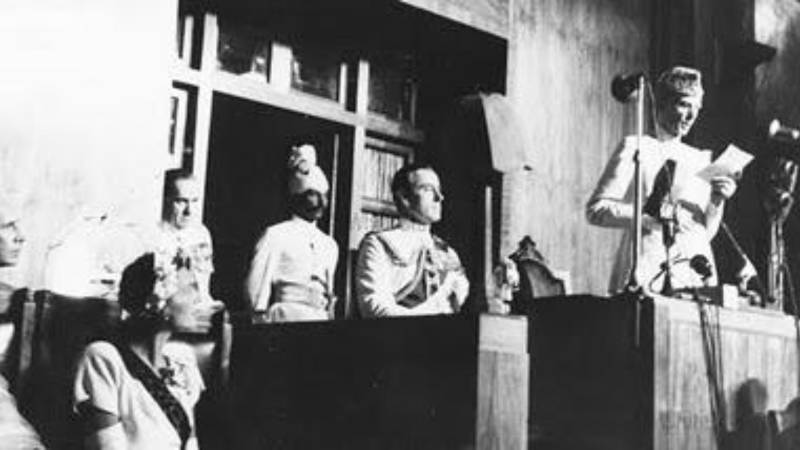
In his article, ‘India’s unremitting misadventure’ published in the News International dated 10 May 2025 Raoof Hasan refers to a message he received from veteran civil servant Agha Ghazanfar in which the latter urged him to put on record that as early as 1975-76 Mohammad Ali Jinnah’s 11 August 1947 speech had been excluded from the records in Pakistan. This he found out when he, Yousaf Buch, and Hamid Jalal were working on the ‘encyclopedic’ book, Pakistan: Past and Present, published in 1976 by Stacey International, London. Agha Ghazanfar informs that the decision to delete Jinnah’s speech was probably taken by Yahya Khan’s Information Minister, General Sher Ali.
However, after a worldwide search, Syed Ijlal Haider, Director-General of Pakistan Broadcasting Corporation, could procure the original recording of it from the Australian Broadcasting Corporation. Further that the recording ‘crackled a bit ’ and some words were ‘faint or drowned out’, being of poor quality. Nevertheless, he and Hamid Jalal prepared a transcript which was published for the first time in their 1976 book. Agha Ghazanfar asserts further that the original spool was given for archival purposes to the PBC, which was destroyed on the orders of General Ziaul Haq, he suspects.
Finally, he implores Raoof Hasan that “I happen now to be the only living witness of what we did towards the distortion, nay, obliteration, of Jinnah’s words and testament. This is only one proof in support of your worthwhile endeavour, and I think you should make public, with full attribution, this damning evidence as well.”
A mystery has been created about the 11 August 1947 speech when it was published in the Dawn but a story goes around that the editor of Dawn Altaf Hussain was instructed by the government not to publish some portions of the speech
Now, the fact is that several published collections of the speeches and statements of Jinnah were always available in the public domain. Jamil-ud-din Ahmad had been editing Jinnah’s speeches since 1942, and Shaikh Muhammad Ashraf of Lahore had been publishing them, adding more and more of the speeches of the founder of Pakistan. In 1960, the publisher decided to organize Jinnah’s speeches and writings in two volumes. In volume 2, published in 1964, the complete text of the speech is available, and after that, the two volumes were printed almost every two years. In several other collections of Jinnah’s speeches, the speech was available from the beginning.
A mystery has been created about the 11 August 1947 speech when it was published in the Dawn but a story goes around that the editor of Dawn Altaf Hussain was instructed by the government not to publish some portions of the speech but he refused to comply and the whole speech was published verbatim.
Chaudhri Mohammad Ali is often mentioned as the bureaucrat who tried to supress the speech but ironically in his book, Emergence of Pakistan’ published first in 1967 and again in 1973 those famous lines, ‘You may belong to any religion or caste or creed – that has nothing to do with the business of the state… you will find that in due course of time Hindus will cease to be Hindus and Muslims will cease to be Muslims, not in the religious sense, because that is the personal faith of each individual, but in the political sense as citizens of the State’ (p. 239). Chaudhri Mohammad Ali argues that the speech was not a secular covenant but very much a part of the Islamic heritage of treating minorities equally and fairly. This sort of interpretation can be found in the writings of all other Muslim modernists, including Distinguished Professor Sharif Al-Mujahid.
Noted journalist Nadeem F. Paracha writes in the Dawn of 13 May 2017 in the article ‘Smokers’ Corner: The lost recordings of Jinnah’ that in 1972, when he was six, he first heard the speech in Urdu from Radio Pakistan. He read it in his textbook in 1977 when he was in class four. He refers to the late Khalid Ahmed’s who wrote that the speech was quoted during the regime of Ayub Khan (1958-69). However, within the Muslim League, there were those who wanted to suppress that speech, writes Khalid Ahmed.
Paracha, however, informs that the original speech was not recorded in Pakistan because at that time Pakistan did not have recording facilities. All-India Radio did have the recordings of some of Jinnah’s speech but not the 11 August 1947 speech. If that be true, then how could the Australian broadcasting organization have a recording of it, one can wonder.
Agha Ghazanfar, Paracha, and Khalid Ahmed, however, agree that in 1977 the Zia regime banned it from textbooks, and the recording, if any, was destroyed.
I just want to put on record that excluding Jinnah’s 11 August 1947 speech had begun already in 1973, that is, during the Bhutto government. In the Speeches and Statements of Quaid-i-Azam Mohammad Ali Jinnah, published that year, edited by historian Rafique Afzal with a foreword by S. M. Ikram and published from Lahore by the Research Society of Pakistan, the speech is conspicuous by its absence.
It is not clear what Agha Ghazanfar is claiming “full attribution” when the complete text of the speech had been available all along from 1948 onwards in newspapers, collections of Jinnah’s speeches published in successive editions, and in the Pakistan Constituent Assembly records. When the book, Pakistan: Past and Present, was published, the speech was available in published/printed editions widely in Pakistan. Anyone engaged in serious research would not have had any difficulty in finding it. Zia’s alleged orders to destroy it were still some time off, till 1977. And what about, no original recording of it being available in Pakistan, according to Paracha? Did the Australians, of all the nations, take such extraordinary interest in it? If yes, why? Is it not possible that the speech was recorded in Pakistan, but Jinnah himself and his advisers thought it wiser not to publicize it too much, as it had shocked even his closest disciples because it contradicted his core argument that Hindus and Muslims could never constitute one cohesive nation? However, the published text of the speech was available all along and in many publications.