

Having a car in Pakistan no longer qualifies as a luxury—it is fast becoming a necessity. It means showing up to work on time, getting your children to schools that haven’t been reduced to rubble by negligence, and navigating a city where pedestrians are granted barely any space to exist. Once, owning an automobile signified upward mobility: a means of escaping the inefficiencies of public transport, the arbitrary dictates of traffic wardens, and the structural disregard for the working class. That same dream now seems to be evaporating before the eyes of those who once held onto it most dearly. The federal budget presented in July 2025 has rendered even basic mobility more unaffordable, burying it further under a complex tangle of bureaucratic dysfunction, legal inertia, and misguided economic policies. This is no longer merely a case of higher prices or increased taxation—it is the unravelling of the very structure that underpins how the automobile sector is legislated and managed in Pakistan.
Disguised as a forward-looking plan driven by environmental concern and fiscal reform, the 2025–26 budget, in fact, introduces a regressive and counterproductive set of policies. These are not just numerical burdens, they are policy decisions that directly impact the most vulnerable. If the government’s aim was to modernise the automobile industry or catalyse a transition toward electric vehicles, then the implementation has been astonishingly tone-deaf.
At the centre of this storm is the abrupt increase in General Sales Tax (GST) on small-engine cars—those under 850cc—from 12.5% to 18%. These are not luxury sedans or SUVs. These are the modest cars working-class and lower-middle-class families rely on, the no-frills hatchback bought after years of saving. This single measure has added over Rs 200,000 to the cost of such vehicles—an act that effectively prices out families already battered by inflation and shrinking incomes. It doesn’t just impact affordability; it communicates exclusion.
Then came the so-called Climate Levy—a tax on all internal combustion engine (ICE) vehicles, based on engine capacity: 1% for those under 1300cc, 2% for mid-sized vehicles, and 3% for larger ones. Though marketed as a climate initiative, the levy’s purpose and destination remain opaque. No details have been shared regarding how this revenue will be used, where it will be directed, or whether it will fund any actual green infrastructure. There is no trace of a transparent climate fund, no commitment to EV stations, and no assurance that our urban chaos is being restructured to accommodate an electric future.
What Pakistan’s automobile sector needs is not another round of taxation masquerading as reform. It needs law. It needs consistency. It needs a governing framework that treats mobility as a right—not a taxable luxury
Adding to this is a new Rs 2.5-per-litre carbon tax on petrol and diesel—set to double next year. For delivery riders, cab drivers, and small-scale business owners whose livelihoods depend on affordable fuel, this is not an ecological nudge. It is an economic chokehold. There is no relief in sight, no subsidy offered to help these workers transition to electric bikes or EV fleets. The rhetoric is green, but the execution bleeds the already overstretched.
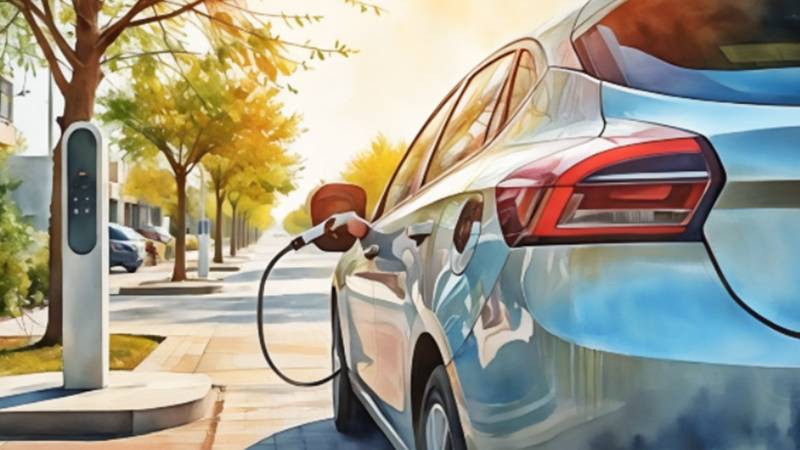
One of the more theatrical components of this year’s budget was the National Electric Vehicle (NEV) Policy 2025–30. On paper, it is ambitious: 30% of all new vehicles sold in Pakistan should be electric by 2030. The government promises Rs 20 billion in subsidies, waivers on customs duties for EV components, and incentives for local manufacturing. Yet the tax policy attached to this plan undermines its very foundation. Hybrids—which still burn fossil fuels—enjoy a reduced GST of 8.5%, while fully electric vehicles are taxed at the full 18%. This is not only illogical, it is deeply hypocritical. You cannot penalise clean adoption while subsidising partial measures and still pretend to champion green reform.
Worse still, there is no clear roadmap for creating the charging infrastructure or battery manufacturing systems that such a transition would demand. Talk of charging stations and local battery plants has become the government’s favourite refrain—always promised, never realised. Without strict deadlines and legal backing, such reforms remain bureaucratic theatre.
These sudden tax changes raise a broader legal question: what happened to policy continuity? In 2021, the government announced the Automotive Industry Development and Export Policy (AIDEP) 2021–26. It promised tariff stability, localisation, and a predictable investment climate. In less than two years, that commitment has been dismantled without consultation, replaced by arbitrary levies and fiscal improvisation. Not only is this economically destabilising, but it also undermines regulatory trust—especially for manufacturers who took policy guarantees at face value.
Then came a more contentious move: the liberalisation of used car imports. Starting July 2026, commercial import of cars up to five years old will be allowed, with regulatory duties phasing out entirely by 2029. This is being sold as a win for consumers seeking affordability and choice. In reality, it is a slow suffocation of the domestic assembly sector. Pakistani auto manufacturers, already dealing with high input costs and constant policy shifts, will now be forced to compete with a wave of cheaper, higher-tech imports. Local employment in parts manufacturing, assembly lines, and logistics faces existential risk. Yet the government appears willing to gamble the future of domestic industry for the illusion of consumer satisfaction—with no parallel protectionist strategy or long-term industrial policy to balance the equation.
And beyond all the tax regimes and import policies lies the silent crisis of legislative negligence, Pakistan’s primary law governing this sector—the Motor Vehicles Ordinance of 1965—remains outdated and only partially implemented. This law was meant to regulate licensing, vehicle fitness, emissions, and safety. Today, smoke-belching buses, unfit vehicles, and underage drivers are a routine sight. Emission testing is barely enforced. Safety standards are practically non-existent. No new federal law has emerged to bring the industry in line with modern practices, EV integration, or consumer protection. The result is a sector operating in contradiction—a policy mess propped up by legal relics.
But policy doesn’t live in the abstract. When fuel gets expensive, it is a delivery boy who feels the pinch. When car prices jump, it is a schoolteacher who parks his / her dream indefinitely. Behind every tariff line or tax code lies a person—working, aspiring, trying to make a life. These are not the people ruining the planet. In many ways, they are its first victims.
It is easy to wrap a policy in green buzzwords. It is much harder to craft one that genuinely balances climate, commerce, and compassion. What Pakistan’s automobile sector needs is not another round of taxation masquerading as reform. It needs law. It needs consistency. It needs a governing framework that treats mobility as a right—not a taxable luxury.
Until that happens, the road ahead for Pakistan’s auto industry will remain as congested, unpredictable, and exhaust-filled as the roads we all drive on.