

I had the honour of participating in the 9th International Forum on Asia and the Middle East, hosted by the Middle East Studies Institute of Shanghai International Studies University (SISU), held in Shanghai from September 27 to 28, 2025. The forum was impeccably organised, reflecting SISU’s enduring commitment to academic excellence and cross-cultural dialogue. I had the opportunity to engage with distinguished scholars from Egypt, Palestine, Saudi Arabia, Yemen, Iran, and India, whose diverse perspectives enriched the deliberations on the Middle East’s changing political landscape and its global implications.
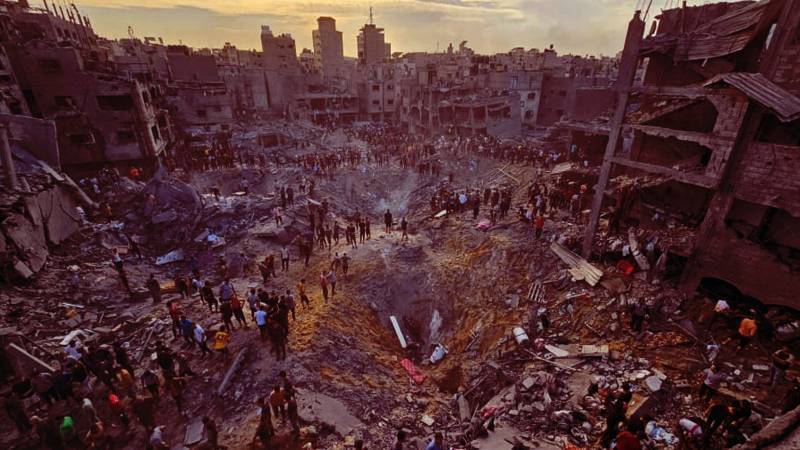
During my presentation, I argued that the Gaza war has once again exposed deep fractures within the global political order. While the humanitarian catastrophe has devastated countless lives, the conflict has also reshaped global diplomacy. It has challenged the moral foundations of Western engagement while creating space for emerging powers, particularly China, to redefine global leadership through what I would describe as ‘normative diplomacy’.
For decades, the United States has portrayed itself as both Israel’s principal ally and the primary broker of peace in the Middle East. Yet Washington’s repeated vetoes of ceasefire resolutions at the United Nations and its unwavering military support for Israel, amounting to $3.8 billion annually, have revealed the selective application of international law. This one-sided policy has alienated much of the Arab world and the Global South, thereby eroding American moral legitimacy.
In contrast, China has stepped into the diplomatic vacuum. Traditionally known for its economic initiatives under the Belt and Road framework, Beijing has adopted a more proactive and values-based foreign policy. Through initiatives such as the July 2024 Beijing Declaration, which proposed a three-phase roadmap for ceasefire, Palestinian unity, and sovereign statehood, China positioned itself as a credible advocate of peace. Its emphasis on humanitarian relief, civilian protection, and adherence to international law resonated strongly across the Arab and Muslim worlds, including Pakistan.
Gaza stands as a powerful reminder that in the twenty-first century, the legitimacy of leadership depends not merely on might but on moral clarity
China’s engagement in the Gaza crisis also reflects a deeper transformation in its global approach, the merging of economic strategy with diplomatic responsibility. The Middle East, long viewed through the prism of energy geopolitics, is now emerging as a space for soft power and moral legitimacy. Beijing’s $3 million humanitarian contribution to UNRWA and its cooperation with Egypt and Saudi Arabia on green energy and maritime security demonstrate its nuanced understanding of regional sensitivities. In a world increasingly sceptical of Western interventionism, China’s commitment to sovereignty, equality, and peaceful coexistence aligns with the aspirations of the Global South.
The United States faces a dual challenge: maintaining military dominance while reclaiming moral credibility. For nearly two years, Washington stood by as a genocidal war unfolded in Gaza, offering diplomatic protection and military support to Israel. Most European powers mirrored this stance through acquiescence. Nonetheless, owing to mounting domestic public pressure, a significant shift occurred this year when the United Kingdom and France formally recognised Palestine as a state, signalling growing European discontent over the human and moral cost of the conflict.
Against this backdrop, the Trump-led peace initiative recently accepted by both Hamas and Israel represents a cautious but notable step towards ending years of bloodshed. The plan, shaped through sustained diplomatic engagement, involved eight Muslim-majority countries playing active mediating roles. Pakistan, in particular, deserves recognition for its principled advocacy of the two-state solution, its vocal humanitarian position, and its behind-the-scenes diplomacy in mobilising Global South support for peace.
The Gaza war represents more than a humanitarian tragedy; it marks a defining moment in the evolution of global politics. The moral foundations of the international order are shifting towards multipolarity, where legitimacy stems not from coercive power but from consistency, empathy, and justice. China’s calibrated diplomacy during the conflict has strengthened its standing across the Middle East and the Global South, contrasting sharply with the militarised and morally compromised approach of the United States.
As I reflected during the forum’s discussions, Gaza stands as a powerful reminder that in the twenty-first century, the legitimacy of leadership depends not merely on might but on moral clarity. In this emerging order, values matter as much as weapons, and credibility cannot be proclaimed; it must be earned.