

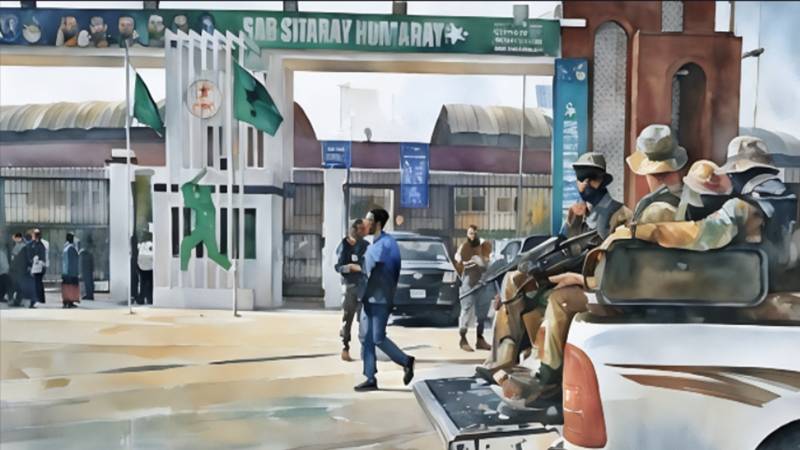
The return of international cricket to Pakistan was not just a sporting revival — it was a symbolic milestone loaded with pride, hope and emotional rehabilitation. For over a decade, Pakistan’s cricketing arenas carried a tragic emptiness, haunted by the memory of the 2009 attack on the Sri Lankan team. So when international teams began returning, starting with Zimbabwe and later Sri Lanka and others, there was a collective sigh of relief: Pakistan was once again ready to host world-class cricket. This development certainly deserves applause, especially for the resilience shown by the Sri Lankan team, which continued to play despite the blast that occurred in Islamabad. Their commitment to stand with Pakistan in a moment of insecurity will remain a moment of profound sportsmanship and courage.
However, while there is every reason to appreciate the return of cricket, there is also a need to critically examine how Pakistan has attempted to secure visiting teams — and the message that such extreme security conveys to both guests and its own citizens. The intention behind extraordinary measures is understandable: no one wants to see history repeat itself. Yet when entire roads are blocked, bridges are militarised, and civilian mobility is paralyzed for hours, a paradox emerges — the more security a nation displays, the more insecure it begins to appear.
The idea that "more security equals more safety" is not always true, especially when the scale of security arrangements begins to resemble those of a battlefield rather than a sporting event. A cricket match is supposed to feel festive — not like the arrival of a high-risk military convoy. When roads remain sealed for long stretches, when schools and workplaces are forced to revise timings, and when the army patrols the city more than the police, the atmosphere subconsciously communicates fear instead of safety. The very effort to reassure becomes an admission of danger.
This is where Pakistan’s strategy risks backfiring. Instead of projecting confidence, normalcy, and readiness, it broadcasts doubt, threat, fragility, and a lack of trust in law-and-order structures. Visiting teams observe not only what is arranged for them, but also what is disrupted because of them. The excessive deployment may unintentionally suggest, "We expect something might go wrong," which undermines the larger goal of restoring Pakistan’s image.
The cost is not only reputational — it is psychological and practical, and it is paid most heavily by Pakistan’s own citizens. For many, these matches do not represent celebration, but inconvenience, anxiety, and disruption to daily life. Roads blocked for hours mean students cannot reach universities, professionals miss appointments, commuters face exhaustion, and patients struggle to access hospitals. Patriotism becomes punishment.
Hina Khan, a student at Bahria University, said she and her classmates were already suffering due to the ongoing construction of the Margalla underpass — a major developmental project. However, their frustrations have doubled with the constant roadblocks during cricket team movements. The construction slowed down their commutes, but the security lockdowns have trapped them — adding stress, unpredictability, and wasted time. For students seeking routine and academic focus, this feels like being caught between national pride and personal misery.
A cricket match is supposed to feel festive - not like the arrival of a high-risk military convoy
Similarly, Rashid Abbas, who travels daily from Rawalpindi to Islamabad’s F-7 area for work, expressed how life has turned chaotic. The construction of the Kacheri Chowk flyover in Rawalpindi has already made commuting a daily battlefield of jams, detours, and delays. When cricket-related road shutdowns layer on top of that, his ordeal becomes unbearable. He now plans for delays that could range from one hour to several — with no reliable timeline, no advance notice, and no alternative routes. Such experiences are not isolated — they reflect a larger pattern of civilian inconvenience that rarely receives official empathy or compensation.
It is crucial to ask: Is this the right way to promote a soft image? Is disrupting the lives of millions justified simply to craft a narrative that “Pakistan is safe”? Ironically, the message received may be the opposite: that Pakistan is not safe enough to host an event without turning the entire city into a controlled zone.
A soft image cannot be performed; it must be lived, experienced, and observed organically. Nations do not become trustworthy by staging safety — they become trusted when life appears normal, spontaneous, and unrestricted. Tourism thrives not where soldiers are stationed, but where civilians roam freely.
If cricket teams are uncomfortable with routine public-level security, perhaps it signals that Pakistan should pause, improve internal stability, invest in policing reforms, and build confidence gradually rather than rushing to prove readiness through spectacle. Bad advice leads to rushed decisions, and rushed decisions lead to damaging public experiences. In this case, the attempt to show “all is well” is inadvertently convincing the world that “all is not well.”
Pakistan must aim for security that is smart, invisible, and integrated, rather than security that is overwhelming, intimidating, and militarised. Countries like England, Australia, and New Zealand protect sports teams without shutting down entire cities. Their model is quiet confidence, not loud caution.
Pakistan can get there too — but not by prioritising image over citizen comfort.
Cricket’s return to Pakistan is a blessing, a victory, and a source of national happiness. But happiness should not come at the expense of ordinary people or by broadcasting insecurity in the name of protection. True safety is felt, not enforced. True image is earned, not staged. And true progress balances pride with practicality.
Until that balance is achieved, Pakistan will continue to secure cricket — but not necessarily the confidence that cricket is meant to restore.