

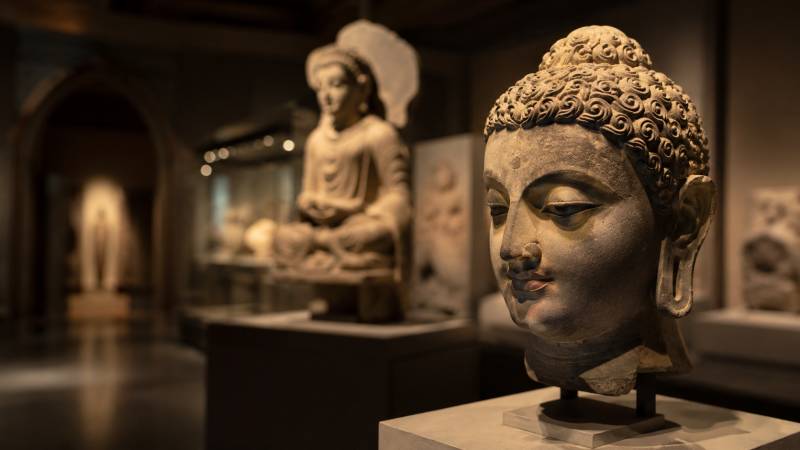
The applause in Islamabad was deserved. The return of more than 450 antiquities from the United States to Pakistan, now displayed in the newly inaugurated “Legacy Returns Home” gallery at the Islamabad Museum, marks one of the most significant acts of cultural restitution in recent Pakistani history.
Among the recovered objects spanning multiple historical periods and regions of present-day Pakistan, Gandharan sculptures and Buddhist antiquities remain the most visually prominent and symbolically charged. The gallery was inaugurated by Federal Minister for National Heritage and Culture, Aurangzeb Khan Khichi, alongside US Assistant Secretary of State S. Paul Kapur. Pakistani officials described the return as the homecoming of a lost civilisational inheritance.
But amid the celebratory speeches and museum lighting, one uncomfortable question remained carefully unasked: why did this “legacy” leave home in the first place? And perhaps an even more unsettling question: what exactly has returned home?
The official narrative is emotionally satisfying. Ancient Gandharan sculptures, terracotta figurines from Mehrgarh, Buddhist relief panels, coins, stucco Buddhas and ritual objects were stolen, trafficked through international smuggling networks, seized by American authorities, and finally returned to Pakistan.
The Manhattan District Attorney’s Antiquities Trafficking Unit, assisted by Homeland Security, claims to have repatriated hundreds of Pakistani antiquities over the last decade.
Yet the story of antiquities trafficking in Pakistan has never been a simple morality play of thieves abroad and victims at home. Scholars of illicit antiquities networks, including Neil Brodie, Donna Yates and Monica Hanna, have repeatedly shown that the global antiquities market survives through a complicated ecosystem of looters, dealers, museums, collectors, auction houses, corrupt officials and, crucially, local economies of survival.
Pakistan fits that pattern precisely.
For decades, sites in Taxila, Peshawar and the wider Swat Valley were transformed into extraction zones for the global art market. Gandharan heads were detached from relief panels because detached heads sold better in London and New York galleries. Entire archaeological layers were destroyed not by ideology alone, but by market demand.
Looting was not accidental; it was structurally produced.
To be fair, the Pakistani state has shown renewed interest in Gandharan and Buddhist heritage in recent decades through conservation projects, museum development and tourism initiatives in Khyber Pakhtunkhwa and Punjab.
In Khyber Pakhtunkhwa, projects linked to the “Gandhara Strip” and proposed “Gandhara Knowledge Corridor” seek to connect Buddhist heritage sites across Swat, Mardan, Peshawar and Taxila through tourism and research infrastructure.
Heritage cannot become publicly accessible unless it is first educationally integrated and ethically understood as part of a shared historical inheritance rather than a selectively celebrated civilisational brand
In Punjab, the recent declaration of Taxila as an “International Heritage City”, alongside multi-billion-rupee allocations for restoration projects, signals a major policy shift towards heritage-led tourism development.
This resurgence is important and long overdue. But heritage revival will remain cosmetic unless deeper structural issues are addressed.
For decades, archaeology departments remained underfunded, site museums deteriorated, and communities living around heritage zones were incorporated into the heritage economy only marginally, often as guards, labourers, transporters or informal traders.
Even today, many archaeological landscapes remain vulnerable to encroachment, illicit excavation and unregulated construction.
Equally neglected is the artisanal economy surrounding Gandharan replica production in places such as Taxila and Peshawar.
Many craftsmen involved in reproduction workshops possess extraordinary technical knowledge of ancient sculptural traditions, yet remain trapped within informal or illicit economies tied to the counterfeit antiquities market.
Rather than viewing these artisans solely through the lens of criminality, heritage reform could integrate them into legitimate craft, conservation and art education initiatives through institutions such as the National College of Arts.
And this is where the language of “legacy” becomes complicated.
Experts working on Pakistani antiquities trafficking have long pointed out that the illicit market is saturated not only with stolen archaeological material, but also with sophisticated fakes produced by contemporary artisans.
Workshops in and around Taxila and Peshawar have, for decades, produced Gandharan-style sculptures for tourists, collectors and international dealers.
Some are obvious replicas. Others circulate through laundering networks until they acquire invented provenances and museum legitimacy, both in Pakistan and abroad.
The global antiquities market rarely rewards authenticity alone. It rewards narrative.
A Gandharan Buddha in Manhattan is not simply an object; it is a performance of civilisation, spirituality, rarity and elite ownership.
Once the market values “ancient Pakistan” as aesthetic capital, counterfeit economies inevitably emerge around that desire.
In this sense, fake antiquities are not marginal to the market — they are one of its logical consequences.
So when we celebrate the return of “legacy”, we should ask: which legacy?
Is it the legacy of ancient Gandhara? Certainly.
But it is also the legacy of colonial archaeology that removed objects from living landscapes and converted them into museum commodities.
It is the legacy of uneven development that left communities around archaeological sites economically vulnerable.
It is the legacy of national and international looting networks that plundered archaeological sites, trafficked stolen antiquities and flooded the market with counterfeits.
And it is the legacy of a global art market that transformed sacred and historical objects into speculative assets.
The return of antiquities, therefore, cannot become a theatrical substitute for heritage reforms.
A few illuminated galleries in Islamabad will not resolve the deeper crisis.
Pakistan still requires sustained investment in site protection, provenance research, conservation laboratories, digital archiving, museum training and locally rooted heritage stewardship.
Most importantly, communities living around archaeological zones must become meaningful stakeholders in preservation rather than passive spectators to state-led heritage branding.
The irony is profound.
The state now asks ordinary Pakistanis to feel pride in Gandhara, even though for decades the same heritage remained largely absent from school curricula, public discourse and the national imagination because it complicated narrow ideological visions of identity.
Gandhara became internationally marketable long before it became nationally meaningful.
Yet heritage cannot become publicly accessible unless it is first educationally integrated and ethically understood as part of a shared historical inheritance rather than a selectively celebrated civilisational brand.
Still, restitution matters.
The return of these objects is important not because nations “own” the past in any absolute sense, but because looting destroys archaeological context, historical memory and scholarly knowledge forever.
Repatriation cannot fully reverse that damage, but it can interrupt the conversion of history into a commodity.
But restitution without introspection becomes spectacle.
The gallery in Islamabad should therefore not merely display recovered objects.
It should also document the routes of smuggling, the destruction of archaeological sites, the economics of looting, the fabrication of fake antiquities and the complicity of international collectors and local elites alike.
Otherwise, “Legacy Returns Home” risks becoming a comforting nationalist slogan masking a much darker history.
The real question is not whether the artefacts came home.
The real question is whether Pakistan is finally prepared to confront the conditions that pushed its history into exile.