

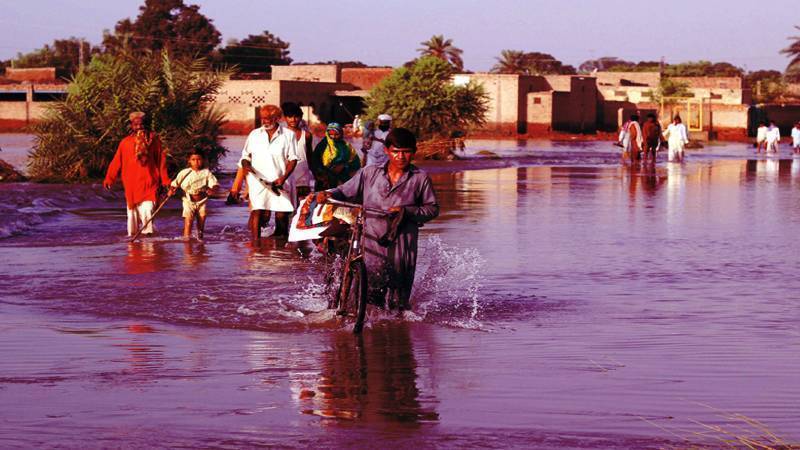
For thousands of years, after the scorching heat of the summer months, the monsoon rains have brought relief to the Indus basin, relieving people and animals, reviving parched fields and filling up depleted reservoirs.
The monsoons also brought the riverine floods; a boon for the fertile plains, carrying rich alluvial soil from the Himalayas, fertilising and replenishing the land. The flood was considered a blessing by communities settled along the rivers; a harbinger of good crops and abundance.
For millennia, the rivers flowed, flooded, receded and ultimately merged into the mighty Indus as it continued south to form the amazing Indus delta before draining into the Arabian Sea. So then, how did the wholesome floods and welcome rains become ‘disasters’?
Indeed there are visible climate change impacts on weather patterns in Pakistan. Monsoon systems are being intensified by the warming oceans and are dumping greater volumes of rain over shorter windows; however, it is not the only factor causing disasters during the monsoon season. The recent disasters are actually man-made and development-induced, compounded by bad governance.
In the northern areas, the rivers swell rapidly after rainfall up in the mountains, resulting in flash flooding. A surging river, gushing downstream, has tremendous force and will obliterate everything along its path, including any structure built on its banks. The river sweeping away all structures, including hotels and resorts built on and inside river banks in Khyber Pakhtunkhwa, is now a regular occurrence every year. But can we call this natural behaviour of the river a ‘disaster’?
In the plains, there is urban flooding, which is almost entirely due to ill planning, bad governance, lack of environmental risk assessment and poor drainage. The situation is worse in areas where there are massive encroachments on the seasonal nallahs, smaller rivers and their catchment areas. The streams and nallahs, choked with waste and abused as garbage disposal, are flooded after rain; they overflow their banks and inundate adjacent areas. At the same time, the rainwater also gets trapped there as the construction restricts its drainage along its natural path. The logical result is water entering houses, sweeping away vehicles and sometimes even people. Can we call this natural behaviour of the nallah a ‘disaster’?
The government must prioritise rainwater harvesting in flood-prone areas, which can channel rainwater into the natural underground aquifers, prevent urban flooding and recharge the groundwater
This season, the rainfall in most parts of the country has been average or below average. It is only the Potohar region, situated in the foothills of the Himalayas, which has experienced heavy rainfall in areas of Islamabad, Rawalpindi and Chakwal. In this region, because of the hilly terrain, the rainwater drains quickly into the nallahs and there had never been any floods in Chakwal or Islamabad even after the heaviest of rainfall.
The heaviest rainfall was experienced in Islamabad in July 2001 when 620 mm was recorded in just ten hours. Consequently, Nallah Lai in Rawalpindi overflowed, causing inundation; however, there was no flooding in Islamabad.
In the last two decades, vast agricultural lands, fruit farms and grasslands surrounding the cities have been grabbed by land developers for building housing societies. With the rapid shrinking of green areas and the cutting down of trees, water can no longer be absorbed into the ground and all the rainwater ends up as run-off water. According to UN-Habitat and the Sustainable Cities Network, 20 to 30 per cent of cities should consist of green spaces, which can absorb rainwater and reduce urban heat, but in Pakistan, there is hardly any green space left in cities, leading to rising temperatures and urban flooding.
Similarly, there has been massive deforestation in the mountains, causing landslides and flash floods. GLOF is also a risk as there are now thousands of vulnerable glaciers in Pakistan.
If Pakistan is committed to better disaster management, then the way forward is a paradigm shift in strategic planning, focused on mitigation and adaptation to climate change impacts, and much improved governance in place of just contingency planning.
The government must act to remove all encroachments on rivers and nallahs and prohibit all future construction on river banks and catchment areas. All infrastructure, including major roads, railways and bridges that restrict the natural flow of river water and cause flooding, must be identified, scrutinised and their design flaws rectified. For instance, the motorway at Qadarabad near Pindi Bhattian obstructs the natural flow of Chenab River waters, leading to flooding in nearby villages and loss of property almost every year. This type of flooding is entirely man-made and can be prevented.
The government must prioritise rainwater harvesting in flood-prone areas, which can channel rainwater into the natural underground aquifers, prevent urban flooding and recharge the groundwater.
After many tragic accidents during the current monsoon season, causing great loss of life and property, it is evident that the existing early flood warning and safety systems, as well as rescue capabilities, are totally inadequate, and road travel, especially in the northern areas, is extremely risk-prone and needs a major upgrade.
Much more effective and efficient monsoon planning and early warning systems need to be put in place and public awareness campaigns carried out. The National Disaster Management Authority consistently has an ineffective and uninspired performance and is nowhere to be seen throughout the year. Even the NDMA website is dull, inadequate and outdated, and hence useless as a public warning system. The government’s ‘emergency’ response is usually post-disaster; a practice that fails to mitigate future risks or prevent disasters.
Although all these recommendations and solutions require financial resources, the cost of not doing anything is much greater. Risk and vulnerability will affect the economy and eventually lead to displacement and migration of people. Nobody wants to live, invest or even travel to places which pose a risk to life or property.
Pakistan is not even close to securing the billions of dollars of climate financing that are actually needed for adaptation in order to reduce impacts on agriculture, health, food security and air quality. Pakistan needs to develop solution-oriented projects and sustainable green development programmes which can attract more climate financing, both domestically and internationally.
For example, there is now technology and products available for refining petroleum products, which can reduce emissions by up to eighty per cent. The amount it will cost in Pakistan is negligible compared to the huge benefits it can provide, including clean air, pollution and disease control, fuel efficiency and billions of dollars in savings on oil imports.
Similarly, there are nature-based solutions for cleaning rivers, wastewater and plastic waste management, groundwater recharge, green infrastructure, public transport, resilient agriculture, crop improvement, food security, value addition of fresh produce and carbon sequestration.
But to find the right solutions, the government needs to reach out to the relevant experts in these fields and organisations that have the expertise and technology to combat environmental challenges with context-specific, scalable, innovative green solutions.
In the end, it is business as usual by governments that would turn out to be the real ‘disaster’.