

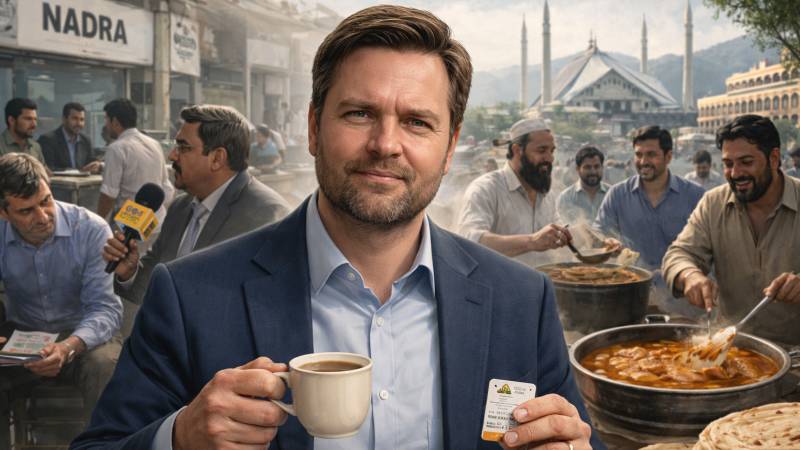
By the time JD Vance landed in Islamabad, he had already been to NADRA twice and was still waiting for his degree attestation by HEC.
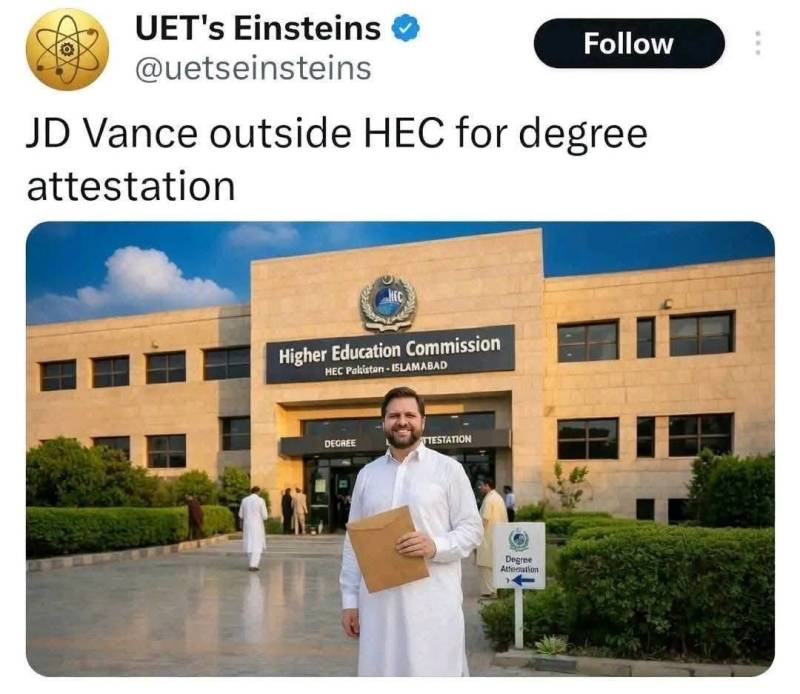
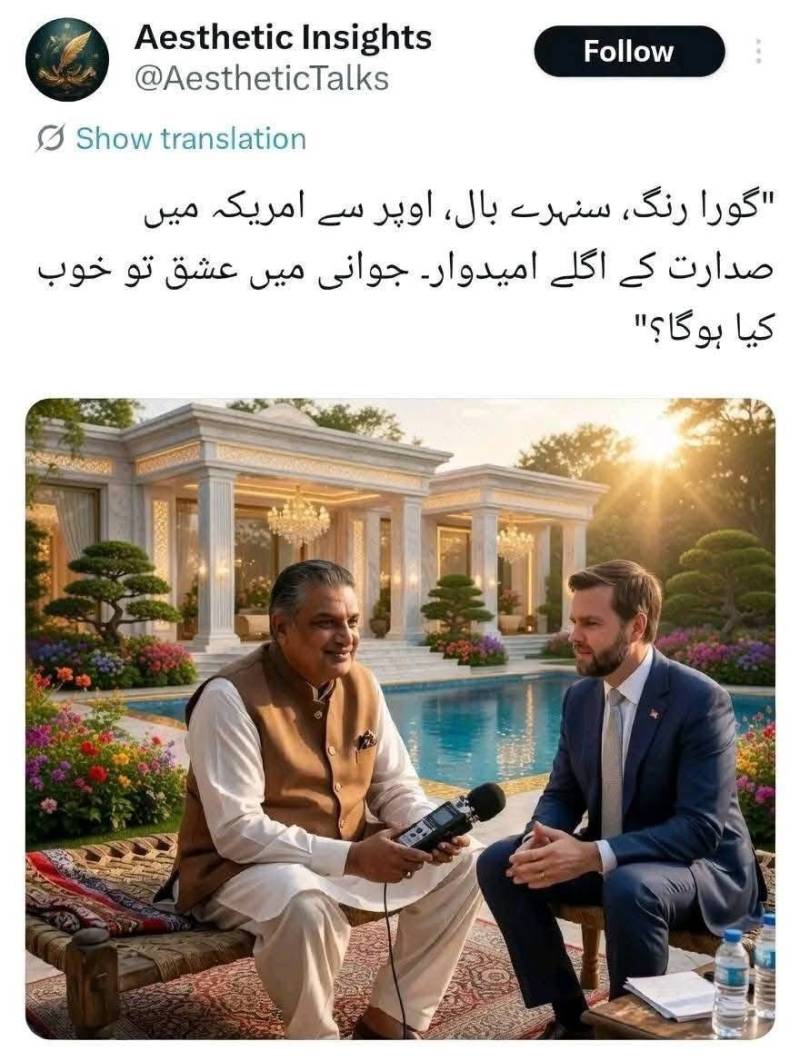
That was the version that people met first. Not the official one, but the one already translated into local life. A guest who could be fed, delayed, and gently confused like everyone else. He tried nihari, failed to get his phone PTA approved, bought a faded T-shirt from Sunday Bazaar, and politely asked someone’s auntie for a nikah date. In one version, he was also being interviewed by Suhail Warraich in his thick accent on his love affairs in the past.
None of this happened. And yet, it did.
That is the strange power of the meme. It takes a man who represents one of the most powerful states in the world and makes him legible in local terms. Not as a big-shot diplomat or Vice President, but rather as a slightly confused guest trying to figure out how things work here.
And boy, did Pakistanis excel at it.
There is something deeper going on than just humour. A meme is a way of saying, " We understand you now, we know where you sit in our world. The moment Vance becomes someone who needs chai, who might get a challan, who could be sent to the wrong counter and told to come back tomorrow, he is no longer distant power.
He is familiar and, in turn, manageable. This quiet kind of equalising helps people have agency, and let’s be honest, have fun. But it is also a kind of ownership because Islamabad talks were serious business with long hours, tense rooms, and careful statements. Pakistan was playing host at a moment when the region was watching closely. And yet, online, the tone was light and fun, but more importantly, irreverent. As if to say, global diplomacy may pass through our country, but it will do so on our terms.
All of this is not new. South Asia has always had a way of pulling the powerful into everyday language. Sometimes gently, sometimes sharply. The British “babu” did not stay intimidating for long because our people made him a character.
The same humour that makes politics accessible can also make misinformation, or malinformation, feel harmless and fun, until it is not
His accent copied, his habits joked about, his authority quietly chipped away in everyday conversation. In more recent times, think of how Narendra Modi’s past as a “chaiwala” keeps returning in political talk. It was once used to mock him. It also became something he owned, even leaned into. A simple label turned into a whole political story about class, mobility, and authenticity.
Because these details are never neutral here. Food, accent, even the way someone stands or orders tea, all of it is coded. It signals class, education, and background. So when a meme places someone in a certain setting, it is not just being funny. It is assigning them a social class or a ‘tabqa.’ To take a powerful figure and drop him into a setting that feels “below” his status does two things at once. It is flattening power, yes, but it is also reinforcing the very hierarchy it pretends to disrupt. We laugh at power by pushing it down, but in doing so, we reveal exactly how deeply we still believe in the ladder itself.
In the same way, memes familiarise power, but just faster and more unhinged, and perhaps also more likely to be misused in the wrong hands than one might accept. And there is always a thin line here: what looks like humour can quickly become class commentary, or worse, class contempt. When you reduce someone to what they eat, how they speak, or where they might belong in a social hierarchy, the joke can start to reveal more about the person making it than the person in it.
Still, the appeal is obvious. Memes make politics easier to hold. They travel fast and ask for very little effort. We saw it before with Ukraine, with Gaza, with India-Pakistan flare-ups. Serious things turned into something shareable.
So, what has shifted now? AI has entered the chat.
Right now, most of these JD Vance memes are clearly jokes. You can tell they are fake; that is part of why they work. But the tools being used are getting better. Deepfake videos, AI-generated voices, edited clips that look almost real. The distance between a joke and a believable lie is shrinking. Our elders, or so-called Boomers and Gen X, are already getting deceived quite easily, with mothers forwarding WhatsApp messages on how even JD Vance has now accepted Islam, while scolding their child for missing the Friday sermon.
And once that line blurs, the stakes change. A fake video of a politician saying something outrageous, or a clip of a meeting that never happened. The same humour that makes politics accessible can also make misinformation, or malinformation, feel harmless and fun, until it is not.
There is also an interesting absence worth noticing. The meme wave around Islamabad felt very Pakistani because it was loud and creative. On the American side, there was no single shared joke of the same scale. Some scattered reactions, some niche conversations, but nothing that took over timelines in quite the same way. All this says something about who is shaping the narrative, at least online.
But it also raises a question. When everything becomes a meme, what gets lost? Perhaps the detail and the seriousness. The parts that do not fit neatly into a joke. And maybe that is the trade-off. Scholars call this phenomenon media framing, where complex reality gets compressed into a simple, repeatable story that is easy to share but harder to fully understand. Another opinion that appeals to rationality is that perhaps this is just how politics works now. Not only in press conferences and policy papers, but in group chats and Instagram stories.
Either way, JD Vance’s visit will be remembered in more than one way.
In official records, it will be about talks and outcomes. Online, it will be about a man entering Pakistan and getting battered at government offices. Or being welcomed by Multan’s Wain community as their own because “Vance” sounds close enough to “Wains” for the internet to claim him.
The bottom line is, before any deal is signed, before any statement is released, the internet has already decided where you belong. As Walter Lippmann once wrote, we do not see reality as it is, only the pictures in our heads.