

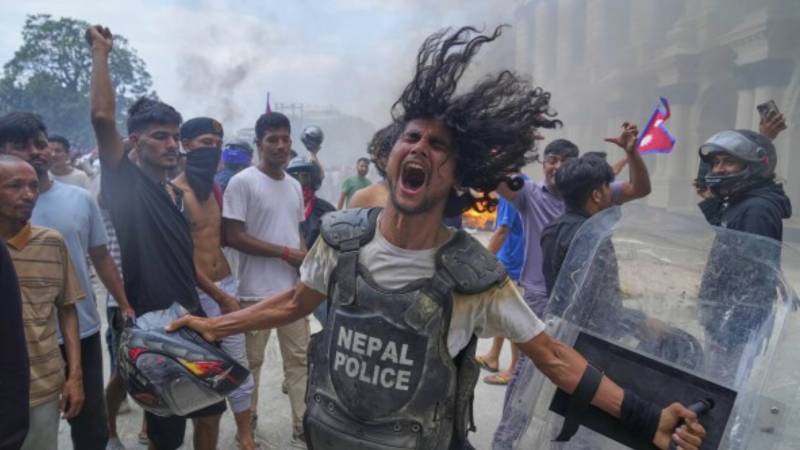
Is it so simple to launch a socio-political movement to overthrow a government without a political party or any leader, relying solely on social media platforms like Facebook, Twitter (X) hashtags, TikTok live streams, and Instagram’s viral reels to organise protests and mobilise the masses? Or is South Asia heading towards an Asian Spring or a colour revolution, similar to those experienced by Central Asian and Eastern European states during the Cold War epoch sponsored by great powers?
In South Asia, within a year, another government has been toppled by youth, using social media to mobilise the masses for a political movement. Last year, it was Bangladesh, the Bengal Tiger and today, it is Nepal, the land of Sagarmatha.
On 9 September 2025, the government of Nepal under Prime Minister KP Sharma Oli, amid widespread anti-government protests over corruption, banning social media pages and nepotism, was toppled.
In these demonstrations, Gen Z, including students and social media activists, primarily led these massive protests, initially calling for lifting the ban on social media applications, and later demanding the government’s removal. Protesters, however, perceived the ban as an attack on freedom of expression and an attempt to suppress critics, particularly targeting a digital campaign against the lavish lifestyles of politicians’ children, who used the hashtag #NepoKids to expose state-level corruption and nepotism.
The government, in contrast, stated that these 26 social media applications were instructed to register themselves but failed to comply with the law of the state of Nepal, claiming these digital platforms were responsible for spreading misinformation and posing cybersecurity risks. Therefore, the government considered regulating these applications.
Apart from that, Gen Z, through digital modus operandi, exposed socio-political inequalities and bad governance in Nepal, and they evolved from digital activism to a political movement by using hashtags such as #WakeUpNepal, #GenZProtest, #StopCorruption, #SocialMediaBan, and #PoliticiansNepoBabyNepal, which socially and emotionally resonated with the people.
As a result, the incumbent government resigned, curfew has been imposed, and the Nepali military has taken charge of the country; according to reports, so far 34 people have died, more than 1,000 have been injured, and political perplexity still lingers due to the conflict over the leaders’ names for the interim government.
Digital platforms, particularly those owned by Facebook and Twitter (X), are playing a drastic role in launching, organising and supporting socio-political movements and revolutions in South Asia
In a similar regional context, on 5 August 2024, the Bangladesh government was overthrown by protesters, primarily led by students and Gen Z, who opposed Sheikh Hasina’s administration over issues related to the quota system, unemployment, and governance. Similar digital tactics were employed to launch social media campaigns and trend hashtags, mobilising the masses. Likewise, in 2022, Sri Lanka’s Aragalaya movement was initiated against President Gotabaya Rajapaksa over the economic crisis and debts, through social media platforms, particularly Facebook and Twitter/X, using hashtags like #GoHomeGota. As a result, in July 2022, he resigned when protesters—evolving from social media campaigns to occupying the presidential palace—had changed the movement. In this regard, Facebook played a curious role in mass mobilisation.
Most of these socio-political, digitally driven movements were organised in the same way by engaging youth or Gen Z. Except in the case of former Prime Minister of Pakistan, Imran Khan, who was ousted through a no-confidence motion launched by the establishment and the Opposition, neither by youth nor any political movement. Khan and his party PTI accused Washington and its man, Donald Lu, the former United States Assistant Secretary of State for South and Central Asian Affairs, of being behind this regime change operation, citing the leaked diplomatic cypher document.
Sheikh Hasina similarly accused Washington of orchestrating her government’s downfall after she exposed a United States plan to create a Christian state, akin to East Timor, from parts of Myanmar.
However, questions remain about the true agenda behind these regional geopolitical developments. Critics ask: Are these socio-political movements in South Asia organic, or are they orchestrated by external and regional powers using digital tactics?
Apart from these conspiracy theories, one fact is apparent: Digital platforms, particularly those owned by Facebook and Twitter (X), are playing a drastic role in launching, organising and supporting socio-political movements and revolutions in South Asia where these under-developing states, already marked by high debt dependency, poverty, unemployment, bad governance, corruption, and illiteracy, are heavily reliant on international INGOs, NGOs, foreign aid, funds, and loans.
In this context, several questions arise: Is an “Asian Spring” looming over South Asia? Are protests under mobocracy to topple governments a better alternative to democratic elections, which are often marred by rigging and dynastic politics? Are these developing countries, grappling with corruption, hybrid regimes, political instability, and burgeoning young populations, ready to exercise digital rights fully?
Alternatively, ergo, is South Asia confronting a new form of colonialism in the guise of digital colonialism?