

In South Asia, the garden has, for centuries past, been central to art and culture. In 1525, soon after Babur conquered vast territories in northern India, he set about designing and planting a garden. Seeking the orderly design of his homeland’s Samarkand gardens, Babur commissioned the first charbagh to be laid out on the Jumna riverfront in Agra. His heirs took up the task with diligent ambition. Lahore, in particular, was graced with an abundance of Mughal gardens, among them the Shalimar Bagh and the charbagh complex in Shahdara at the site of Jahangir’s tomb. Each tomb acts as a palace for the deceased amidst the four-part garden of paradise (charbagh).
If these gardens have lost much of their original planting, we can still see how they looked 400 years ago by viewing any number of paintings from the Mughal royal courts. Pahari and Rajput paintings from the ateliers of Hindu rajas are, as well, filled with tree- and flower-rich landscapes. Today, Lahoris, inheritors of the Mughal tradition, cultivate gardens around their homes. Some are extensive and pay tribute to a multitude of indigenous flora; others are small and selective. Sabah Husain is among them. The courtyard garden at her family home in Lahore is not extensive, nor is it comprehensive, but it serves as a place of respite and a quiet, comforting environment where she often retreats to write, paint, and listen to music.
Her current exhibition, Gardens of Memory, derives from deeply imprinted emotions associated with the gardens she has inhabited, and from broader reflections on native flora. Well-versed and deeply immersed in the arts and culture of South Asia, its art, music, history, and literature, Sabah is also an accomplished practitioner of the arts of Japan. Her prints, drawings, and video works on display at Chawkandi Gallery in Karachi are a juxtaposition of art and culture from two distinct traditional sources: South Asia and Japan.
In 1988, Sabah earned an MA in Graphic Arts from Kyoto City University of Fine Arts and Music, where she studied printmaking. She returned to Japan in 2004 for research and studio practice at Tokyo National University, where she received the Japan Foundation Fellowship. She studied papermaking at the Kochi Institute in Shikoku in 1988, and in subsequent years produced reams of handmade paper using native fibres. In the process, she acquired a keen understanding of how different fibres affect the outcome of paper texture, colour, and how it reacts to paint in the printmaking process, as well as to drawing with sumi, graphite, and vegetable dyes.
Among the numerous plants, trees, cacti, and shrubs that Sabah sketched, painted, and photographed over the years, she selected a collection that best represented particular characteristics: they are fragrant or medicinal, have fractal formations, or are simply beautiful. These triggered memories for her and may do so for her audience as well.
One of the emotions evoked from her memories of the garden is that associated with the laburnum tree (tree of life). It was planted by her mother, who would sit quietly under the tree and admire its blossoms. A video and photographs in the exhibition convey the lilting beauty of its yellow flowers, which hang from the branches in lyrical gestures. The tree elicits memories of floral and arboreal motifs that passed through her life and that of her family during the years they moved from place to place. Its generous spread offers shade and comfort.
Called one of the five most sacred plants on earth in the Atharva Veda (c. 1500–500 BCE), cannabis was believed to be associated with the Hindu god Shiva
Sabah’s diptych featuring Cannabis indica is far more delicate than the species known so well in the United States. It grows wild throughout South Asia and, in the 1980s (and for some time thereafter), it filled the back two quadrants of the charbagh at Jahangir’s tomb. Perhaps there is a message here. Its medicinal properties, well known to Punjabi ancestors, have become less familiar today.
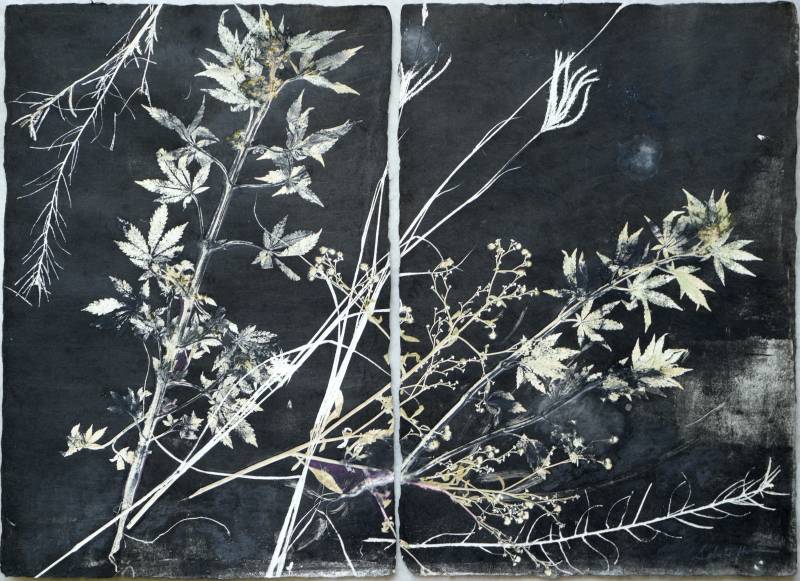
Called one of the five most sacred plants on earth in the Atharva Veda (c. 1500–500 BCE), cannabis was believed to be associated with the Hindu god Shiva. Accordingly, Shiva used the drug to focus inward and harness divine powers to do good for the human race. In the form of bhang, cannabis is openly and widely used even today in India’s Holi festival. Closer to Sabah’s home in Punjab, Sufis have used bhang or hashish to achieve a state of spiritual ecstasy, or to clear the mind and free the spirit to commune with God.
Cannabis was cultivated in Japan too, as early as the Jomon Period (6,000 to 10,000 years ago). Its fibres were used for clothing and cordage, and quite likely in Shinto rituals. I suspect Sabah unintentionally absorbed aspects of Shinto belief a folk religion whose core characteristic is the appreciation of the beauty and power of nature. Rituals centre on the worship of kami, or divine spirits, that inhabit all aspects of nature. This elegant print, like others in the exhibition, reflects Sabah’s intimate connection to Japanese art-making. Printed on handmade paper of kozo fibres, constructed when she was resident in Japan, it offers the perfect degree of absorbency for her oil-based paint. She highlighted leaves and stems here and there for additional effect. The dramatic contrast between the distinctly shaped leaves and thin stems against the dark background creates a bold simplicity typical of the Japanese aesthetic.
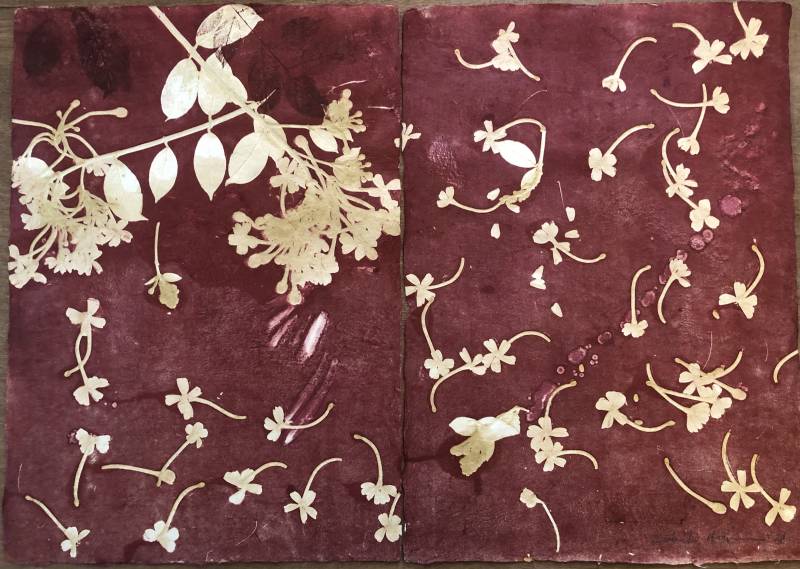
While Sabah’s diptych of delicate clover-shaped flowers of the Vinca plant, known as Sadabahar in Pakistan, does not convey the same sense of drama as the cannabis diptych, this tiny plant has a handful of beneficial medicinal properties. The red background suggests the service this plant renders for the heart. Alkaloids in the plant help manage blood pressure and may strengthen general cardiac function. It also possesses anti-bacterial and anti-inflammatory properties. Called periwinkle in the United States, this plant is a favourite in gardens there as well as in Pakistan. Though she has chosen the white version to maintain consistency in her series, Sadabahar produces pink and purple flowers as well. Like the cannabis diptych, the flowers are printed on handmade paper of kozo fibres and dabbed with white paint. The conscious separation of each flower into a symmetrical pattern identifies the tiny lobed flower as the dominant feature of the Sadabahar plant, whereas the leaves of the cannabis plant, in contrast, are its primary characteristic.
Sabah’s mixed-media works seek to touch the esoteric as well as the exoteric
Gardens can evoke memories: coming into contact with a certain medicinal herb or plant might spark recollections of a childhood cure. A wide array of scents is well known to elicit past experiences. What memory do you have when, sitting in the garden, the fruity aroma of Madhumalti fills the air? Sabah’s work featuring this aromatic plant, also known as Rangoon Creeper, depicts its leaves and small, delicate flowers. Petals, detached from their stems and scattered about the composition, give the sense of a windy day. Recalling its honeysuckle-like scent, the viewer might imagine its cluster of pink and red flowers. Sabah, however, has once again chosen white stems and flowers for her print. On handmade paper, as with the other works in this exhibition, she has overpainted with white and drawn upon the surface to personalise the image. Known to attract pollinators, these plants contribute to the welfare of the entire garden.
The composition featuring bamboo is a study in fractals infinitely complex, self-similar patterns. Such patterns are inherent in Sabah’s compositions. The leaves create abstract impressions. In East Asia and South Asia alike, bamboo holds abundant symbolism. For the Japanese, bamboo represents strength, prosperity, and growth. It is a symbol of flexibility in the face of adversity, as it can bend in the wind but does not break. Amir Khusrow, the 13th-century Sufi mystic, in a famous verse referencing bamboo, says, “Hare hare bans laga more angna” (my courtyard is covered with green bamboo).
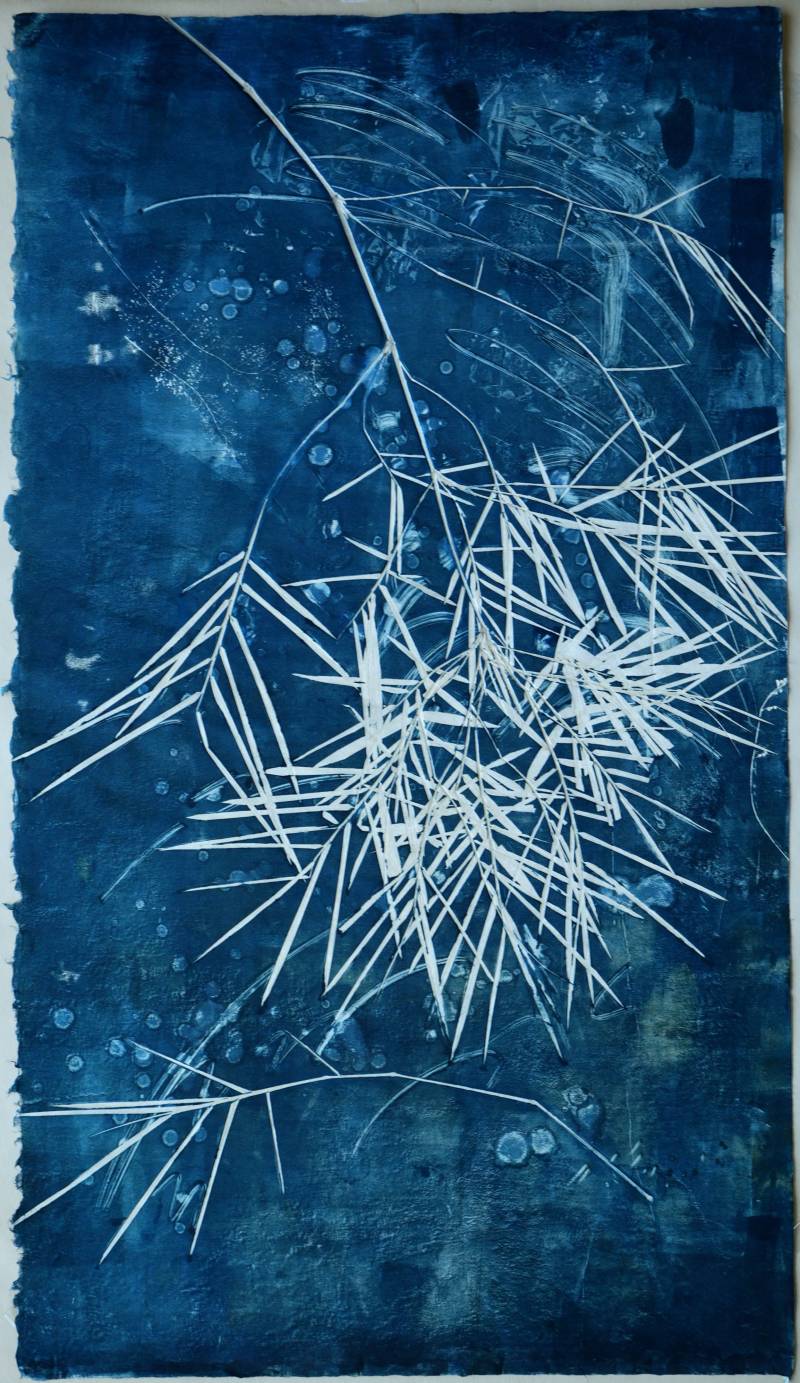
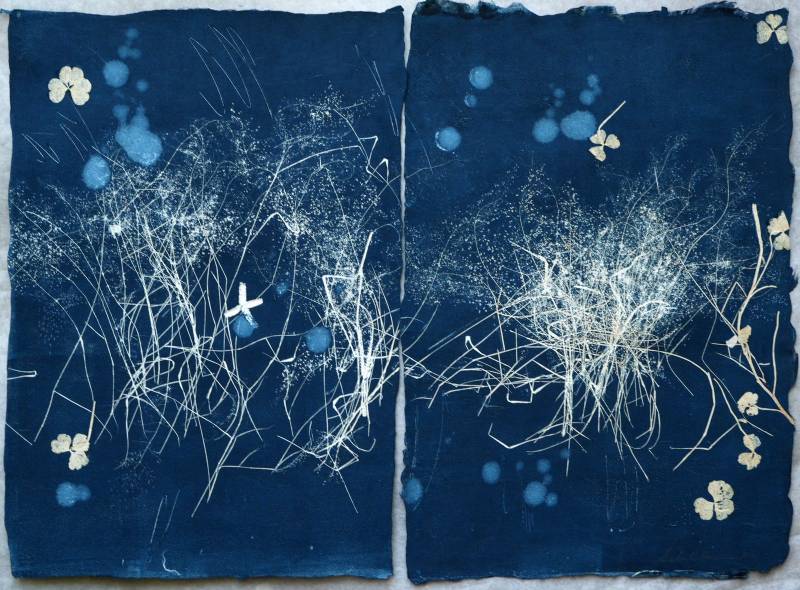
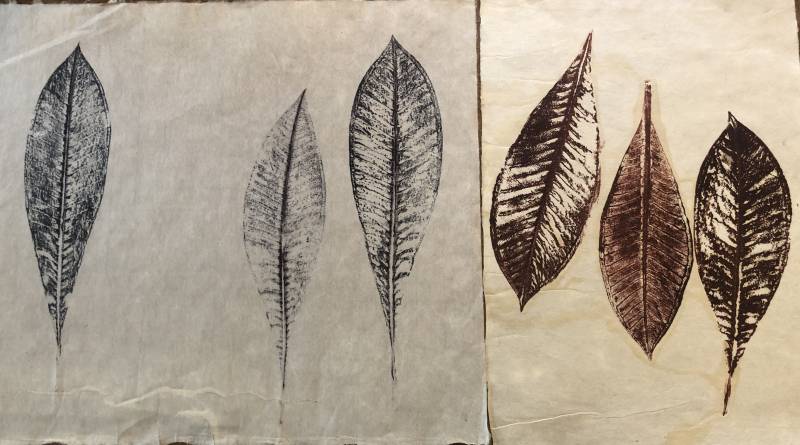
Other plants, no less significant, add structural definition to the mixed-media works as well as background for interpreting the series. Weeping Willow (Bede Majnoon) is a triptych, creating lyrical lines with indentations. Autumn grasses and weeds huddle together in clusters for warmth and conversation on burnished gold paper. The image with Champa leaves possesses a minimalist quality, delicate, sombre, evoking Gul-Chandni, Zehra Nigah’s poem.
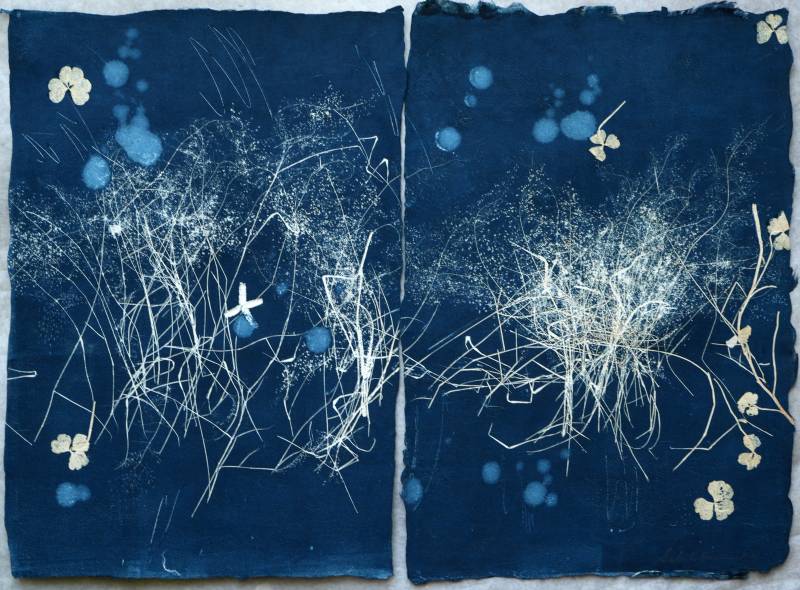
In South Asia, the garden holds multifaceted levels of meaning. Sabah’s mixed-media works seek to touch the esoteric as well as the exoteric. I see a parallel in the simple but layered verse by the Persian poet Hafiz Shirazi:
“From the garden of heaven a western breeze
Blows through the leaves of my garden of earth.”