


Accurate and timely information can save lives, but misinformation can destroy them. In a country on the frontlines of the climate crisis—one of the world’s most climate-vulnerable nations—Pakistan faces floods, heatwaves, droughts, glacial lake outburst floods (GLOFs), and widespread environmental degradation. These challenges are further worsened by a rising tide of climate disinformation that complicates response and recovery efforts.
The 2025 monsoon floods and misleading claims of a so-called “cloudburst” illustrated how false narratives can quickly overshadow scientific evidence, obscure the real drivers of climate disasters, and deflect government accountability. Despite repeated warnings from UN bodies such as the IPCC about erratic rainfall patterns in South Asia, climate change in Pakistan is still dismissed by many as a foreign agenda, divine punishment, or simply ignored.
A new study by the Institute for Research, Advocacy and Development (IRADA), supported by International Media Support (IMS), highlights the urgency of addressing climate disinformation in Pakistan. The report, “Climate Disinformation in Pakistan: Silencing Indigenous Peoples’ Voice,” shows that misinformation surges during climate-induced extreme weather events and spreads most rapidly on social media, particularly in Urdu and regional languages.
The study finds that climate disinformation is largely crisis-driven, emotionally charged, and primarily circulated through social media platforms. Nearly all documented cases (95%) occurred during high-impact events such as floods, heatwaves, droughts, and smog—precisely when public demand for accurate information is greatest and official communication is often delayed or inconsistent. An overwhelming 98% of disinformation cases spread via social media platforms and messaging apps, with content largely presented in Urdu and regional languages.
The report highlights how disinformation harms Indigenous communities by undermining safety and livelihood decisions, causing psychological distress, eroding trust in institutions, discouraging local ecological knowledge, and increasing their exclusion from climate policy and governance.
Climate Governance Undermined by Disinformation
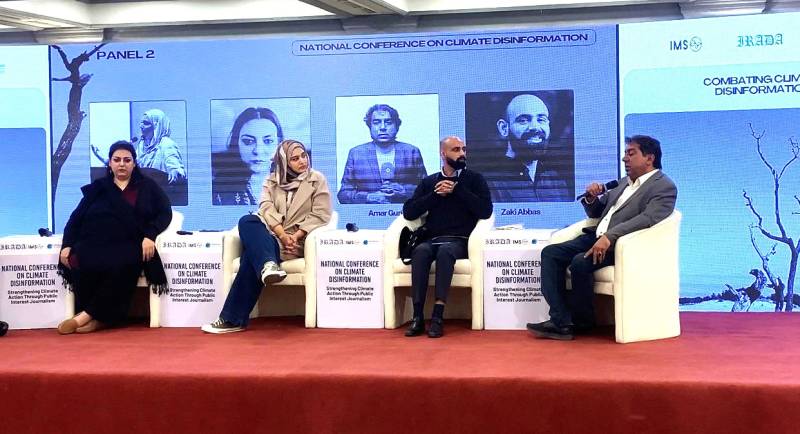
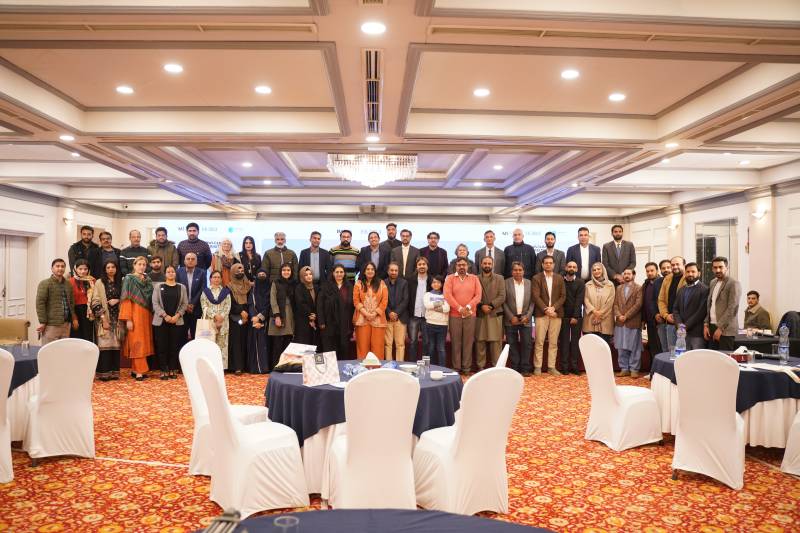
Climate resilience depends not only on infrastructure and adaptation planning but equally on integrating information integrity into climate governance to safeguard truth, transparency, and public trust. This was the consensus among experts and speakers at the National Conference on Climate Disinformation, organised by IRADA with IMS and the Digital Democracy Initiative of Denmark, Norway, and the European Union, held in Islamabad on Thursday, 11 December.
A baseline research study titled “Climate Disinformation in Pakistan: Silencing Indigenous Peoples’ Voice” was launched at the event. Its central message was clear: Pakistan cannot achieve climate resilience without accurate information, integrity, and public trust.
“Climate resilience depends not only on infrastructure and adaptation planning but also on ensuring accurate information in climate governance,” said Muhammad Aftab Alam, Executive Director of IRADA. He emphasised a major national challenge: misinformation spreads faster than official warnings, while political interests often take precedence over scientific evidence.
Adnan Rehmat, IMS Programme Manager, summed it up succinctly: “Climate communication is the road that connects climate policy with climate action.” In Pakistan, he noted, that road is often broken.
Rehmat added that a Google search assessment in Pakistan showed the top three searches were cricket, AI tools, and opportunities, with climate change also appearing—indicating growing public concern. He stressed the importance of effective climate communication in raising awareness about adaptation and mitigation efforts.
During the conference, Dr Abid Suleri, Executive Director of SDPI, argued that Pakistan’s climate plans must be grounded in local realities. “Climate plans should flow upwards from districts to the national level, not the other way around,” he said, warning against top-down policymaking that ignores lived community experiences.
Humera Qasim Khan, senior climate resilience and development leader and lead researcher and co-author of the study, emphasised the need for algorithmic accountability by Big Tech companies and social media platforms to curb the unchecked spread of climate disinformation online.
Indigenous Peoples: The Worst Hit by Disinformation
Most critically, the study highlights the disproportionate impact of climate disinformation on Indigenous and rural communities. These groups depend heavily on accurate information and their own ecological knowledge for survival, yet misinformation undermines both. Communities face confusion over evacuation decisions, psychological distress, and cultural disruption, while their exclusion from climate policymaking deepens. By crowding out scientific facts and Indigenous wisdom, climate disinformation leaves Pakistan’s most vulnerable populations even more exposed.
Humera Qasim Khan clarified that Indigenous Peoples (IPs) in Pakistan are not formally recognised. They include diverse ethnic, tribal, pastoral, forest-dependent, and coastal communities with identities tied to specific lands, languages, and customary institutions. While Pakistan’s Constitution provides general rights such as equality, religious freedom, and protection against discrimination, it does not explicitly recognise Indigenous Peoples. Pakistan did, however, support the UN Declaration on the Rights of Indigenous Peoples in 2007. Although no official census exists, estimates suggest there are 4–5 million Indigenous Peoples, mostly living in the merged tribal districts.
Khan noted that during her visits to flood-affected areas, she witnessed how mountain communities are disproportionately impacted, with women bearing the heaviest burden. In rural and mountainous regions, men often leave home early for work, leaving women as first responders when disasters strike.
She stated that during recent climate disasters in Pakistan, over 200 instances of disinformation were recorded, including misleading AI-generated videos and fabricated news reports.
Many women do not have access to mobile phones to contact family members, nor do they possess the disaster-response skills that men typically have. As a result, they face greater risks, limited communication, and fewer resources to protect themselves and their families during emergencies. Khan added that communities already displaced by floods or droughts experience heightened anxiety and trauma, amplified by misinformation. Incorrect forecasts, exaggerated warnings, and conspiracy narratives further erode trust in institutions.
The Challenges of Reporting Climate Change in Pakistan
The study also highlights serious challenges in climate journalism in Pakistan. Coverage remains largely reactive, focusing on disasters and immediate events, with limited attention to structural causes, adaptation strategies, or scientific accuracy. During the 2022 floods, fewer than half of TV bulletins featured flood news as their top headline.
Journalists face multiple constraints, including limited climate expertise, editorial prioritisation of political news, and commercial pressures. Many still regard climate misinformation as a secondary issue.
At the conference, climate activists, journalists, fact-checkers, and science communicators described a media landscape where misinformation often outperforms verified reporting. Poor access to climate education leaves communities vulnerable, particularly young people in rural and Indigenous areas who rely heavily on unverified sources.
Environmental journalist Amar Guriro highlighted challenges such as limited climate training, lack of institutional support, and pressure to follow trending narratives instead of scientific accuracy. He explained that environmental journalism is expensive and often rejected by newsrooms. Covering a GLOF-related story properly can cost up to one lakh rupees, leading editors to abandon such reporting in favour of cheaper political stories.
Climate journalist and activist Afia Salam argued that climate misinformation often originates from the government itself. She noted that authorities frequently highlight climate impacts on agriculture and economic losses while ignoring emissions from methane gas, the machinery sector, and the negligence of fertiliser companies.
A Worldwide Battle for Climate Information Integrity
For the first time in history, COP30 formally recognised climate disinformation as a global threat, launching the Global Declaration on Information Integrity to protect truth in climate communication. This aligns with findings from the CAAD report “Deny, Deceive, Delay: Demystified,” which documents how fossil fuel interests and digital platforms strategically spread misleading narratives to confuse the public and delay climate action.
The report shows that modern disinformation rarely relies on outright denial. Instead, it creates confusion, portrays climate solutions as unrealistic, and isolates supporters of climate action by amplifying misleading or divisive content.
These global insights closely mirror the IRADA and IMS study from Pakistan, which reveals how misinformation spikes during extreme weather events and disproportionately harms vulnerable and Indigenous communities. Together, these findings underscore a critical truth: combating climate disinformation is now central to effective climate governance.
The conference concluded with a shared understanding—Pakistan cannot fight climate change if it is simultaneously fighting misinformation about climate change.