

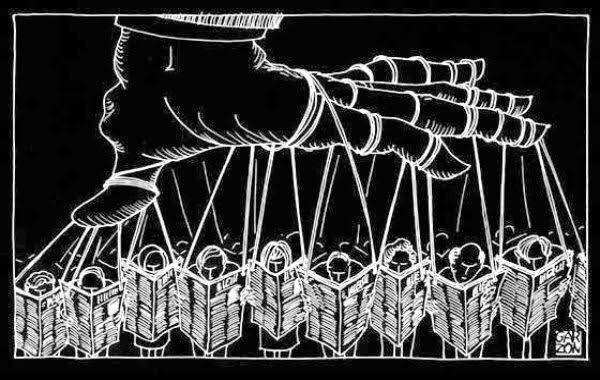
The failure of liberal democracies in recent decades to address people’s problems was evident in the recent election results in many countries. There is widespread discontent among people with their governments' misplaced priorities as they struggle to make ends meet, pay bills, obtain quality education for their children, access affordable healthcare and housing, and live in safe communities. This created an opportunity for fringe politicians and even non-politicians to enter the political arena with election platforms that resonated with people’s needs. They promised to govern in an authoritarian style, disrupting the status quo and turning the establishment around for the benefit of the people. This led to the emergence of several authoritarian governments, whether elected or not.
There have always been a few authoritarian regimes in the world run by dictators who ruled with an iron fist, crushing any opposition to their authority with a heavy hand. These dictators of the past tended to be tinpot military generals or leaders of some revolutionary or resistance movement, acting alone or with a small group of close-knit, like-minded associates. Often, they lacked specific skills to govern a state and typically led their countries to economic ruin.
The infamous authoritarian regimes of the past, whose rule was marked by immense human misery and devastation, include Hitler’s Nazi Germany, Stalin’s Soviet Union, Mussolini's fascist Italy, Imperial Japan of pre-1945, Franco’s Spain, and Pinochet’s Chile. Their rule of death, destruction, and ravages of war is now on historical record.
Today’s dictators, however, are much more sophisticated. They are often billionaires or are surrounded by billionaire friends and rarely act alone. They oversee state-owned or state-controlled mega businesses that are very successful, providing them with a steady cash flow to fund their activities. Typically, they adopt an autocratic model of governance, which enables them to suppress any opposition, allowing them to rule with a free hand.
In her book Autocracy Inc., American historian and journalist Anne Applebaum examines how autocracies acquire power and what they do with it. Although they have not formed a formal alliance, as there is no common ideology among them, they have created a network and cooperate in maintaining their control and suppressing any opposition to their authority. Applebaum argues that one of their main goals seems to be discrediting the democratic system of government as a failed experience.
Today’s autocrats can be classified into three broad categories. First, the traditional ones such as military dictators, revolutionary groups, and absolute monarchies, did not go through even a sham electoral process. Examples include the military junta of Myanmar, the Taliban government of Afghanistan, the Kim family dynasty of North Korea, the House of Saud of Saudi Arabia, and the recently ended rule of the Assad family dynasty in Syria.
Unless democracies seriously address the needs of their people and develop and implement plans to address them, we may see more countries sliding into autocratic rule
The second category of authoritarian rulers is those who managed to seize power through sham, rigged, or one-party elections with rules skewed in their favour. Russia, China, Venezuela, Belarus, Cuba, Iran, and Pakistan would fall into this category (more on Pakistan later).
Finally, the third category of authoritarian rulers includes those who were democratically elected but subsequently set aside democratic norms in their governance. Notable examples include Donald Trump’s first and now second term as US president, Hungary’s Prime Minister Viktor Orban, and Turkey’s Recep Tayyip Erdoğan.
The most repressive authoritarian governments are characterised by centralised control of security forces, strict control of political expressions, suppression of dissent, surveillance, tight control of media, dissemination of misinformation and disinformation, assassinations, disappearance of dissidents, human rights abuses, and no accountability to the populace.
A deeper look at the state of democracy in a few notable countries would be worthwhile.
The Islamic Republic of Pakistan, which is neither truly Islamic nor genuinely a republic anymore, has been ruled directly or indirectly by the powerful military establishment for over four decades. Although there have been nominal elections, the establishment has played a pivotal role in determining the outcomes and deciding which political party would form the facade of a civilian government while the Generals maintained their control over key state institutions from behind the scenes. The most recent elections, held in February 2024, were, by all accounts, heavily rigged before, during, and after the polls. International observers have uniformly declared them rigged; however, the military granted its blessings to the resulting government.
The authoritarian government has been abusing its powers without any checks from the judiciary or media. Political opponents have been thrown in jail on trumped-up charges, and people mysteriously disappear from their homes, sometimes reappearing after several days without any explanation. Government threats have muzzled the media, and most judges are now under the government’s thumb. According to the Democracy Index published by the Economist Intelligence Unit, Pakistan slid another six spots in the ranking in 2024. With an overall score of 2.84, Pakistan was ranked 124 out of 165 countries studied in the global ranking, categorising it as an authoritarian regime.
The United States, which for decades has stood as a beacon of freedom and democracy, has begun sliding toward autocracy. In his second term, which started in January 2025, President Donald Trump has surrounded himself with a group of billionaire oligarchs. At least a dozen of these oligarchs hold formal, high-profile roles in his administration. Scores of others outside his administration have easy access to and influence on the President. These oligarchs intertwine business and politics similarly to what was observed in Russia after the fall of the Soviet Union. Oligarchy is not just about wealth; it involves blurring the line between business and government and exerting significant influence on government policies.
Less than 100 days in his second term, Trump has already taken authoritarian actions in several areas such as, deporting illegal immigrants without any due process, revoking visas of international students and deporting them if they participated in protests against the Gaza war in college campuses, threatening to take over Greenland and control of Panama Canal by force, threatening its close ally and neighbor to the north Canada to annex it as the 51st state of the US by applying economic squeeze on it, and ignoring trade agreements it signed with other nations and imposing arbitrary tariffs on their exports to the US.
Ironically, while Trump has berated all US allies, including Canada, the UK, EU, Japan, Korea, and Australia, as cheating and ripping off the US for years, he took no action against Russia. In fact, he has praised Russian President Vladimir Putin as a ‘genius’ and ‘smart’ leader. Of note, the International Criminal Court has issued an arrest warrant for Putin for his war crimes in Ukraine.
The US Congress seems to have abdicated its role of check and balance as Republican members who hold the majority in both houses fear Trump's wrath if they go against his wishes as this could jeopardise their chances of winning the next election. This gives Trump a free hand to aggressively pursue his agenda with an iron hand over the next three-and-half years and transform the US government into an autocratic regime.
Unless democracies seriously address the needs of their people and develop and implement plans to address them, we may see more countries sliding into autocratic rule.