

There has been a trend in some educated circles to downplay the lasting effects of colonialism. They say not all colonists were brutal and cruel, and that they also did some good things. And since much time has passed since the independence of previously colonised people (eg India), it is time to move on and leave the past in the past.
If we take individual examples of the benevolence of colonial masters, that would be misleading. A snapshot in just a snapshot. It belies the whole truth. Missing in the snapshots are images of lasting effects of colonial rule on natives.
Culture and culture-based traditions are the bedrock of peoples. These are passed down through generations and it gives them a sense of belonging. It also instils in them a collective pride.
When colonists sailed from their shores to distant lands, their main purpose was to make money. There were colonists – the British among them – who considered it a divine mission to civilise the natives. At least that is what they claimed. In an act of extreme hubris, they considered themselves superior to the locals and thus made it their mission to impose their culture, language, and ethos on the natives. But all that was secondary to making money using local resources and cheap labour.
It is surprising that using the tactics of divide and rule, the British were able to control and rule the Indian Subcontinent that is thirteen times bigger than Great Britain.
We natives were not allowed to enter Peshawar Club except as servants. Natives were not allowed to purchase land in the cantonment to build residences. They were also not allowed to purchase anything in the high-end shops that lined Saddar Road
As schoolboys, we had often heard the Brits were in India to help the natives get educated and that they were doing so at a great financial loss to themselves. Somehow this narrative was common among those Indians who were educated and worked for the British India Government. This naïve narrative resonated with masses who toiled hard to make the British rule a success. Hidden behind the pomp and pageantry of the Raj was the fact that the British systematically looted India and enriched Great Britain.
Many decades after the independence of India, scholars paid attention and analysed the economic situation of India before the Raj and after independence. According to economist Utsa Patnaik, drawing on nearly 200 years of detailed data on trade and tax, she concluded that Britain siphoned off about $45 trillion from India between 1765 and 1938.
This is how the scheme to defraud India worked. The East India Company ruled India for a century before handing over the colony to British government. During its rule, the East India Company collected taxes in India and used a third of the collected money to fund the purchase of Indian goods for British use. British traders did not pay anything to acquire those goods.
Was the colonial mindset that the Brits exhibited in India peculiar to them or was it a universal phenomenon?
Edward Said (1935-2003) was professor of Literature at Columbia University and according to Time magazine, a leading philosopher of the 20th century. He was a Christian Palestinian born in Jerusalem. His 1987 monumental work Orientalism puts colonialism in perspective by arguing that Western scholars, writers, and thinkers constructed, deliberately, a particular vision of the Orient portraying it as inferior, exotic, and uncivilised compared to the “rational and superior” West.
It was that peculiar mindset that guided the colonists throughout the Middle East, Far East and elsewhere. And when they left, their subjects were poorer and oblivious to their own history and rich culture. They also left them with a robust sense of inferiority complex.
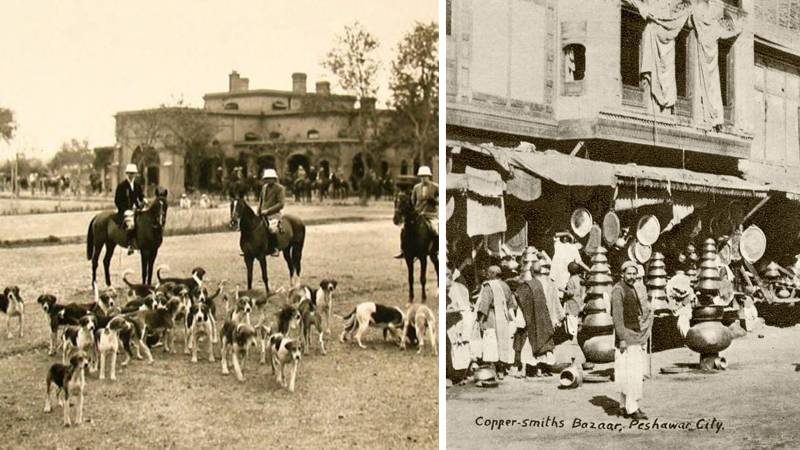
I experienced firsthand the effects of colonial rule while growing up in Peshawar. Peshawar Cantonment was built in early 1900s as a garrison town. It was hemmed in by a high barbed wire fence and gates. It was a white conclave with spacious bungalows, leafy boulevards, a governors’ mansion, cinemas, Garrison Club and churches. Native servants were obliged to leave the cantonment at sundown to go to their nearby villages or to the old city six miles away.
We natives were not allowed to enter Peshawar Club except as servants. Natives were not allowed to purchase land in the cantonment to build residences. They were also not allowed to purchase anything in the high-end shops that lined the main thoroughfare called Saddar Road. Most of the shopkeepers were Brits with a handful of desis running a few shops.
The servants and their dependents shopped in desi bazaars that all over India, which, by some quirk, were called Urdu Bazaars. In due course, colonies were constructed for native servants. Since most of them were domestic servants and they wore red uniforms, these colonies came to be known as Lall Kurti or (the residences of) red shirt (servants).
The British encouraged western education in India. With the passage of time, we were more familiar with British and European history than the history of our own people. Slowly and methodically the Brits encouraged natives to wear Western attire instead of their own traditional clothes. It was also the desire on the part of the educated natives to emulate the masters.
The British left in 1947 but left behind a caste system based on wealth and education. In 1971, when I eagerly returned to Pakistan to serve there as a cardiovascular surgeon, I found the country was still shackled with British rules and regulations. I was refused service in Peshawar Club because I was not dressed in Western attire. At Lady Reading Hospital, I was reprimanded by the hospital superintendent for wearing native clothes on hospital rounds.
It takes a long time to wash away the false coat of so-called sophistication from one’s persona.
It is paradoxical that in the early stages of the East India Company, many Englishmen adopted local customs. William Dalrymple, in his 2002 superb book White Mughals: Love and Betrayal in Eighteenth-Century India, sheds light on an obscure history of India where mutual respect and acceptance of the British and Indians was not an unusual occurrence. Such intermingling, adoption of Indian culture, and religious tolerance by the Brits came to a screeching halt when – after the Mutiny in 1857 – the East India Company gifted India to Queen Victoria. From that point on, the distinction between the rulers and the ruled became sharp and distinct.
It takes courage, persistence, and tenacity to stand against the tide of Westernisation and champion one’s cultural traditions. In Pakistan the pendulum has swung in the right direction. Now it is commonplace to see officials in native clothes. While Western attire is still common amongst the educated, it does not dominate the landscape. And that is the way it should be.
In closing, I am reminded of the story of a free-spirited Englishman who was found roaming the hills of the tribal areas. He was brought to the village chief, an elderly man, wiser than his years, who asked the man what he was doing in those mountains. The man replied that he was on a mission to discover lost people. To that the elderly chief looked heavenward and said, “Praise be to God, I did not know we were lost.”