

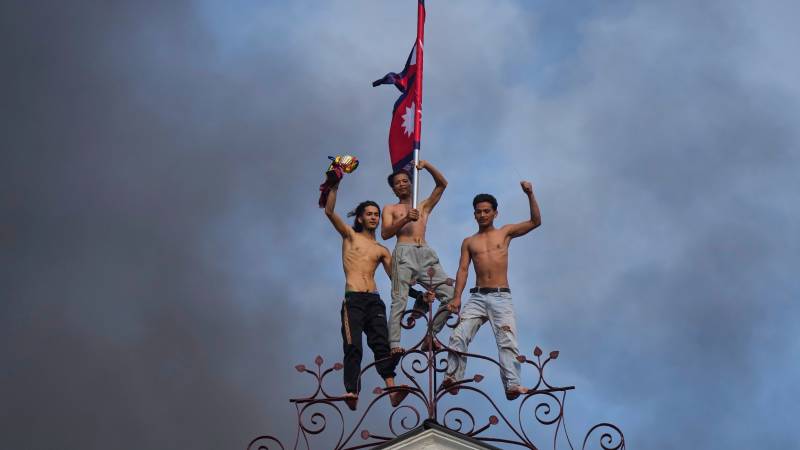
Young Nepalis have exploded onto the streets of Kathmandu and other cities in a wave of protest that marks Nepal’s most violent unrest in decades. What began on 8 September 2025 as a reaction to a sudden ban on Facebook, WhatsApp, Instagram, and dozens of other platforms quickly turned into a full-scale “Gen Z” uprising against the ruling elite. Thousands of young demonstrators – many in school and college uniforms – breached barricades around parliament, set fire to Singha Durbar (the government secretariat) and ransacked the homes of top officials.
The security forces responded with overwhelming force: police used tear gas, water cannons, and even live rounds against the crowds. By the night’s end, at least 19 protesters lay dead (17 in Kathmandu, 2 in Itahari), and well over a hundred more were wounded. Hospitals ran out of beds, and curfews were imposed as the capital smouldered under billowing black smoke. Within a day, Prime Minister K.P. Sharma Oli resigned under pressure, and the government hastily lifted its social media ban – but the uprising has not died down, exposing far deeper fractures in Nepali society.
The immediate spark for the unrest was the government’s announcement on 4 September that all major platforms must formally register under new regulations or be blocked. This edict deactivated about two dozen apps, including Facebook, WhatsApp, X, YouTube, and Instagram. To many Nepalis, especially the young, the ban felt like blanket censorship. “Stop corruption, not social media” became the ubiquitous slogan of the crowds.
In their hands, the banned platforms had become tools of accountability: platforms like TikTok and Reddit were awash with posts exposing the lavish lifestyles of ministers’ children, nicknamed “nepo kids”, and mocking official impunity. The government presented the shutdown as a necessary crackdown on fake news and hate speech, but to the protesters, it looked like a cynical ploy to silence dissenting youth.
Behind the rhetoric of “digital regulation”, the protests were against Nepal’s internalised corruption and privilege. On social media, in recent months and years, people have seen photos of leaders’ children travelling abroad, shopping at brands like Gucci, and showing off costly gadgets, while ordinary families struggled. Generations-old corruption scandals only added fuel. In 2025 alone, for example, a federal minister resigned over a bribery scandal, another former prime minister faced fraud charges, and reporters uncovered graft in airport construction and gold smuggling rings. But very few were punished. Because of this, the protests became a way for people to release their anger that had built up for years.
Social media was the only public place where young Nepalis could make a mockery of their leaders and share anti-graft ideas
The authorities met this surge of youth activism with force. Human Rights Watch reported that police “opened fire on crowds largely consisting of young people and children.” Hospitals quickly filled with victims. Within 24 hours, the home minister quit in disgrace, and the prime minister offered a perfunctory apology – even as authorities blamed “infiltrators” for the violence. But curfews and army checkpoints could not douse the unrest. By the second day, crowds were again in the streets, torching the Nepali Congress party office and even attempting to storm the presidential palace.
These eruptions are not due to the apps, but rather have occurred as a result of the overall, deep-rooted political crisis within Nepal. A generation is growing up with higher education but few opportunities, and watching the elite’s children glide into cushy careers by connection and bribe. In this situation, the online “nepo kid” exposés became a strong symbol. Social media was the only public place where young Nepalis could make a mockery of their leaders and share anti-graft ideas. When it was cut, many felt their only way for accountability was strangled. Protesters then asked not only to roll back the ban but also for significant political reforms like an anti-corruption body, removal of key leaders, and a government accountable to the people.
Nepal’s uprising is part of a broader South Asian wave of youthful discontent. Just three years ago, Sri Lankan protesters – many of them young people – stormed government buildings in 2022’s “Aragalaya”, chanting “Gota Go Home!” and ultimately forcing President Gotabaya Rajapaksa to resign. Sri Lanka, like Nepal, briefly imposed social media restrictions during that unrest, only to lift them as the crisis deepened.
And Pakistan – another South Asian nation with an enormous under-30 population – has likewise experienced Gen Z-driven ferment. Over 31% of Pakistani youth are unemployed, and social media have fueled activism from climate marches to job-rights campaigns. Analysts note that Pakistan’s young generation – educated and digitally connected – has grown cynical about a politics of endless regime change and corruption. Digital hashtags and online platforms have become the organising tools for a generation that otherwise feels shut out of power. In all these countries, the grievances overlap: joblessness, inequality, corruption and a sense that an older political class delivers for itself while neglecting common people.
In Kathmandu now, a historic rupture seems to have opened. The Asia-Pacific Foundation of Canada observes that Nepal’s Gen Z protests “reflect longstanding frustration over corruption, economic hardship, and youth alienation from the entrenched political elite” – and that these are “the most serious unrest since Nepal’s 2006 pro-democracy movement”. After weeks of intense pressure, Prime Minister Oli has stepped down – but the streets have made clear that merely changing names will not suffice.
The protests have already forced the lifting of the social media ban and the promise of investigations. But for the young Nepalis pouring into Kathmandu’s avenues, those are only the opening moves. The real demand is accountability and opportunity: to reclaim the future their leaders have mortgaged. In their chants and hashtags – with phones and placards raised aloft – Gen Z is sending a message to the entire South Asian elite: the new generation will no longer be silenced or sidelined. Only time will tell if the country’s political class can heed that warning or if Nepal must grapple with yet more turmoil.