

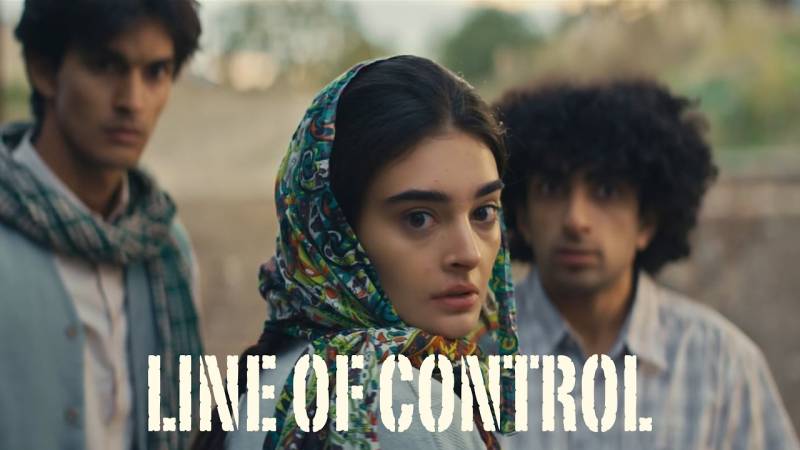
I watched Line of Control in the din of a Manhattan afternoon. The film belongs to another world: mist, barbed wire, mountain air, and the uneasy calm of a place watched too long by soldiers and ghosts. Written and directed by Travis Hodgkins, and based on The Collaborator (Penguin, 2011) by my friend Mirza Waheed, the film carries Kashmir carefully and without spectacle.
To adapt Kashmir for the screen is already risky. To adapt The Collaborator—a book shaped by memory, shame, complicity, and survival—seems almost impossible. Yet that difficulty gives the film its strength. In frame after frame, one senses people trying to hold together something that keeps breaking apart.
After watching the film, I wrote to producer Rashaana Shah to ask about its making. She replied that things kept collapsing during production. Locations fell through. Budgets shrank. The crew kept searching for faces and landscapes. They moved between the Gurez Valley near the Line of Control and locations in Tbilisi, Georgia, searching for places that could stand in for Kashmir. Once I read her note, I understood the film differently. What first felt overly controlled began to feel like an attempt to keep something from vanishing.
The film finds its rhythm early. In the recruitment scene, Captain Kadian draws the young collaborator into his orbit without raising his voice. The scene works because it avoids drama. Coercion arrives quietly, through conversation and narrowing choices. The film understands something essential about Kashmir: the most dangerous weapon is often not the gun, but the shrinking of alternatives.
Rudi Dharmalingam gives Captain Kadian intelligence and restraint. Another actor might have turned him into a stereotype. Instead, he plays him as a man educated enough to understand what he is doing and damaged enough to continue doing it. A portrait of Mahatma Gandhi hangs in his quarters. The irony is obvious. Nonviolence watches silently over violence. The captain mocks “lit—ray—ture” with careful pronunciation, as though literature were decorative rather than moral. He treats culture as performance before returning to control.
What remains after the film ends is not resolution, but atmosphere: lives suspended between memory and erasure
The film moves slowly. At first, I resisted this. I wanted interruption and the sudden way violence enters ordinary life. But slowly, the pacing began to make sense. The film refuses to turn suffering into entertainment. Most war films rush through devastation and convert pain into momentum. Line of Control waits. It asks viewers to stay inside discomfort.
The landscape matters deeply here. Yellow forsythia blooms against hillsides while bodies lie in the fields below. Spring arrives without caring about history. The mountains remain indifferent.
The film also carries echoes of older tragedies. After a bus bomb blast, a soldier carries the body of Asma—played with restraint by Anastasia Jairath—in a way that recalls Lear carrying Cordelia. Grief escapes politics and becomes human again. Later, a skull lifted in the field recalls Hamlet and Yorick. These literary echoes could have felt heavy-handed, but the film uses them lightly, as though literature itself has wandered into the valley.
One scene troubled me deeply: the collaborator gathering wood to cremate a Muslim fighter. In Kashmir, families return the dead to the earth quietly, wrapped in prayer and soil. Fire feels wrong there, almost like a second erasure. And this is in a place where people still speak of unnamed graves and bodies buried without witness. People in Kashmir do not forget their dead.
Politics enters the film in fragments. “Go Back” appears half-erased on walls, carrying within it the fuller slogan still heard across the valley: “Go Back India Go Back.” Fear fractures speech.
Then, amid all this, a transistor plays “Main ye sochkar uske dar se utha tha,” with lyrics by Kaifi Azmi. The moment changes the film. The song does not feel inserted. It feels remembered. For a moment, the valley speaks in its own voice.
What remains after the film ends is not resolution, but atmosphere: lives suspended between memory and erasure. One finally understands that certain films about Kashmir choose witness over certainty, even under pressure from politics, money, distance, and fear.
Perhaps that is why the film’s 117 minutes linger beyond their runtime.
Not because Line of Control explains Kashmir.
But because, for a brief time, it allows the valley to breathe beside us again.
The film is currently available to stream on Apple TV and YouTube Movies, with both Hindi-dubbed and English original versions.