

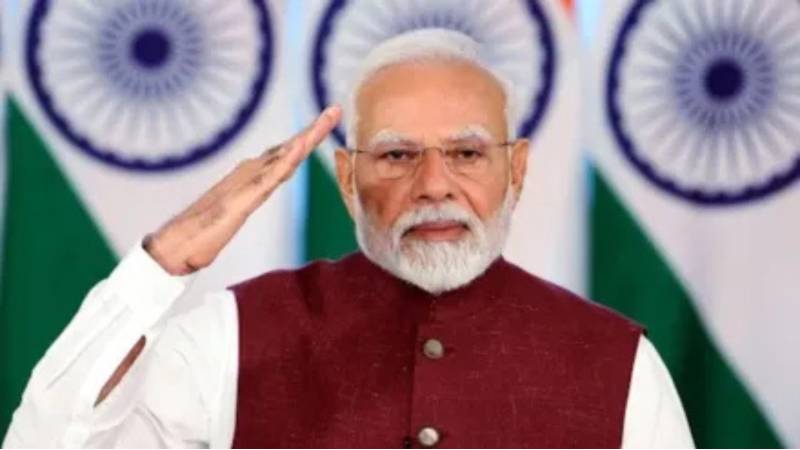
Narendra Modi’s televised speech on the evening of 12 May began with a blatant lie — that Pakistan had pleaded for a ceasefire. The absurdity of this claim is evident in the CNN report. Not only that, but President Trump had something entirely different to say: “we have got to do a lot of trade with you guys, let’s stop it, let’s stop it. If you don’t stop, we’ll have no trade!”
In the same breath Modi went on to add that Operation Sindoor marks a new normal in India’s response to acts of terrorism. Pakistan and terrorism, he declared, cannot be de-hyphenated. Any future dialogue with Pakistan will centre solely on terrorism and the issue of Pakistan-occupied Kashmir. India, he asserted, will not succumb to nuclear blackmail. India will remain vigilant, closely monitoring Pakistan’s actions and responding if necessary. According to Modi, the headquarters of terrorism within Pakistan have been destroyed through surgical strikes, showcasing the prowess of domestically manufactured weaponry.
He concluded with the ominous remark: “blood and water cannot flow together”.
Much of Modi’s speech rehashed familiar rhetoric, primarily revolving around the theme of terrorism — a narrative India has employed for over two decades to marginalise Pakistan on the international stage, tarnish its image as a sovereign state, and deflect from its own covert sponsorship of terrorism within Pakistan via groups such as the BLA and TTP. This long-standing strategy seeks to destabilise Pakistan’s internal security, weaken investor confidence, and deter foreign capital.
Modi’s speech has two notable points: one quite amusing, the other deeply dangerous.
Take a look at the amusing part first — the boast about the supposed superiority of Indian weaponry!
Modi appears to have no viable option for direct military action to appease his far-right support base. His political career and premiership now hang in the balance
Which weapons, precisely? The Tejas jets, which have scarcely flown beyond test trials — a project plagued by delays and widely considered a failure since its launch in 1984? Or perhaps the BrahMos missiles, many of which were intercepted by Pakistan’s air defence systems. A few did strike, but even those failed to hit intended targets such as the Noor Khan Airbase — with one missile landing on a road outside the compound. Moreover, the missile stock depot was destroyed the following morning by Pakistan’s Fatah-1 missiles in the Beas area in India. While highlighting the lethality of Indian drones, Modi completely ignored the widely circulated videos showing Pakistani lads carrying them on motorbikes.
In boasting about indigenous weaponry, Modi was perhaps attempting to deflect attention from the loss of three much-vaunted French Rafale jets — an incident widely attributed by the international community to the poor training of Indian pilots.
Mr Modi, don’t you know why Rafale’s stock value plummeted?
Modi’s deeper problem appears to be his refusal to listen to sound military counsel. He dismissed the Vice Chief of the Indian Air Force after the latter warned that pilots were ill-prepared to handle the Rafales. He similarly ignored the concerns of Air Chief Marshal Amar Preet Singh, who had raised alarms over the delayed delivery of the Tejas jets and flagged a shortfall of at least 14 IAF squadrons. Rumours suggest that senior officers physically assaulted Air Chief Singh following the loss of five jets — accusing him of being prejudiced against India due to his Sikh identity. The dynamics surrounding Punjabi Sikhs are a broader issue that maybe discussed another time. Still, this troubling sequence of events may explain the desperation behind Modi’s farcical posturing before a national and international audience.
The truly alarming component of Modi’s address was his reiteration that “blood and water cannot flow together” — a clear reference to India’s suspension of the Indus Waters Treaty (IWT) following the Pahalgam incident on 22 April. With this statement, Modi effectively signalled his intention to continue reducing the flow of the Jhelum and Chenab rivers through dams illegally constructed in violation of the IWT, or to release water during peak flooding periods without warning — actions that endanger civilian lives, property, and crops on the Pakistani side.
This is very dangerous.
Pakistan has made its position unequivocally clear: any attempt to weaponise water will be treated as an act of war. Such a provocation would invite a strong and immediate response. Even Victor Gao — widely known as an unofficial spokesman for Beijing — stated categorically in an interview with CGTN America that India’s violation of the IWT would be considered a crime against humanity. A clear provocation.
It constitutes water terrorism.
And yet, Modi appears determined to pursue this path of coercion against Pakistan — a recklessly provocative course of action. The danger is heightened by the current reality: the Indian Air Force has been effectively grounded after Pakistan demonstrated its ability to paralyse Indian air defences through cyber-attacks and shoot down five of India’s top fighter jets. Reports suggest the Indian military is not fully prepared for an all-out war. There are also credible accounts of Sikh regiments refusing to fight what they see as an illegitimate war driven by the Hindutva ideology of Modi’s extremist RSS-BJP government. One report suggests that twelve-thousand Sikh soldiers applied for leave in the wake of recent escalations. The Indian government termed it as a “mere coincidence”.
Thus, Modi appears to have no viable option for direct military action to appease his far-right support base. His political career and premiership now hang in the balance.
So, what options remain?
As I argued in detail in my previous column, Modi may resort to some reckless action, including the possibility of initiating a nuclear strike against Pakistan, now that the myth of Indian superiority in conventional warfare has been shattered. If he stops short of such extremity, he is likely to continue waging a two-pronged campaign: using water as a weapon to inflict pain on Pakistan, and intensifying acts of terrorism within the country, particularly in Balochistan, where India already maintains active assets in the form of BLA and TTP operatives.
The question, then, is this: how many wounds will Pakistan be expected to endure before it responds with a major military operation against India? There is, inevitably, a red line — a point of exhaustion. When that threshold is reached remains to be seen. In the meantime, diplomatic efforts, talks, and narrative warfare will continue to engage audiences both domestic and global.
One thing, however, is certain: Kashmir cannot remain unresolved forever.