

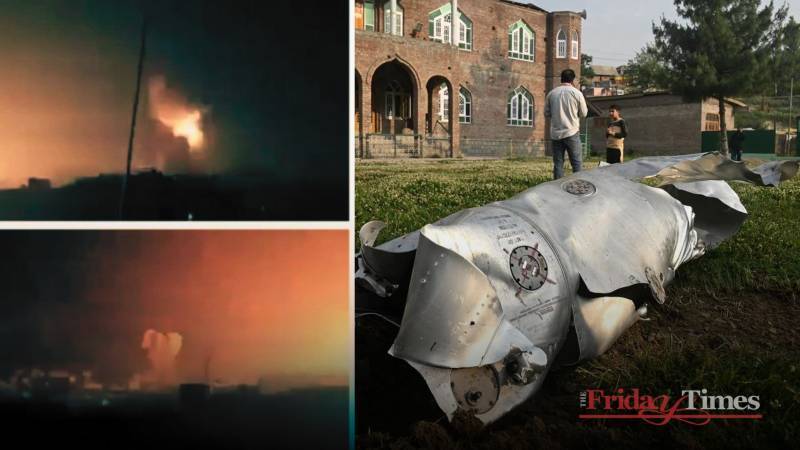
The three days of highly intense and offensive conflict between Pakistan and India finally concluded by the US President Donald Trump’s announcement of a ceasefire on his Truth Social Platform on Saturday, “After a long night of talks mediated by the United States, I am pleased to announce that India and Pakistan have agreed to a full and immediate cease-fire.” Later, both Indian and Pakistani authorities have also confirmed. The confrontation brewed after the tragic incident of Pahalgam, causing the brutal killing of 26 Indian and foreign tourists on April 22. Without any concrete evidence, the Indian government accused Pakistan of plotting anti-Indian activities and sponsoring terrorist organisations. A malicious campaign against Pakistan has been promulgated in the media to legitimize war and aggression, followed by the beginning of India’s military operation ‘Sindoor’ on May 7.
The midnight on May 7, India attacked various cities of Pakistan: Kotli, Muzaffarabad, and Bahawalpur. Indian media deemed it a major success, claiming that dozens of terrorists and their leaders who were involved in the Pahalgam assault have been exterminated. The story hasn’t ended here. India continued its aggression on May 8 and 9, blitzing missiles, targeting various sensitive sites of Pakistan, including Noor Khan Airbase, Rawalpindi, Murid airbase, Chakwal, and the Rafiqui airbase in Shorkot.
Director General, Inter-Services Public Relations (DGISPR), Lieutenant General Ahmed Sharif Chaudhry, in his press briefing, urged that Pakistan’s response to “Indian aggression” would come at a “time, method, and place of our choosing”. May 10 was the day. The whole world witnessed the audacity and skills of the Pakistan Air Force: they infiltrated Indian airspace, struck their targets, and returned safely. The calm and defensive reaction of Pakistan throughout the conflict, except the last offense, manifests that Pakistan has followed the principles of Sun Tzu: “He will win who knows when to fight and when not to fight”. It is important to break down the basic tenets of Pakistan’s war strategy, which made the Pakistan Air Force the undisputed king of the skies of South Asia.
While India initiated hostilities with full confidence in its military superiority, it was Pakistan that dictated the tempo and direction of the conflict
The Indian drones were lingering in the main cities of Pakistan like migrating Siberian birds. Lahore, Karachi, Islamabad, Rawalpindi, and other main cities have become a hunting ground for Indian drones. Everyone was amazed and criticising the armed forces and the air defense system: how had they failed to intercept and shoot down them at the borders? It was a deliberate move, nonetheless. Pakistan did not want to expose its radar system at the initial stage to keep India blind, which worked later, profoundly. According to Pakistani sources, six Indian crafts, including two French-made Rafales, have been downed by Pakistan in the recent skirmishes because of their reckless movement and miscalculations near the Line of Control (LOC). India neither agreed nor denied this claim.
By allowing drones to fly close to the ground, Pakistan minimised the need to deploy high-grade weapons. Instead, smaller arms were employed to neutralise drones in less critical areas, signaling control without escalation. This strategic calm confused India. The lack of an immediate, large-scale Pakistani response emboldened Indian forces, pushing them toward overconfidence and operational exhaustion. For three days, India conducted aggressive operations, only to be met with silence from Pakistan until May 10.
Amidst the chaos, the Pakistani government and its Military media wing kept the whole world informed about Indian aggression through national and international media. They always came with a bundle of audio and video proofs, highlighting how India is violating international laws and customs by attacking the mainland of another state. Similarly, it also reaffirmed, Pakistan carries a right to defence and can take any offensive measure to protect its sovereignty. This approach not only gave legitimacy to Pakistan’s actions but also created a sense of fear in the international community that the tension between the two nuclear powers is worsening day by day, and must be resolved earnestly, to ensure global appeasement.
Lastly, the element of surprise in “Operation Bunyan Marsoos,” which was conducted on May 10, soon after the Indian attack on three Pakistani air bases. Considering the experiences of the last few days, the Indian forces were not expecting a counter attack, however, Pakistan responded with full throttle, ambushed various military locations and air fields including: Udhampur airbase, Pathankot airbase, Drangyari artillery gun position, Uri field support depot, Nagrota, Beas, Adampur air base and Bhuj air base. Precisely, “They came, They saw, They conquered.” According to Pakistan, the strikes were so colossal, costing India a heavy loss. On the contrary, while having a press briefing, Indian authorities rejected Pakistan’s report, claiming that some of the said sites have been “partially damaged.” It’s hard to quantify the level of, but one thing is quite evident: the loss is much more than partial damage.
In one of his conversations on an Indian news channel, John Mearsheimer, an eminent political philosopher, argued that Pakistan will retaliate to equate Indian actions by keeping the end in mind because the prolongation of war is not in their favor. Events have happened accordingly. Increasing diplomatic engagement from the US and other parts of the world for a cease-fire, Pakistan opted for the right time to respond: targeted maximum Indian sites with full potential without giving any opportunity to India to fight back because they were crystal cleared: de-escalation is on the hand. Don’t overlook the role of ISPR, through continuous media interaction, ISPR has convinced the urgency of a truce between Pakistan and India is inevitable for regional and global peace.
The close observation of the series of events befallen over the last few days between these two nations reveals that in terms of military strategy, Pakistan is way ahead of its opponent. Ironically, while India initiated hostilities with full confidence in its military superiority, it was Pakistan that dictated the tempo and direction of the conflict. As DGISPR rightly stated, "The war was started by India, but we will finish it." And indeed, the world witnessed that Pakistan not only defended its sovereignty but also maintained moral and strategic superiority throughout.