

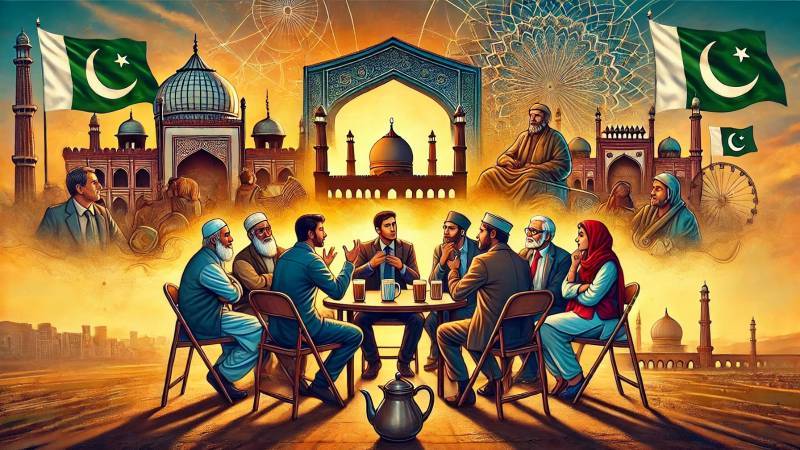
Guess a country where political polarisation, religious militancy, terrorist attacks and governance failures regularly make headlines—but where the social sciences barely feature in public discourse or policy formulation. Yes, you guessed correctly. This country is Pakistan. Here, the social sciences are not just marginalised and underfunded; they are often treated with disdain. This is not a trivial shortcoming. It has serious consequences for how we understand ourselves, our society and the crises we face.
Disciplines such as sociology, political science, anthropology, psychology, international relations, and history—fields that lie at the heart of understanding human behaviour, the evolution of institutions and the mechanics of power—remain tragically undervalued. In Pakistan, they are treated as academic leftovers, fallback options for students who fail to secure admission into medicine, engineering, or business schools. Often referred to dismissively as “soft” subjects, they are perceived to lack both utility and prestige. This cultural and economic prejudice is echoed in the choices of parents who routinely steer their children towards STEM fields, convinced these offer a safer, more lucrative path. In doing so, they are not entirely wrong—because the perception, grim as it may be, is backed by data.
Young graduates who enter the job market with degrees in sociology, political science, or anthropology often find themselves unemployed or underemployed, with few clear pathways into stable careers. The private sector has no real appetite for their expertise, and the public institutions that might hire them are either too few or underfunded. In this vacuum, students no longer see the social sciences as a viable path towards a respectable career. Talented young minds that might have transformed these disciplines instead flee them, drawn instead to more “practical” disciplines with better financial returns.
Social scientists must be seen not as armchair theorists, but as vital contributors to public understanding and national development
But the problem is not just societal. The state, too, has been complicit in this intellectual decline. Successive governments have poured money into professional and technical education, while doling out mere crumbs to the humanities and social sciences. Research funding is scant. Think tanks are anaemic. The state’s own policymaking apparatus displays no interest—none—for serious social science input. And this in a country racked by extremism, misogyny, corruption, weak institutions and a fraying social contract. These are the very issues social sciences are designed to study, explain and solve. But in the absence of a strong academic voice, these debates are left to TV anchors, self-styled gurus and social media hysterics.
Let us be clear: this is not just an academic issue. It is a national one. A country that produces engineers but not urban planners, IT graduates but not historians, coders but not sociologists, is a country that builds without thinking. To address this crisis, a serious national shift is needed.
What must be done?
First, the state must invest in the social sciences with the same seriousness it invests in technology and defence. Universities must be equipped with proper research funding, international collaboration opportunities, and faculty development programmes. Scholars must be incentivised to publish, to collaborate, and most of all, to take part in national conversations.
Second, there must be a complete overhaul of social science curricula. Students should be taught not just the theories of Marx, Weber and Foucault—but also how to apply these frameworks to Pakistan’s own history, conflicts and institutions. Fieldwork must be central. Research methods must be modernised. Plagiarism must be penalised with real consequences. Critical thinking and writing should be foundational skills, not optional ones.
Third, the university departments themselves must be depoliticised. For too long, student groups and ideological factions have stifled academic freedom. Faculty appointments must be made on merit—not on party loyalty, personal favour or provincial quotas. International peer review should be the standard for both hiring and promotion. Only by restoring professionalism can the social sciences reclaim their lost relevance.
Fourth, academia must stop speaking only to itself. Universities must build bridges—to civil society, to government ministries, to policy think tanks and media outlets. Social scientists must be seen not as armchair theorists, but as vital contributors to public understanding and national development. Their input should shape conversations on education, justice, gender, urban policy, constitutional reform. These are not side issues. They are the heart of our national predicament.
Finally, the culture must change. Families, teachers, employers, the media—all must stop treating the social sciences as inferior disciplines. Intellectual life must be rescued from the margins and brought to the centre. It must be celebrated, not derided. This country’s greatest minds—its poets, thinkers, historians—did not emerge from laboratories. They came from classrooms where wisdom and humanity mattered.
The choice before us is stark: revive the social sciences, or continue stumbling from one disaster to the next, never understanding the roots of our disorder. If Pakistan is to evolve into a plural, democratic and humane society, it must first learn to look at itself without flinching. No discipline holds up that mirror better than the social sciences. They are the tools we need to ask hard questions, to revisit buried histories, to rethink what kind of country we want to become.
We need fewer blind technocrats and more critical minds. The time to act was yesterday. But perhaps if we begin today, there is still time to reclaim the role of the social sciences in shaping a saner future for Pakistan. A future where reflection is valued as much as innovation, and where understanding society is seen as a prerequisite for transforming it.