

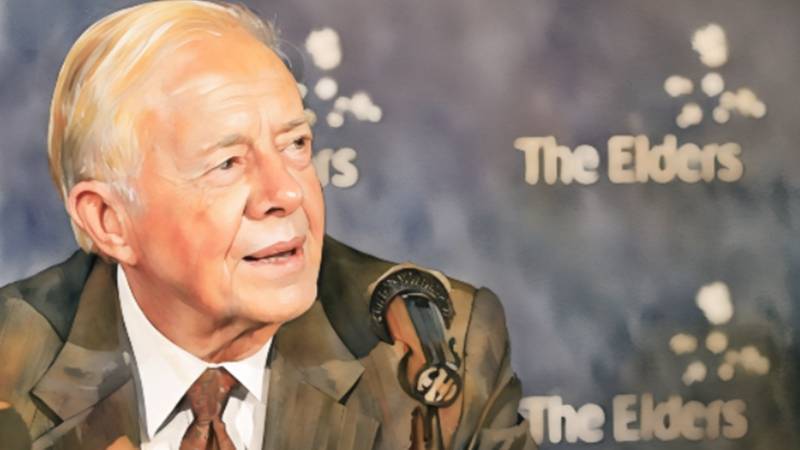
President Jimmy Carter the 39th President of the United States from 1977 to 1981died on 29th December 2024 at the age of 100. He was not lucky in politics and could manage to serve only one term as the president but has many political achievements to his credit. His biggest achievement or contribution to world peace and security was the peace accord between Egypt and Israel in the shape of the Camp David Accord in 1978. President Joe Biden and First Lady Jill Biden praised President Carter’s leadership, saying: “Today, America and the world lost an extraordinary leader, statesman, and humanitarian. With his compassion and moral clarity, he worked to eradicate disease, forge peace, advance civil rights and human rights, promote free and fair elections, house the homeless, and always advocate for the least among us. He saved, lifted, and changed the lives of people all across the globe.” Jimmy Carter was a passionate and dedicated believer in Human rights and firmly believed that American Foreign policy should be formulated around the basic principle of adhering to Human rights he believed that “Human rights is the soul of our foreign policy … because human rights is the soul of our sense of nationhood.”
Carter survived only one term in office but even this short stint had some notable achievements in the realm of foreign policy. The biggest feather in his cap was the 1978 Camp David peace accord signed by the Israeli Prime Minister Menachem Begin and the Egyptian President Anwar Sadat. This peace treaty resulted in the opening of the Suez Canal, and the return of the Sinai to Egypt captured by Israel in the 1967 war. This treaty established diplomatic relations between Israel, Egypt, and Jordan and brought immense economic benefits for Egypt. This exemplified Carter’s belief in the power of American diplomacy and why US presidents should courageously assume the difficult task of peace-making. In 2002 the Nobel Foundation recognised Carter’s role in promoting world peace and awarded him the Nobel Prize for Peace. The Nobel Committee said that while President George W. Bush was planning an invasion of Iraq: “Former President Jimmy Carter was awarded the Peace Prize for undertaking peace negotiations, campaigning for human rights, and working for social welfare.” The Nobel Committee acknowledged that the Prize to Carter was in recognition of his decades of untiring efforts to find peaceful solutions to international conflicts, to advance democracy and human rights, and to promote economic and social development. After retirement from public service, he established the Carter Center to pursue his personal diplomacy at a global level. After its establishment in 1982, this center has monitored about 110 general elections in 39 countries.
Jimmy Carter’s commitment to human rights never went away and his concept of a human-rights focused foreign policy has become permanently encoded in the global conversation
Jimmy Carter was a deeply religious person and a devoted practicing Christian who worked tirelessly all his life to promote democracy and human rights supported scientific work to eliminate disease and mediated wherever possible to prevent conflict and war. He was a prominent member of The Elders comprised of global leaders who worked passionately for peace, social justice, climate change, and human rights. During his years of active membership, Carter dedicated significant energy to the Israeli-Palestinian conflict, visiting the region on a number of occasions to support the Elders’ work. During the 1990s Carter was involved in mediating between the USA and several states branded as Rogue by the US govt, such as North Korea and Libya.
In 1994, Carter supported the US government’s diplomatic efforts to resolve an increasingly tense nuclear weapons situation with North Korean leader Kim Il Sung. Carter met with Kim in June 1994, becoming the first former US president to visit the country. The trip laid the groundwork for an eventual bilateral deal between North Korea and the US. The agreement saw North Korea pledge to freeze its plutonium weapons program, while the US agreed to offer aid. He remained active after retirement and continued to work even in his 90s. He was openly critical when Trump announced in May 2018 that he was withdrawing the US from the Iran nuclear agreement, which had been negotiated by the Obama administration in 2015. He called Trump’s move a “serious mistake”. Carter felt that an international agreement made by an American president needed to be binding on all their successors and that by walking away from the Iran deal the US was signaling a “message to North Korea that if the United States signs an agreement, it may or may not be honored.” Jimmy Carter’s commitment to human rights never went away and his concept of a human-rights focused foreign policy has become permanently encoded in the global conversation. The former president’s work brought him international acclaim and illustrated why the nation’s leaders should reject short-sighted calculations that risk the US being complicit in human rights violations. One of Carter’s major accomplishments since leaving office was his center’s work in health care, specifically the eradication of Guinea-worm disease. This is a parasitic infection caused by drinking contaminated water. The consequences of the illness, while not fatal, can incapacitate the sufferer and lead to permanent disability.
Carter sought closer relations with the People's Republic of China (PRC), continuing the Nixon administration's drastic policy of rapprochement. The two countries increasingly collaborated against the Soviet Union, and the Carter administration tacitly consented to the Chinese invasion of Vietnam. In December 1978, he announced the United States' intention to formally recognise and establish full diplomatic relations with the PRC starting on January 1, 1979, while severing ties with Taiwan, including revoking a mutual defense treaty with the latter. In 1979, Carter extended formal diplomatic recognition to the PRC for the first time. This decision led to a boom in trade between the United States and the PRC, which was pursuing economic reforms under the leadership of Deng Xiaoping. Carter supported the China-allied Khmer Rouge regime in Cambodia fighting the Soviet-backed Vietnamese invasion. While historians generally consider Carter a below-average president, his post-presidency activities have been universally praised, including his peacekeeping and humanitarian efforts.
The Independent wrote in 2009, "Carter is widely considered a better man than he was a president.”