

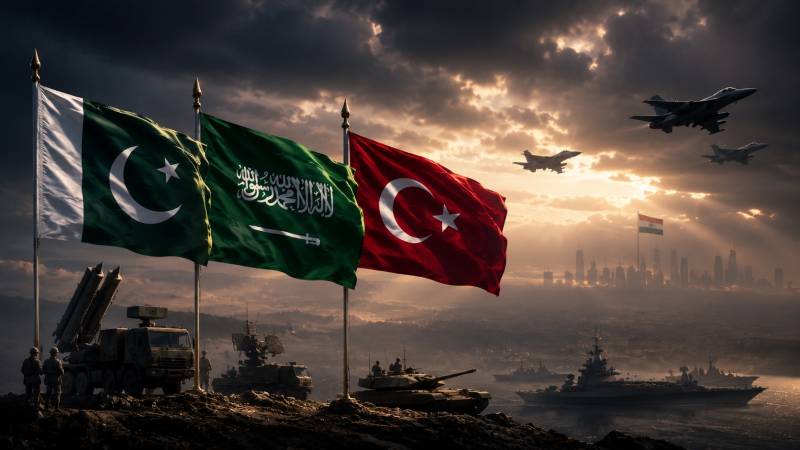
Pakistan celebrates its 79th Independence Day in circumstances few could have anticipated only a few years ago. A country widely associated with economic vulnerability, political instability, terrorism and diplomatic isolation has demonstrated credible military deterrence against India, regained diplomatic relevance, strengthened its major external partnerships and acquired a consequential role in the rapidly changing strategic order of West Asia. The timing gives this Independence Day particular significance. Pakistan enters its 80th year immediately after the Makkah Joint Defence Agreement with Saudi Arabia and Türkiye, extending the Saudi-Pakistan strategic defence relationship into a trilateral framework. Its collective-defence commitment and provisions for military coordination, joint exercises and defence-industrial cooperation place Pakistan within an emerging regional security architecture involving two of the most important states in the Muslim world.
The larger transformation is worth examining precisely because it did not occur in isolation. For decades, India sought to confine Pakistan internationally within the narrative of terrorism. Pakistan's own policies gave that narrative credibility. The consequences of General Zia-ul-Haq's Islamisation, the Afghan jihad and the subsequent proliferation of militancy eventually turned inward, costing tens of thousands of Pakistani lives and damaging the country's economy, social fabric and international reputation.
Pakistan has spent much of the past two decades trying to reverse that inheritance. Terrorism has certainly not disappeared, as continuing violence by the TTP and Baloch insurgents demonstrates. But the state that once tolerated or instrumentalised religious militancy now regards its violent manifestations as a fundamental threat to national security. The lesson has been extraordinarily costly: religious extremism may initially serve political or strategic purposes, but eventually threatens the society that allows it to flourish.
The consequences of General Zia-ul-Haq’s Islamisation eventually turned inward, costing tens of thousands of Pakistani lives and damaging the country’s economy, social fabric and international reputation.
This history makes the contemporary comparison with India particularly instructive. Pakistan began moving towards religious conservatism and extremism after 1979 and has spent decades struggling with the consequences. India, once internationally admired for secularism, pluralism and democratic accommodation, has moved increasingly towards Hindu majoritarianism under Narendra Modi and the BJP.
India remains a democracy, a major economy and a formidable military power. Ignoring those realities would reduce serious analysis to nationalism. But Hindutva has changed the political character of the Indian republic. The position of Muslims and other minorities, recurring communal tensions and the constitutional transformation of Jammu and Kashmir since August 2019 all illustrate how religious identity has moved closer to the centre of Indian statecraft.
Pakistan should draw precisely the opposite conclusion from India's trajectory. Having experienced the consequences of politicised religion itself, it has neither reason nor room to reproduce another form of majoritarian nationalism. Its strongest answer to Hindutva is a secure, tolerant and economically successful Muslim-majority state that protects minorities and remains faithful to Jinnah's inclusive conception of citizenship.
The reversal is equally striking in foreign affairs. India spent years attempting to isolate Pakistan, yet Islamabad today maintains its strategic partnership with China while enjoying exceptionally close relations with Saudi Arabia and Türkiye, rebuilding its importance in Washington, retaining communication with Iran and becoming increasingly involved in West Asian diplomacy.
The Iran conflict demonstrated the value of this diplomatic range. Pakistan remained engaged across competing camps and helped facilitate diplomacy that produced the Islamabad Memorandum of Understanding between Iran and the United States in June. Its ability to communicate simultaneously with Washington, Beijing, Riyadh, Ankara, Doha and Tehran reflects something Pakistan lacked for years: diplomatic space created by relationships that are not mutually exclusive.
The Makkah agreement takes this evolution considerably further. Pakistan is no longer simply supplying military expertise or maintaining bilateral defence relationships in the Gulf. It has become part of a formal trilateral security arrangement with Saudi Arabia and Türkiye at a time when the regional order is being reshaped by the Iran conflict, the weakening of Tehran's proxy network and continuing concern about Israeli military expansion.
India's international circumstances offer a useful contrast. Its economic rise remains substantial, but the assumption that economic size would translate automatically into expanding strategic influence has encountered limits. Relations with Bangladesh deteriorated after the political upheaval of 2024. Strategic competition with China remains entrenched, while India's relationship with Washington has become more transactional than the partnership envisaged during the previous three decades.
American tariff pressure over India's purchases of Russian oil demonstrated those limits. Washington imposed an additional 25 per cent tariff in 2025 and removed it in February 2026 after India committed to stop directly or indirectly importing Russian oil, while retaining the option of restoring the measure if those imports resumed.
For a country whose democratic reputation long constituted an important source of international influence, these developments carry consequences.
More damaging has been the controversy surrounding alleged Indian operations abroad. Canadian authorities publicly alleged links between agents of the Indian government and violent criminal activity in Canada, charges New Delhi rejected. In the United States, however, the case moved through the courts, with Nikhil Gupta pleading guilty in February to participating in a plot to assassinate a US citizen in New York at the alleged direction of an Indian government employee. For a country whose democratic reputation long constituted an important source of international influence, these developments carry consequences beyond the individual cases.
The May 2025 India-Pakistan conflict produced perhaps the most important change in Pakistan's national psychology. Whatever competing accounts persist about individual engagements, the broader outcome demonstrated that India's overwhelming advantages in population, economic size and defence expenditure had not eliminated Pakistan's ability to maintain credible conventional deterrence.
That mattered because the widening economic disparity between the two countries had encouraged assumptions that the military balance would eventually become untenable for Pakistan. The conflict challenged that proposition. Pakistan demonstrated that training, preparedness, technology, intelligence and integration of military capabilities can partially offset disparities in material power. The result was a restoration of national confidence that subsequent diplomatic developments reinforced.
There is also a deeper historical comparison as Pakistan enters its 80th year. Partition produced an extraordinary civilisational irony. Pakistan became custodian of the geographical heartland of the Indus Valley Civilisation. Mohenjodaro, Harappa, Ganeriwala and hundreds of associated sites lie in present-day Pakistan, while the Indus itself runs through the country to the Arabian Sea. Even the name India ultimately derives from the Indus.
This does not make the Indus civilisation exclusively Pakistani. Ancient civilisations belong to humanity. But Pakistan has been slow to appreciate the depth of its own territorial inheritance. Its history encompasses the Indus cities, Gandhara and Buddhism, successive Muslim eras and eventually the movement that created Pakistan. A confident nation has no need to erase any layer of that past.
Partition created an equally revealing irony for India. Many of the monuments through which modern India presents itself internationally are products of centuries of Muslim civilisation. The Taj Mahal remains its most recognisable monument, while India's prime minister addresses the nation every Independence Day from the Mughal Red Fort. The Muslim contribution to India's architecture, language, literature, music, cuisine and political culture cannot be separated from Indian civilisation without mutilating the history itself.
This is why Hindutva's attempt to impose an overwhelmingly Hindu interpretation upon India's extraordinarily plural past is ultimately self-defeating. Pakistan made its own attempts to compress history and identity into ideological categories and paid heavily for doing so. Neither civilisation nor geography accommodates such simplification.
Pakistan's rediscovery of its history is occurring alongside a reassessment of its geography. It is increasingly difficult to understand Pakistan merely as the western edge of South Asia. The country lies simultaneously at the intersection of South Asia, China, Central Asia and West Asia, with the Arabian Sea connecting it directly to the Gulf and the world's principal energy routes.
Gwadar gives that geography strategic expression. CPEC connects Pakistan northwards with China, while expanding relations with Saudi Arabia, Türkiye and the wider Gulf increasingly draw it westwards. The country's involvement in the Iran diplomacy and the Makkah agreement therefore represent more than temporary diplomatic successes. They reflect Pakistan's gradual emergence as a West Asian middle power whose relevance derives from geography, military capability, diplomatic access and connectivity.
Yet geopolitical relevance cannot substitute for national development. Pakistan remains economically vulnerable, terrorism persists, political polarisation is deep and governance and education remain inadequate. Rapid population growth continues to place extraordinary pressure on the state's capacity. A country cannot become a sustainable middle power abroad while remaining institutionally weak at home. Nor should Pakistan measure its progress by India's difficulties. India's economy is many times larger and its technological and industrial capabilities remain formidable. Pakistan's opportunity lies instead in understanding why its own position has improved and ensuring that the gains are not squandered.
The contrast between the two countries is therefore useful not because one nation's decline automatically produces the other's rise, but because their recent experiences contain reciprocal lessons. Pakistan has learned through decades of bloodshed that ideological extremism, strategic overreach and internal instability eventually diminish national power. India risks discovering that economic growth and military strength cannot indefinitely insulate a country from the domestic and external consequences of majoritarian politics. Pakistan enters its 80th year with an opportunity that seemed remote only recently. Its deterrence has survived a direct military test, its principal strategic partnerships have strengthened, its diplomatic reach has expanded and its geography is acquiring new value as the strategic centre of gravity around it shifts westwards.
The test now is whether Pakistan can convert this favourable external position into durable national power. That requires economic reform, investment, education, technological capability, internal security and political stability, while continuing the long retreat from the extremism that damaged the country for a generation. If Pakistan can accomplish that transition, the significance of its present moment will lie not in having gained an advantage over India, but in having finally absorbed the lessons of its own difficult history.