

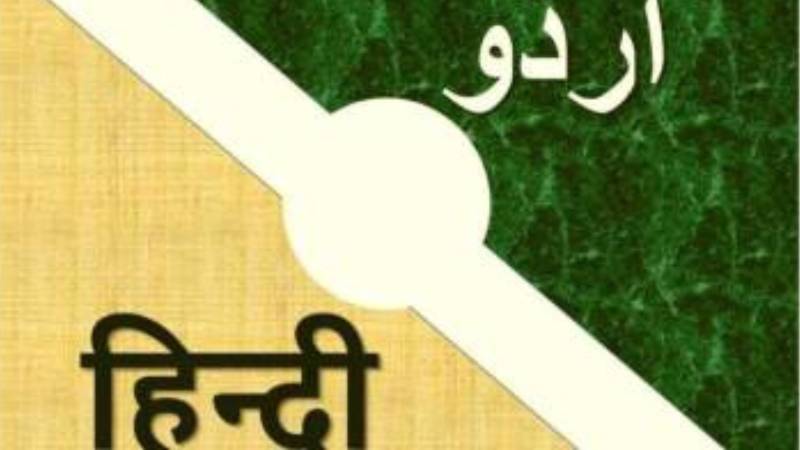
The politics of language in South Asia, particularly around Urdu and Hindi, has long been a site of conflict, identity formation, and state-sponsored imagination. The dominant narrative promoted by Hindi nationalists portrays Urdu as a “Lashkari” (camp language), a so-called recent invention of Islamic military culture, distinct and opposed to Hindi, which is claimed to be the natural descendant of ancient Sanskrit.
This narrative, however, is not just historically flawed but ideologically motivated. As scholars have demonstrated, Urdu and Hindi are not two languages but two registers of the same linguistic base—Hindustani. The differences between them are more about script and lexical preference than structure or grammar. Furthermore, Urdu’s history, far from being merely “centuries old,” reaches deep into the soil of ancient India, evolving organically over millennia from local dialects and cultural intermixing.
The popular but erroneous belief that Urdu is a “Lashkari Zaban” (language of the military camps) has been widely circulated in both popular discourse and some academic circles. This idea suggests that Urdu originated in the Mughal army camps, where soldiers speaking Persian, Turkish, Arabic, and local dialects developed a language for communication. While it is true that linguistic interaction took place in these spaces, to reduce Urdu’s genesis to the battlefield is a severe oversimplification.
Linguist Tariq Rahman, in his book From Hindi to Urdu: A Social and Political History (2011), debunks the Lashkari origin myth: "The term ‘Urdu’ itself does not appear in literature until the 18th century, long after the language had already flourished as Hindavi, Dakhani, or Rekhta in different regions of India."
Similarly, Shamsur Rahman Faruqi, a leading authority on Urdu literature, points out:
“The idea of Urdu as a military language has no real basis in literary or linguistic history. Rather, Urdu evolved through the intermingling of local Prakrits and Persianate culture over a long period.” (Early Urdu Literary Culture and History, 2001)
Framing Urdu as foreign or derivative is intellectually dishonest and ideologically dangerous, erasing centuries of shared South Asian cultural history and reinforcing sectarian divides
Thus, the Lashkari thesis is better understood as a political myth rather than a historical fact. Urdu and Hindi are not separate languages in their spoken form. As any speaker of Hindustani knows, everyday conversation in Delhi, Lucknow, Karachi, or Lahore flows seamlessly between what is labelled Urdu or Hindi. The grammar, phonetics, and basic vocabulary are identical.
According to Khursheed Alam, in his paper The Myth of Hindi-Urdu Divide (Aligarh Journal of Linguistics, 2015):
“The so-called division is a colonial construct formalised by British educational and administrative policies to fragment a shared linguistic heritage along religious lines.”
Grierson’s Linguistic Survey of India (1903–1928), one of the most comprehensive linguistic mapping exercises ever undertaken, classified both Urdu and Hindi under the Hindustani family, noting:
"The only real difference between Urdu and Hindi lies in the script and in the borrowed vocabulary: Persian-Arabic for Urdu and Sanskrit for Hindi."
The divergence became political in the 19th century when Hindi revivalists demanded the replacement of Urdu with Devanagari in government and education under the banner of nationalistic purity. This movement was not rooted in linguistics but in identity politics.
The version of Hindi promoted by state institutions in India today is far removed from the colloquial Hindustani spoken by millions. It is marked by an aggressive Sanskritisation, purging Persian and Arabic words and replacing them with classical Sanskrit terms.
Linguist Ruth Vanita critiques this in her article Language and Nationalism in India:
"The deliberate Sanskritisation of Hindi is part of a larger ideological project to ‘purify’ Indian culture by erasing Muslim contributions. The result is a form of Hindi that is often unintelligible to its native speakers."
This process mirrors the earlier purification projects in Europe, such as the Nazi promotion of Aryanised German, and reflects a broader Hindutva agenda to present India as essentially Hindu and Sanskritic, sidelining its Persianate and Islamic cultural layers.
As Alok Rai notes in Hindi Nationalism (2001):
“Modern Standard Hindi was a nationalist project aimed not just at creating a national language, but at excluding Urdu—and by extension, Muslims—from the idea of the Indian nation.”
Hindi nationalism, as a movement, arose in the colonial period but gained aggressive state patronage post-Partition. It is not merely a linguistic movement but a civilisational one: an attempt to construct an Indian identity rooted in Vedic culture, to the exclusion of other traditions.
This ideology was evident in the Hindi-Urdu controversy of the late 19th century, especially in North India, where Urdu had been the court and literary language. The demand to replace Urdu with Hindi in the Nagari script became a flashpoint for communal politics.
Scholar Christopher King in One Language, Two Scripts (1994) argues:
“The Hindi movement’s rhetoric of ‘mother tongue’ obscured its real aim: to define Indian nationalism in opposition to Islam, and thus against Urdu.”
The postcolonial Indian state’s linguistic policies, making Hindi an official language while marginalising Urdu, only continued this agenda. Despite being spoken by over 80 million people in South Asia (2011), Urdu is systematically denied state resources, educational infrastructure, and media representation.
Contrary to the myth of Urdu being a mere 300-year-old language, its roots go back over thousands of years. Urdu evolved from Apabhramsha, which itself emerged from Shauraseni Prakrit, spoken in north-western India around 600–1000 CE.
In fact, early forms of Urdu, under the name of Hindavi or Dakhani, were used in poetry and literature as early as the 13th century. The Sufi saint Amir Khusro (1253–1325), often called the “father of Urdu literature,” composed verses in Hindavi:
“Zabān-e-Dehlavi ba-ahl-e-Hind jān ast.”
(The language of Delhi is the life of the people of Hind.)
Dakhani Urdu, used in the Deccan region as early as the 14th century, shows an independent trajectory of Urdu’s development, unconnected to Mughal courts.
As Sunil Sharma notes in The Persianate World (2019):
“Urdu grew as part of the Persian cosmopolis, but was always deeply embedded in local Indian speech patterns. It is a language of India, not of invaders.”
Framing Urdu as foreign or derivative is intellectually dishonest and ideologically dangerous, erasing centuries of shared South Asian cultural history and reinforcing sectarian divides.
Urdu is not the “other” of Hindi, nor is it a byproduct of Islamic conquest. It is an indigenous language, shaped by diverse influences but rooted in Hindustan’s soil. The colonial and nationalist efforts to divide and hierarchise Urdu and Hindi have done lasting damage, but language, as always, resists borders.