

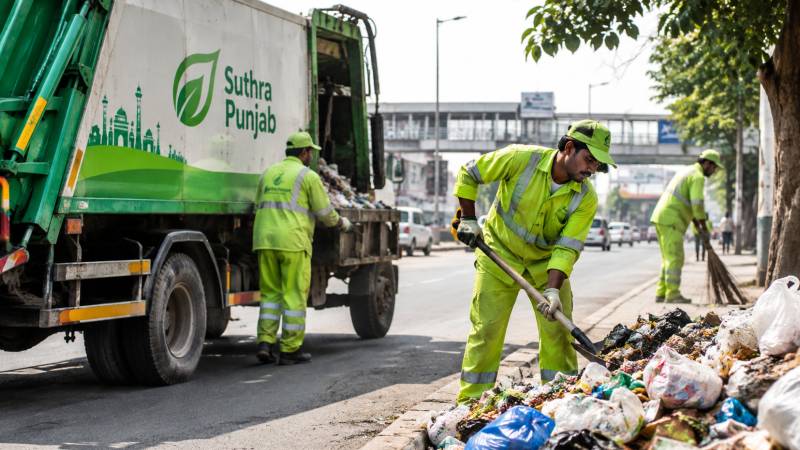
Punjab's latest sanitation deadline should lead to a public account of what changes on the ground. On 2 November, Radio Pakistan reported that Chief Minister Maryam Nawaz Sharif had given authorities 15 days to improve sanitation, alongside instructions on staffing, equipment and timely wages. Those directions provide a useful starting point. Residents and workers should be able to see how they are carried out.
A clean street depends on several connected tasks. Waste must be collected, transported and taken somewhere suitable. Vehicles need maintenance, routes need supervision and the people handling rubbish need protection. Suthra Punjab should be judged across this entire service, including streets and villages away from prominent roads.
The programme has a legal foundation. The Suthra Punjab Authority Act 2026 was published in the provincial Gazette on 25 February. Its stated purposes include an integrated system for waste collection, transportation, treatment and safe disposal, alongside recycling and rural sanitation. That establishes an institutional mandate. It does not, by itself, show whether a particular neighbourhood receives dependable collection or whether waste reaches an appropriate facility.
The financing arrangements also deserve careful scrutiny. An APP report published in The News on 3 October said the Excise Department had begun issuing sanitation bills for around five million urban commercial and residential properties. This is a reported billing programme. It should not be mistaken for a count of properties receiving reliable service, or evidence that the billed money has been collected.
Earlier reporting explains why implementation matters. On 5 August, The Express Tribune described financial pressures, disagreements with contractors and salary delays affecting operations. These were reported problems at that time, not proof that every district faces the same conditions today. They nevertheless identify issues that public reporting should address rather than leave residents and workers to resolve individually.
The first priority should be a collection schedule people can understand and use. Residents need to know when a visit is expected, who is responsible and where to report a missed collection. This information should be available through local offices and public notices as well as digital channels. A household should not need a smartphone simply to find out when its rubbish will be removed.
Worker protection deserves the same attention as visible cleanliness, because unpaid wages, unsafe equipment and unrealistic routes can undermine the entire sanitation system.
Complaint handling needs a clear finish. Recording a complaint or uploading a photograph should not automatically count as resolving it. Operators could record the missed visit, the corrective action and confirmation that the location was checked. Repeated failures on one route should trigger a review of staffing, vehicle availability and scheduling rather than another temporary clean-up.
Worker protection should receive the same attention as visible cleanliness. Contract monitoring could include checks that wages reach workers, deductions are explained and protective equipment is available and usable. Workers should have a confidential route to raise payment and safety concerns, with a named office responsible for responding. A dispute over contractor payments should come with a clear process for protecting frontline staff within the applicable law and contracts.
Monitoring should also ask workers what prevents them from doing the job safely. Equipment that cannot be replaced, a vehicle awaiting repair or an unrealistic route can undermine the best instructions. Managers could record these problems and publish aggregate information about how quickly they are addressed, without exposing individual workers or turning complaints into grounds for retaliation.
The destination of collected waste is another essential test. District reports could distinguish material collected, transferred, recovered, treated and disposed of. Each measure needs a clear definition. Material sent towards recycling should not automatically be counted as material successfully recycled. Checks at transfer points and disposal facilities would make the figures more useful than a single headline tonnage.
Billing needs comparable clarity. A property owner should be able to understand the basis of a charge, the period covered and the route for correcting a mistake. Service information should accompany the bill. Authorities could publish collection reliability and complaint outcomes for the relevant area, helping residents judge what the charge supports without implying that every service problem cancels a legal obligation to pay.
A short district report could bring these priorities together: scheduled collections completed, repeat complaints, unresolved wage issues, equipment faults and verified waste destinations. Publishing definitions and acknowledging missing information would make comparison more credible. Independent spot checks could then test whether the figures match conditions, instead of rewarding whichever operator produces the most impressive presentation.
Suthra Punjab deserves support for its ambition to provide organised sanitation more widely. Sustaining that support requires dependable local service and fair treatment of the workers delivering it. The strongest response to a deadline would be a record that people can check: fewer missed collections, prompt action on wage complaints and a clearer account of where the waste goes.