

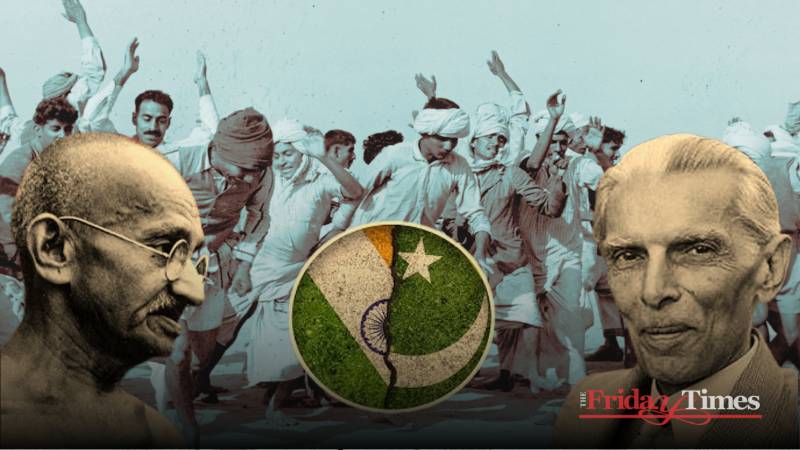
Indian historian Anil Seal, widely hailed as the founder of the Cambridge School of Indian history, recently stated what is now an obvious but deeply inconvenient fact of history: partition of India was the doing of the Congress high command and not Jinnah. From Maulana Azad to H M Seervai, all astute observers of the political events of the closing decade of the British Raj have affirmed this fact and there is very little to argue against it. The undeniable fact is that at every stage, Jinnah held out an olive branch to the Congress which was repeatedly rejected by Nehru, Gandhi, and Patel. Jinnah’s “Pakistan” was never predicated on the actual partition of India. Instead, his maximum demand had been an autonomous region within a united India and he was willing to negotiate on this as well. Barely a month before the Lahore resolution, Jinnah wrote of joint governance of the common motherland of India. Even the name Pakistan was according to Jinnah “fathered upon us by the Hindu press”. That at the very eve of partition, Jinnah accepted the Cabinet Mission Plan is evidence that till the very end, Jinnah was willing to settle based on a united India.
That this pokes holes in the official Indian nationalist mythology about partition is a no-brainer. It takes away the convenient villain in the story of India’s independence – as Anil Seal says Indian nationalism needed Jinnah to be the villain of the story; a Mephistophelean counterfoil to the angelic Mahatma and his selfless cohort. This hackneyed simplistic story has made peaceful coexistence between India and Pakistan impossible.
However, the facts are equally inconvenient for the Pakistani hagiographers of Jinnah as well. After all, what was Jinnah’s role in history if not as the uncompromising single-minded advocate for the creation of Pakistan? We have grown up listening to Stanley Wolpert’s quote about Jinnah “Few individuals significantly alter the course of history. Fewer still modify the map of the world. Hardly anyone can be credited with creating a nation-state. Muhammad Ali Jinnah did all three.” So if Jinnah did not do any of these, did the myth of the omnipotent Quaid-e-Azam collapse? It is this psychological hurdle that Jinnah’s Pakistani admirers cannot cross to admit that Jinnah did not want partition of India or the creation of a completely separate sovereign Pakistan.
Maulana Azad, who had no love lost for Jinnah or the Muslim League, said so in black and white that the responsibility of partitioning India lies with Congress, not the Muslim League
The truth is that Jinnah had cemented his role in history long before he began to agitate for Pakistan. He had been active in public life since 1904 and had risen to the top of the Congress party as an indefatigable campaigner for self-rule in India. The only politician to be called the Best Ambassador of Hindu-Muslim unity, Jinnah’s contributions as a legislator, lawyer, and activist in the struggle for self-rule cannot be swept under the carpet simply on account of crass communal prejudice. Incidentally, even the Indian military academy in Dhera Dun owes its existence to Jinnah’s efforts towards the Indianisation of the officer ranks in the Indian army. He was also one of the original proposers of the idea of an Indian Supreme Court. His mark on the constitutional and legal developments in the subcontinent is indelible.
It must be remembered that the demand for partitioning India along Hindu-Muslim lines developed independently of Jinnah. As early as 1924, Lala Lajpat Rai, the Congress leader and freedom fighter, was arguing for a partition into Hindu and Muslim areas. This was before Iqbal famously posited his idea for a consolidated Muslim majority state in the Northwest of India, significantly “within or without India”. It was some years later that Chaudhry Rahmat Ali coined the name Pakistan and gave it primordial justification. Jinnah had stood apart from these trends, arguing for a united India, proclaiming that he was an Indian first, second, and last. Jinnah’s political genius lay in consolidating the demand for a Muslim homeland to bring together Muslims of minority provinces and the Muslims of majority provinces together on one platform.
Once having fashioned a phalanx, Jinnah held out the promise of an all-India settlement between Hindus and Muslims. It was a moment that, if capitalised upon, could have secured an organic unified, and consociational India for Hindus and Muslims alike. Political exigencies as well as a centralizing vision that Congress leaders had never allowed the moment to reach its fruition. The decision to jettison the Muslim-majority areas had been made by Congress. If there has to be blame for partition, the majority of it lies squarely at the door of Gandhi, Nehru, and the Congress party. This is the only logical conclusion that every fair and impartial historian will ultimately draw. Even Maulana Azad, who had no love lost for Jinnah or the Muslim League, said so in black and white that the responsibility of partitioning India lies with Congress, not the Muslim League.
Jinnah’s role in history, therefore, is assured but just not in the way Indian and Pakistani nationalist mythologies want it to be. Jinnah will be remembered and indeed deserves to be recognized, as a constitutional genius who worked to further the cause of self-rule for all Indians regardless of religion, caste, or creed. In Pakistan, his lasting legacy would be his vision for a secular democratic state that would reconcile Islam with modernity. Sooner or later, I have no doubt, that Pakistan would return to that original vision.