

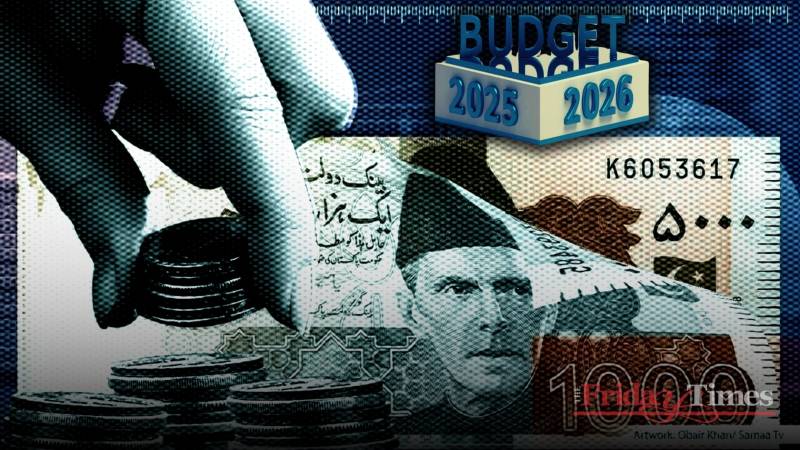
The federal budget 2025–26 lays bare more than just numbers. It exposes a country caught in a pattern of reaction rather than reform, reflecting a strategic drift where long-term planning has given way to fiscal firefighting. While official pronouncements tout growth, consolidation, and reform, the allocations and exemptions paint a different picture—one of a state muddling through, failing to course-correct even as economic and social pressures mount. Rather than steering the country toward a viable development path, the budget’s revenue measures and spending priorities indicate an institutional stasis, rooted in tactical compromises and an avoidance of deeper structural change.
Policy Disconnect
The Pakistan Economic Survey 2024–25, unveiled days before the budget, admitted that economic growth fell short of targets across major sectors. Real GDP inched up by 2.68%, falling short of the 3.5% goal. Agriculture, once a mainstay, barely registered 0.6% growth, largely due to water shortages and declining yields in key crops like cotton and wheat. Even industrial growth, reported at 4.8%, is questioned because Large-Scale Manufacturing (LSM) shrank for the third year in a row.
The budget projects a 4.2% GDP growth target and sets ambitious goals for agriculture (4.5%), industry (4.3%), and services (4%) in FY26. Yet the policy environment offers little to back these projections. Critical sectors continue to be weighed down by legacy subsidies, politically protected exemptions, and skewed incentives. This misalignment between growth projections and underlying sectoral realities is symptomatic of deeper policy drift. For example, the targeted 4.5% agricultural growth lacks the foundation of adequate irrigation, research support, or input subsidies. Similarly, industrial recovery remains contingent on energy reliability and import rationalisation—neither of which is clearly addressed.
Tax Policy: Regressive Trends and Elite Protection
This year’s tax exemptions hit a historic high of Rs5.84 trillion—up from Rs3.87 trillion the previous year—a 51% increase. This surge undermines the credibility of revenue efforts, particularly when juxtaposed with the government’s stated commitment under the IMF programme to gradually withdraw such concessions. Sales tax exemptions alone rose to Rs4.25 trillion, largely due to petroleum imports and zero-rated supplies under the Fifth and Sixth Schedules. Even as the government slashed local exemptions under the Sixth Schedule, it more than compensated through expanding zero-rated and reduced-rate regimes, reflecting the disproportionate influence of well-lobbied sectors.
The federal budget for 2025–26 is emblematic of a state operating in fiscal survival mode—managing crises instead of preventing them
Income tax exemptions also soared, rising to Rs800 billion from Rs476 billion a year ago. Customs exemptions followed suit, reaching Rs785 billion. These figures underscore the extent to which the state has given up trying to expand the tax base and is instead doubling down on rewarding entrenched interest groups.
The increase in tax exemptions coincides with the removal of taxes on capital gains and real estate, further distorting equity in the tax regime. While ordinary taxpayers and consumers are expected to shoulder the burden, the government walked back on taxing real estate and high-income earners. Super tax rates were trimmed, Federal Excise Duty on immovable property was withdrawn, and the advance tax was reduced. In contrast, solar panels—key to energy transition and long-term import substitution—are now subjected to 18% tax. These decisions signal a skewed policy compass, one that prioritises short-term fiscal band-aids over strategic restructuring.
Development Squeeze under Debt Dominance
Expenditure patterns tell a similar story. Out of the Rs17.57 trillion outlay, Rs8.2 trillion—nearly half—is earmarked for interest payments, underlining the unsustainable debt load. Defence and pensions consume another Rs3.6 trillion combined, while the Public Sector Development Programme (PSDP) is allocated a mere Rs1 trillion. The development budget is essentially being squeezed to make room for survival spending, reflecting a loss of developmental intent.
Pakistan’s debt-to-GDP ratio stands near 74%, with external debt service obligations for FY26 projected to exceed $24 billion. In such a scenario, domestic fiscal space shrinks, leaving little for infrastructure, health, or digital transformation—key drivers of long-term growth.
Human Capital and Climate: Budgetary Orphans
The strategic drift is evident in social spending too. Education remains underfunded, with only Rs39.5 billion allocated for the Higher Education Commission—barely a fraction compared to defence or pension outlays. Health, climate adaptation, and innovation continue to receive lip service rather than fiscal commitment. While the Benazir Income Support Programme (BISP) sees a 21% increase, reaching Rs716 billion, it operates more as a political necessity than a part of a broader social mobility framework.
Pakistan’s youth bulge—over 60% of the population—is receiving limited support in terms of employable skills or educational advancement. No new funding mechanisms were announced for technical and vocational education, while funding for digital skills training declined from last year’s revised estimates.
From Survival Mode to Strategic Realignment
The federal budget for 2025–26 is emblematic of a state operating in fiscal survival mode—managing crises instead of preventing them. Instead of ushering in transformation, it functions as a stopgap, avoiding tough choices. Strategic drift persists as long as elite bargains shape revenue policy and public spending.
Breaking this cycle demands political will—not donor appeasement or technocratic tweaks. The state must prioritise broadening the tax net, dismantling protectionist exemptions, and reallocating resources toward people-centric investments.
Without these structural shifts, the country will remain trapped in a loop of reactive policymaking, watching reform slip further away with each passing year.