

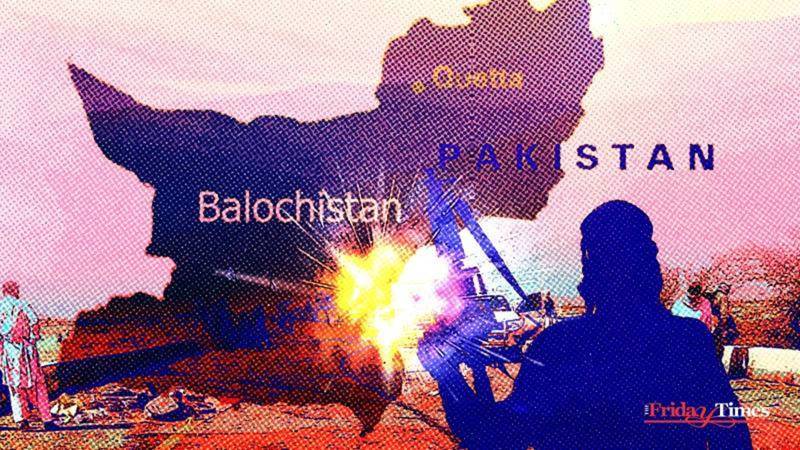
Balochistan, Pakistan's southwestern province, has been at war with the centre, on and off, since the country's inception. The roots of the Baloch insurgency can be traced back to the post-Partition era in the subcontinent. After Pakistan's independence in 1948, the Treaty of Accession of Kalat to Pakistan was signed, which prompted Abdul Karim, the brother of the Khan of Kalat, to revolt against the accession. Although the insurgency ended within a year with the surrender of Abdul Karim, this led to what is popularly known as the first phase of insurgency in Balochistan. The long, tedious, and hostile process of Balochistan’s accession provided grounds for nationalists to push their demand for the Baloch people's right to self-determination, which remained on the agenda of the second phase of the Baloch insurgency in 1958 as well.
In 1963, a new generation of Baloch leaders emerged who claimed to operate at the intersection of Marxist-Leninist ideology and the legacy of Baloch resistance. The People’s Liberation Front (PLF) of Sher Muhammad Murri is a notable example of this wave, which is also considered the third phase of the Baloch insurgency. The fourth phase emerged in the 1970s during Bhutto’s era, when his government dismissed the Chief Minister of Balochistan, Sardar Attaullah Mengal, after the Shah of Iran raised concerns about unrest in Iranian Balochistan caused by Baloch nationalists in Pakistan. In the 1990s, the fifth phase of the conflict emerged mainly due to a lack of consensus among nationalist parties on the political agenda and growing concerns of the public regarding socio-economic inequalities.
The Baloch Liberation Army (BLA)
The Baloch Liberation Army (BLA) was formed by Hyrbyair Marri in 1996, with Aslam Baloch becoming the chief commander in Bolan. Aslam, also known as Achu, killed a policeman during a protest in 1996. This incident heralded a new wave of terrorism in Balochistan. Aslam is considered the father of the BLA's modern guerrilla warfare and an influential figure among the insurgency's different factions. Interestingly, in 2018, Aslam was expelled from the BLA on disciplinary issues and joined BLA-J, but was killed mysteriously in Kandahar, Afghanistan. Chief Minister Sardar Akhtar Mengal’s government was removed through a vote of no confidence in the Nawaz era in 1998, after which Hyrbyair Marri left secretly for Britain in 2000.
Pakistani security institutions view the broader unrest not as an organic political grievance but as a sustained insurgency, periodically reignited and externally supported
Marri was not just the brain behind the BLA, but also served as the provincial Communications and Works Minister in the Mengal government. Nawab Khair Bakhsh Marri, Hyrbyair Marri’s father, was arrested in connection with the gruesome murder of a sitting high court judge in Quetta in 2000. This became the flashpoint between the State and Baloch insurgents. The BLA was born after this incident. From the early 2000s, the issue of enforced disappearances came to the forefront from Baloch nationalist parties, which alleged that the state’s security apparatus was involved. During the same period, the China-Pakistan Economic Corridor (CPEC) and Chinese nationals became the main targets of the insurgents, who claimed they symbolised external exploitation of their resources.
Fragmentation within the Insurgency
The Balochistan Liberation Army (BLA), formally declared a banned outfit by the governments of Pakistan, the United States, Australia, and the UK, has pushed Balochistan to the bloodiest phase in decades, and its recruits no longer look like the rural poor the old story assumed. The BLA is a decentralised terrorist group that operates through local commanders and cells that operate independently. In its early phase, the BLA targeted the government’s infrastructure, railway lines, and communication and transmission networks across the province. They carried out dynamite attacks, rocket fires, and landmines, especially targeting the Frontier Corps, Pakistan's paramilitary force in the region. By 2003, the Balochistan Liberation Front (BLF) was launched, a sister organisation that aimed to push the separatist agenda into the Baloch middle-class strongholds such as Makran and the Rakhshan division.
An internal rift within these organisations resulted in a formal split. BLA spokesman Azad Baloch publicly cut ties with Aslam Baloch and Bashir as its new spokesman, while Bashir Zaib broke away to head a rival BLA faction, leaving the group divided into two distinct wings, BLA-A and BLA-J. The earliest move of BLA-J was the revival of the Majeed Brigade, its suicide terror unit, into active service after seven years of dormancy. The two factions developed distinct operational identities, while BLA-A targeted lower-intensity tactics, such as ambushes, IED strikes, raids, and targeted killings; BLA-J targeted high-profile and high-visibility targets. BLA-A notably distanced itself from the 2008 attacks on the Chinese consulate and bus bombings in Dalbandin.
From Mountains to Cities: Evolution of the Insurgency
The insurgency’s evolution from rural to urban areas is a common phenomenon. With accelerated urbanisation and technological advancements, insurgent groups adapt their modus operandi. Over the past few years, Balochistan has undergone massive urbanisation owing to CPEC and migration. The shift has been sweeping because of the internet and social media platforms such as X (Twitter), Facebook, etc., which have given the BLA space for propaganda and for building a victimhood narrative. Social media platforms have eroded the old internal divisions within Baloch society, creating space for a newer, more radical strand of Baloch nationalism that has served as a force multiplier for the BLA's reach.
Over the past few years, the BLA’s terrorist attacks have amplified both in frequency and complexity, spreading across various militant factions of the BLA, which shows that the BLA has evolved from a group of guerrillas operating in the mountains to an urban guerrilla movement. The BLA has used suicide bombings by men, and notably women, as a strategic tool against the state of Pakistan, whereas attacks on Chinese nationals, CPEC projects, and occasional and temporary seizing of territories have also been utilised. Since 2025, the BLA has intensified its attacks on civilian targets, such as the Jaffar Express attack carried out by the BLA Jeeyand faction. The government launched Operation Green Bolan in response to the attack, which resulted in 30 casualties, 26 passengers, and four rescuers (2), while 33 terrorists were killed, and hostages were released. Regarding the number of hostages, there is a discrepancy between the account presented by the Pakistan government and the militants (roughly 400 passengers were taken hostage).
The official statement by Pakistan claims that 354 hostages were rescued. Aside from the Jaffar Express, four suicide attacks have been carried out by both male and female suicide bombers. Besides this, they conducted major operations across Balochistan, resulting in temporary occupations of suburban districts. While major attacks were concentrated within Balochistan, BLA-J and other factions have attacked Karachi, Sindh, with savage attacks, including suicide bombings.
The BLA has sustained itself owing to several factors, including pockets of support from certain factions of Baloch society, foreign sanctuaries across two international borders, its guerrilla capabilities with hit-and-run tactics, and a weak provincial government. Its narrative of Baloch victimhood, however inflated parts of it may be, taps into something real enough that even Baloch who reject the group's violence often share its underlying sense of grievance. External sanctuaries in Iran and Afghanistan provide them space to regroup and relaunch operations, which a purely domestic insurgency cannot sustain for long. It has adopted suicide bombing as a tactic, and has accessed advanced weaponry, traceable to the abandoned equipment of the United States military in Afghanistan.
Controversies Surrounding Mahrang Baloch
The most polarising figure in the conflict, who is not a militant, is the one whose dispute over what she represents has become a proxy war in itself. Mahrang Baloch has been a leading voice against enforced disappearances, setting forth the argument that the state uses them as a policy to suppress Baloch separatism. Pakistani security institutions view the broader unrest not as an organic political grievance but as a sustained insurgency, periodically reignited and externally supported, most notably by India, which they assess uses local proxies and sympathetic public figures to internationalise what is fundamentally a domestic counter-terrorism issue. According to the state’s accounts, many of those reported as disappeared are individuals who went underground to join militant ranks and were either neutralised in counter-terrorism operations or crossed into Afghanistan or Iran.
Following the Jaffar Express train hijacking in 2025, the Director General of Inter-Services Public Relations (DG ISPR), briefing on the 23rd of May 2025, stated in a press conference that an organised propaganda campaign was being led through proxy groups to provide ideological and informational cover for terrorism in Balochistan. In a subsequent press briefing on the 23rd of May 2025, he further alleged that the Baloch Yakjehti Committee (BYC) and its leadership were acting as facilitators and proxies for militant groups. He alleged the Baloch Yakjehti Committee (BYC) and its leaders were facilitators and proxies of militant groups.
State institutions allege that Mahrang’s role in the insurgency is not incidental but instrumental because of her family ties with the BLA. In June 2026, she was convicted and sentenced to life imprisonment by an anti-terrorism court in Quetta over the death of a Frontier Corps soldier, killed by a mob during a 2024 protest. Allegedly, she had referred to FC personnel as occupiers. These allegations bring her legitimacy as a woman in public life into question.
The case that troubles her defenders most is not innuendo; it is a pattern of specific facts. Her father, Abdul Ghaffar Langove, was a BLA member/commander. Her cousin, who also served as her bodyguard, was an active BLA fighter, allegedly killed in 2025. According to reports, she glorified a BLA suicide bomber, Wadood Satakzai, which did not sit well with the government authorities. When her conviction came down in 2026, commanders from the BLA, the BLF, and the BRA all publicly voiced solidarity with her, an alignment of sympathy that, whatever its cause, is hard to wave away.
Allegations against BYC of Youth Recruitment
In years of public advocacy, neither Mahrang nor the BYC has condemned BLA or BLF attacks on Punjabi or Sindhi civilians or labourers. Silence is not proof of sympathy. But sustained, selective silence—speaking out about disappearances while saying nothing about sectarian killings carried out in the name of the same cause—is a legitimate pattern to put to her directly, and it is one her movement has not yet answered. Another allegation levelled against her by officials is that the BYC, under her command, had attempted to remove the dead bodies of slain terrorists from Civil Hospital Quetta in the wake of security operations. Media coverage characterised the incident as an attempt to obstruct identification and legal procedure. Security officials claim that militant deaths are routinely recast as missing persons cases to manufacture sympathy.
Security officials further allege that the BYC has served as a platform for the early-stage recruitment of minors. One case officials cite involves Sarfaraz, an 18-year-old from Kharan, who was allegedly assigned to conduct reconnaissance on police and polio vaccination teams. According to the DIG CTD, Sarfaraz was first drawn into the BYC, where he took part in protests and road blockades, before being recruited into militancy by Jahanzeb, also known as Mehrban, a 20-year-old. Authorities claim women or children are involved in its activities; the evidence they've gathered suggests minors are, in fact, being pulled into militant activity through social and protest platforms. Security analysts go further, arguing that the BYC operates as a deliberate "human rights shield", moving quickly after militant attacks to reframe perpetrators as victims, and running an international advocacy operation, particularly across Europe, that they say reflects external sponsorship rather than organic civil-society work. Taken together, they assess that the BYC has long since ceased to function as an independent rights organisation, if it ever was one, and has instead become a recruitment pipeline, a narrative engine, and a coordination mechanism for militant networks operating both inside and outside Pakistan's borders.
The government describes it as a deepening radicalisation crisis, and to address it, it has announced rehabilitation centres in Quetta, which will prioritise psychological counselling and social reintegration. It is a belated acknowledgment that kinetic responses alone cannot close the space the BYC and groups like it have occupied.
Note: The next article will look at the nuances of the approaches that the insurgents employ, and what could possibly be done by the state.