

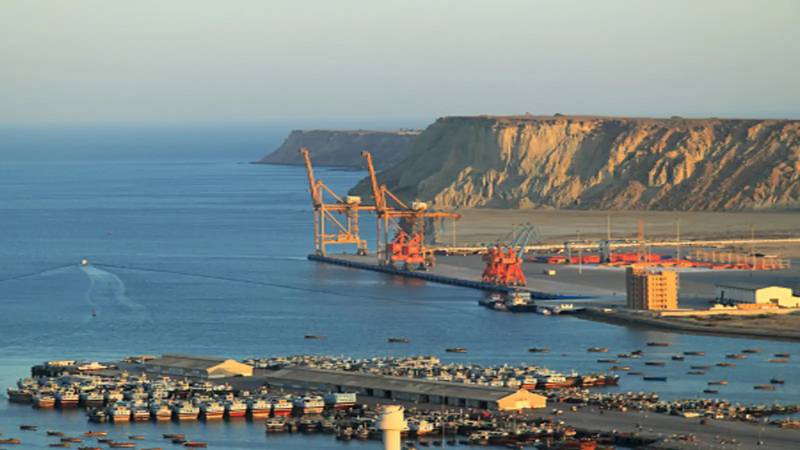
A recent statement by Railways Minister Hanif Abbasi sparked widespread backlash and reignited a long-running debate over Gwadar and its place in the larger issue of Balochistan’s grievances. In a controversial remark, Abbasi claimed that ‘Gwadar is not a property of anyone’s father or grandfather.’ He added that it was purchased by Pakistan from Oman in 1958 by paying money.
This comment drew strong reactions, particularly from voices in Balochistan. One of the most vocal responses came from former Senator Kahuda Babar, a native of Gwadar. He acknowledged that Pakistan indeed purchased Gwadar from Oman under an official agreement. However, he rejected the idea that this transaction nullifies the rights of the people of Gwadar. He stressed that Gwadar is not just a piece of land bought with money. It is deeply connected to the identity, heritage, and generations of the people who have lived there for centuries.
The exchange between Abbasi and Kahuda reflects how Gwadar has long symbolised the larger debate around Balochistan’s place within Pakistan. For many who argue that Balochistan’s grievances are real and serious, Gwadar is often cited as an example of how the province’s resources are used without local ownership or benefit. On the other hand, those who dismiss these grievances often claim that Gwadar was never historically part of Balochistan and was simply purchased by the state, implying there is no special local claim over it. But the real story behind Gwadar’s past tells a more complex and rooted history, grounded in facts and official records.
To understand that history, we need to go back to the late 18th century. According to the book Gwatar Bay to Sir Creek: The Golden Coast of Pakistan — History and Memoirs by Vice Admiral Iftikhar Ahmed Rao, Gwadar was initially part of the Kalat State, the predecessor of modern-day Balochistan. In 1778, the Khan of Kalat took control of Gwadar. Then, in 1783, an Omani prince named Sultan bin Ahmad arrived in Gwadar after a failed coup attempt in Muscat. The Khan of Kalat, Noori Naseer Khan, offered the prince refuge and allowed him to manage Gwadar. The prince was given half of the revenue from Gwadar as a maintenance allowance.
Reducing Gwadar to a mere financial transaction strips it of its emotional and symbolic value. It also dismisses the people who have lived there for generations and continue to call it home
A few years later, in 1792, the same prince became the Sultan of Oman. Despite his new position, he never returned Gwadar to the Kalat State. This arrangement, which was meant to be temporary, gradually became permanent as Oman tightened its grip on the area. The version of events described by Admiral Rao is also supported by Feroz Khan Noon in his autobiography From Memory, published in 1966. Noon, who served as the seventh Prime Minister of Pakistan, wrote that the prince was allowed to collect revenue from Gwadar to sustain himself. After becoming Sultan of Oman, he kept control of Gwadar rather than returning it, even though the original arrangement had not given him full ownership.
This was not the end of the story. Over the years, the Kalat State made repeated efforts to reclaim Gwadar. According to Noon, in 1839, the British Empire subjugated Kalat and made it part of their larger colonial administration. In 1861, the Khan of Kalat officially requested the British to help return Gwadar, but the British refused. At the time, Oman was a British protectorate and the empire had no interest in disturbing the arrangement.
Later, in 1903, another formal attempt was made by the Khan of Kalat, this time through the British Indian government. All these moves show that Kalat never gave up on its claim over Gwadar, and that the control of Oman was always viewed as temporary or illegitimate by Kalat.
When Pakistan gained independence in 1947, Oman continued to administer Gwadar. But Pakistan soon began diplomatic efforts to bring the territory into its fold. The argument Pakistan presented during these negotiations was built around the historical connection between Gwadar and Kalat. Since Kalat had now become part of Pakistan, it was only logical that Gwadar, which was once part of Kalat, should also join.
During the negotiations, Prime Minister Feroz Khan Noon framed the issue as a legal matter. He argued that Gwadar was essentially a jagir, a land grant given for revenue collection. Such grants, under British rule, did not amount to full ownership and were cancelled over time. Pakistan could have followed that same principle and taken over Gwadar without any financial deal. However the country chose to go for a negotiated settlement instead.
The process of negotiation was not easy. Sultan Said bin Taimur of Oman was a tough negotiator. He delayed the process as long as he could to get more benefits. Oman even refused to deal directly with Pakistan, which is why the British government had to act as a middleman.
In September 1958, a deal was finally reached. According to Rao, Pakistan agreed to pay three million pounds to Oman for Gwadar. This payment was not described as a purchase in simple terms. Instead, it was structured carefully to avoid the impression that Oman had sold a piece of land outright. Oman was also promised 10 percent of any profits from oil discovered in Gwadar for 25 years. This condition highlights how Oman, even after the deal, retained a technical stake in Gwadar’s natural resources.
These details are crucial. They show that Pakistan’s basis for acquiring Gwadar was never rooted in a claim of random purchase. It was directly linked to the historical ownership of Kalat. Without that historical link, Pakistan would not have had the legal grounds to negotiate for Gwadar in the first place.
The statement that Gwadar was bought and therefore has no ancestral or local claim is misleading. It ignores the fact that the area was part of the Baloch state of Kalat, and the only reason Pakistan had any claim was because Kalat had joined Pakistan. This historical fact strengthens the argument that Balochistan, as the successor of Kalat, has a legitimate claim on Gwadar.
Beyond legal and historical arguments, there is also the question of identity and belonging. For the people living in Gwadar, the land is not just a port or a source of revenue. It is part of their history, their culture, and their sense of self. Reducing Gwadar to a mere financial transaction strips it of its emotional and symbolic value. It also dismisses the people who have lived there for generations and continue to call it home.
So, when someone says that Gwadar was simply bought by Pakistan and therefore belongs only to the state, they are not telling the full story. The truth is that Gwadar was part of the Kalat state before it was ever part of Pakistan. It was reacquired based on that very connection. Recognising this history is not just a matter of facts, but a step toward fairness and respect for the people who belong to the land.