

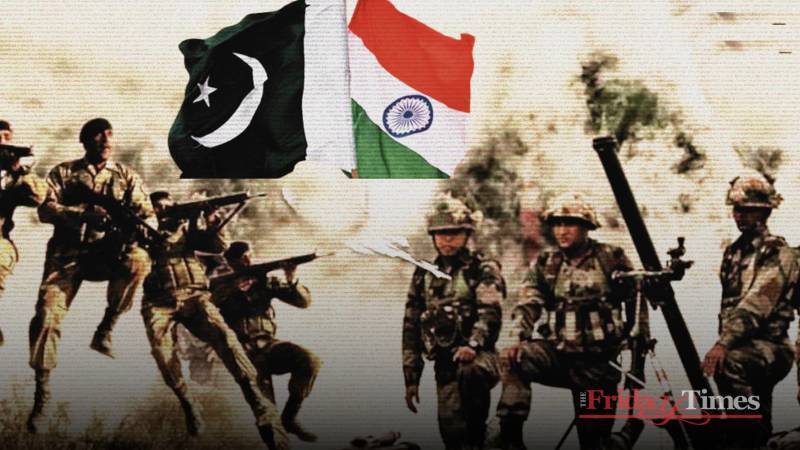
The brief but intense crisis of May 2025 may not have escalated into a full-scale war, but it has already redrawn the intellectual map through which we understand conflict in South Asia. If earlier crises, from Kargil to Balakot, were laboratories of limited war under a nuclear shadow, this episode represents something far more consequential: the arrival of compressed, multi-domain warfare where escalation is not linear, time is not forgiving, and perception can be as lethal as precision-guided munitions.
One of the most striking features of the crisis was that much of the “war” unfolded before any formal declaration or mass mobilisation. Precision strikes, cyber probing, and information operations created a battlespace in which the distinction between peace and war became blurred. Victory, or at least positional advantage, was sought in this ambiguous pre-war phase.
This is not merely an evolution; it is a transformation. Conflict is no longer territorially bounded or temporally sequenced. Instead, it is simultaneous across domains: land, air, sea, cyber, space, and perhaps most decisively, the informational sphere. The integration of these domains has created a strategic environment in which the first move is not necessarily kinetic but cognitive. Pakistan left its strategic signatures in all the novel domains of the strategic environment, which came as a surprise to the opponent and military pundits in international spheres.
Even more destabilising is the compression of decision-making timelines. The integration of drones, AI-enabled targeting systems, and real-time surveillance has reduced reaction windows from hours to seconds. In such an environment, the space for human judgement—traditionally the last barrier against catastrophic escalation—is shrinking. The risk is not just miscalculation; it is algorithmic acceleration.
For decades, South Asian strategic thinking has revolved around the so-called “stability–instability paradox”, a concept most closely associated with Glenn Snyder. Nuclear weapons, the argument goes, create strategic stability by deterring full-scale war, but paradoxically encourage lower-level conflicts by raising the threshold of escalation.
The May 2025 crisis suggests that even this framework is beginning to fray. What we witnessed was not simply instability beneath a stable nuclear umbrella, but a gradual erosion of the very norms that sustained that umbrella. Long-standing guardrails—respect for territorial sanctity, avoidance of certain categories of targets, adherence to confidence-building agreements—were either ignored or actively dismantled. The suspension of treaties and the normalisation of cross-domain strikes signal a worrying trend: the informal rules of the game are no longer binding.
In this emerging landscape, conflict will not be an exception; it will be a persistent condition, managed rather than resolved
More critically, the crisis exposed the illusion of “limited war”. The belief that conventional engagements can be carefully calibrated and contained under a nuclear overhang appears increasingly untenable. Escalation in a multi-domain environment is neither predictable nor easily reversible. A cyber disruption can trigger kinetic retaliation; an information misfire can provoke strategic panic.
Pakistan’s doctrine of Full Spectrum Deterrence was designed precisely to deny space for such limited wars. By lowering the nuclear threshold across tactical, operational, and strategic levels, it seeks to plug the gaps that adversaries might exploit. The May crisis suggests that this doctrinal evolution is not merely theoretical; it is central to maintaining deterrence credibility. Yet deterrence itself is undergoing a quiet transformation.
For a state like Pakistan, economic constraints preclude the pursuit of technologically extravagant defensive shields akin to an iron dome. Instead, the emphasis remains on deterrence by punishment—the assured capability to retaliate decisively and disproportionately. The logic is stark but effective: if you cannot stop the blow, you must ensure that the cost of delivering it is prohibitive.
Central to this logic is the consolidation of a credible second-strike capability. The induction of advanced platforms such as the Hangor-class submarine, capable of carrying nuclear-tipped cruise missiles, marks a significant step towards completing the nuclear triad. In strategic terms, survivability equals credibility. And credibility, in turn, underwrites deterrence.
Equally important, though less discussed, is the indigenisation of both hardware and thought. The crisis demonstrated that strategic autonomy is not just about platforms; it is about the ability to interpret, adapt, and respond without doctrinal dependence. A “tailor-made” deterrence posture rooted in local realities rather than imported templates offers flexibility in an increasingly fluid environment.
If there is one domain that emerged as decisively as any missile system, it is the information space. The 2025 crisis was as much an information war as it was a military one. Competing narratives, amplified through digital platforms, created parallel realities. Reports of destroyed infrastructure—some of which never existed—circulated widely, shaping perceptions and, more dangerously, influencing decision-making cycles. In earlier eras, misinformation was a byproduct of conflict. Today, it is an instrument of conflict.
This has profound implications. Information is no longer merely supportive of kinetic operations; it can independently drive escalation. A viral falsehood can compel a response just as surely as a physical strike. In such a scenario, managing perception becomes as critical as managing firepower. If deterrence held, it did so precariously. And that precariousness points to a larger lesson: deterrence alone is no longer sufficient.
What is needed is an infrastructure of survival: institutional mechanisms that can absorb shocks, manage escalation, and provide off-ramps in moments of crisis. The DGMO hotline, backchannel communications, and the implicit role of third-party actors all contributed, in varying degrees, to preventing the crisis from spiralling out of control. But these mechanisms remain ad hoc and vulnerable to political fluctuations.
There is, however, a more subtle but equally important takeaway. Pakistan’s conduct during the crisis—its calibrated response and subsequent willingness to accept a ceasefire after achieving limited objectives—signals a degree of strategic maturity that is often overlooked in external analyses. The challenge now is to convert episodic maturity into sustained doctrine.
Perhaps the most enduring implication of the May 2025 crisis is not tactical or even doctrinal; it is geopolitical. Pakistan is no longer confined to a narrowly defined South Asian strategic identity. Its increasing engagement with West Asia and the broader Middle East, particularly in the context of maritime security and energy routes, points to an evolving regional role. The old binaries—South Asia versus the Middle East, continental versus maritime—are giving way to a more interconnected strategic geography.
In this emerging landscape, conflict will not be an exception; it will be a persistent condition, managed rather than resolved. Deterrence will not be static; it will be adaptive, multi-layered, and deeply intertwined with technology and perception.
The lesson of May 2025 is therefore not simply that war has changed. It is that our frameworks for understanding war must change with it. Otherwise, we risk preparing for a past that no longer exists, while the future unfolds at a speed we are yet to comprehend.