

Long life is desired by most of us. But living long comes with old age and its limitations. In recent times, the average life expectancy has increased all over the world, though to a greater degree in Europe and North America than in Asia and Africa. The world average life expectancy has more than doubled from 32 years in 1900 to 71 years in 2021. Obviously, more people live into old age now than ever before.
In Pakistan, like the rest of the world, life expectancy has doubled from 34.2 years in 1950 to 67.9 years in 2025. With the increasing life expectancy, the proportion of the elderly in the world population has been increasing, along with falling birth rates.
Old age offers many pleasures and considerable difficulties, physical as well as social. Physically, modern medicine and public health have made it possible to live actively into old age. Yet there is not the same agility and energy as in younger days. Some tasks are difficult to do for most older persons. One cannot carry heavy objects, walk or run fast, or have long periods of intensive work, even if healthy. Those suffering from some conditions of ill-health are even more limited in their capacities.
The pleasures of old age arise from a reduction in responsibilities. One has free time to rest and pursue activities of one’s choice, particularly if one is relatively free from financial and health worries. Yet to live well requires conscious choices and thoughtful efforts.
Old age also means a certain degree of isolation or reduction in meaningful relations. First, those who live long lose some friends and relatives, even of similar age, to death, and some others move away to other places to be near their relatives and children. Often, old age comes with retirement from work, business, and, for women, daily affairs of the family, which means one does not have daily involvement and thus gradually loses touch with new demands and circumstances.
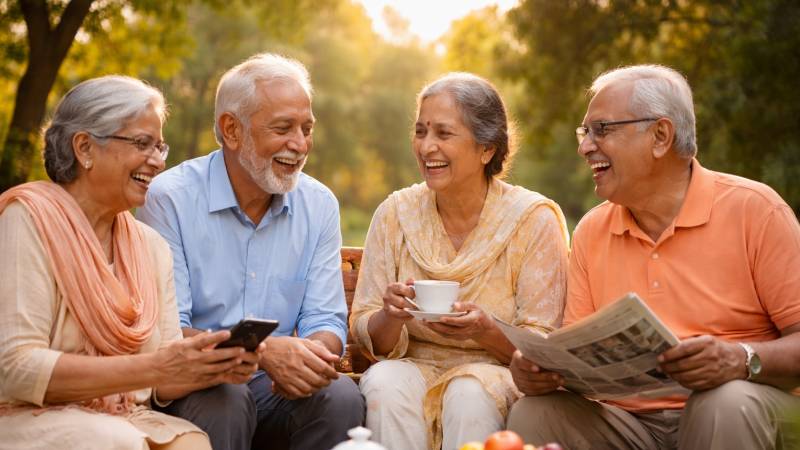
Despite the pleasures and pains inherent in old age, some attitudes and actions help navigate it with considerable satisfaction. First and foremost is to maintain and cultivate friendships and social connections. Second, sustaining your lifelong interests and curiosity in ideas and objects around you. They do not have to be high-minded; even everyday things and activities can offer interest and purposefulness, e.g., helping buy groceries or looking after young children.
An urgent but unrecognised need in Asian and African countries is for seniors’ services, such as care homes, home support, pensions, and social security for the healthy as well as the sick
For women, cooking by choice is a good outlet. For many, religions offer rewarding commitments. Third, accepting people as they present themselves to you and not attempting to make them conform to your image is another key to happiness. Fourth, learning new digital technologies, such as WhatsApp, Zoom, or Facebook and messaging, can be useful in staying connected. These technologies have filtered down to the lower strata. For example, almost 95% of households in Pakistan have cell phones. Similar are the statistics for most other countries.
Culture has a big role in defining the expectations of elderly life. Cultures where relations are based on obligations fare better than those where relations are driven by interests. When interests weaken, the relations weaken in parallel. Yet it must be recognised that individualism is spreading across the world to varying degrees.
Modern occupational structures predispose towards individual strife and fulfilment. Traditional cultures of strong family/clan bonds are under stress. Sons are not staying to work on their fathers’ subdivided farms or work in the same city. One cannot offer physical support to a relative if one is living in distant cities or abroad.
An equally strong factor in determining the everyday life and health of the elderly is their income and resources. Obviously, the poor have a more constrained life. The rich have resources to hire help in dealing with personal and living demands.
Western societies are attempting new ways of dealing with the challenges of sickness and frailty by accepting death as a way out. Medical Assistance in Death (MAID) has been legalised, with ethical and medical checks, in many countries to help incurably suffering elderly. For example, Canada’s legalised MAID was administered to 15,000 persons in 2024. Personally, I know of a few friends and university colleagues who chose MAID for Parkinson’s and other incurable and debilitating conditions.
Asian societies have not yet come to this point, but their elderly are also increasingly isolated. The young move away for jobs and opportunities, and the elderly have to fend for themselves, with some help from local communities and clans.
In fact, an urgent but unrecognised need in Asian and African countries is for seniors’ services, such as care homes, home support, pensions, and social security for the healthy as well as the sick. Yet it is considered ‘too Western’ to contemplate facilities like seniors’ homes presently, but realisation is coming as the needs become ubiquitous.