

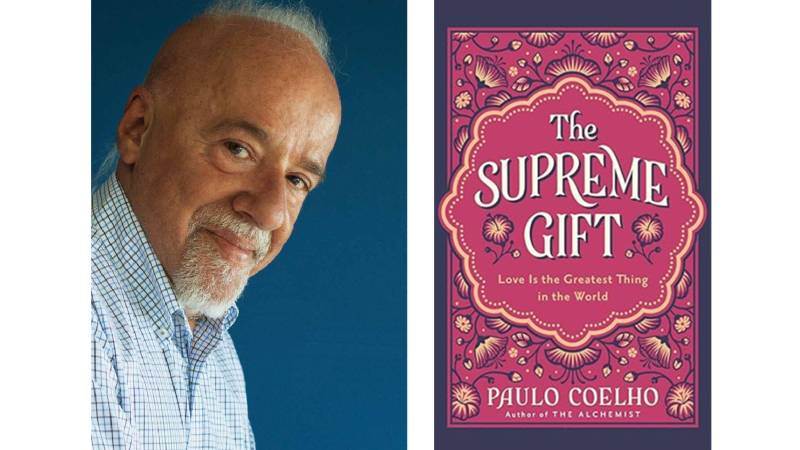
The Supreme Gift speaks of love, which the author Paulo Coelho categorizes as a human being’s greatest fortune and spiritual centre.
In his book The Supreme Gift, Coelho adapts the 19th-century sermon "The Greatest Thing in the World" by Henry Drummond. The work explores St Paul's Letter to the Corinthians, breaking love down into nine essential “ingredients” or virtues that transform daily life. These nine ingredients are: patience, kindness, generosity, humility, gentleness, dedication, tolerance, sincerity and innocence.
Coelho’s message to his readers is that while faith and hope are essential, love is the only immortal force and the most gratifying way to live, regardless of one's religious beliefs. Coelho explains that we are misled to believe that faith is central to life, in fact it is love which is crucial for all existence and the reason for being alive.
In The Supreme Gift, Paulo Coelho summarizes these nine “ingredients” of love as practical virtues that shape our personality and affiliations. Firstly, he talks of patience which is the ability to wait calmly and unhurriedly. It is described as love's “normal attitude,” a quiet endurance that understands that things unfold in their own time. Secondly, he talks of kindness which is called “love in action”. It consists of simple, daily acts that bring serenity to others without expecting a reward. Thirdly, he talks of generosity, which is love in the face of rivalry. It is a lack of envy and a willingness to celebrate the successes and happiness of others. Fourthly, he talks of humility which is the absence of bragging or arrogance. It is the quiet recognition of one’s own place without needing to feel superior to others.
Title: The Supreme Gift
Author: Paulo Coelho
Publisher: HarperCollins, 2026
Fifthly, Coelho writes of courtesy (or gentleness) which is love expressed through good manners and respect. It is the refusal to be rude or offensive, even in difficult situations. Sixthly, he talks of unselfishness (or dedication) which is love that does not insist on its own way. It involves seeking the interests of others and giving up personal rights for their assistance. Seventhly, he writes of good temper (or tolerance) which is the practice of not being easily aggravated, cantankerous, or resentful. It is the choice to understand rather than judge. Eighthly, he mentions guilelessness (or innocence) which is a state of being without nastiness or suspicion. It means viewing people in the best light and refusing to have ill will against them. And lastly, he writes about sincerity, which in his words is loving the truth and refusing to rejoice in misconduct. It is the alignment of one’s words and actions with honesty and integrity.
Not every crisis can be solved merely by being loving – the book could have been a short essay rather than marketed as a tiny book for sales purposes
Coelho emphasizes that these virtues are not just personality traits but skills to be practiced daily to achieve spiritual growth. Coelho quotes from St Paul’s letter to Corinthians, that: “Love is patient and kind, love does not envy or boast; it is not arrogant or rude. It does not insist on its own way; it is not irritable or resentful, it does not rejoice at wrongdoing, but rejoices in the truth. Love bears all things, believes all things, hopes all things, endures all things…So now faith, hope, and love abide, these three; but the greatest of these is love.” Coelho very aptly quotes Stephen Grellet who wrote: “I shall pass through this world once. Any good therefore that I can do or any kindness I can show to any human being, let me do it now. Let me not defer or neglect it, for I shall not pass this way again.”
I enjoyed the portion of the book where Coelho talks of eternal love and explains it in the simplest terms as follows: “To love abundantly is to live abundantly. To love for ever is to live for ever. Eternal life is inextricably bound up with Love. Why do we want to live for ever? Because we hope that tomorrow will bring us someone we can love. Because we want to live another day with the person we love beside us. Because we want to find someone who deserves our Love, and who, in turn, will know how to love as we deserve to be loved.” In another chapter Coelho explains so perfectly that: “Love is here, it exists in us here and now. It is not something that will be given to us after we die. On the contrary, we will have very few chances to learn Love when we are old if we do not seek it out and practice it now.” He adds in another concluding chapter that the final test of every search for salvation will be Love. “What we did or believed or achieved will be of no account,” he writes.
Though I read the book with interest I was disappointed because there was a great deal of repetition around ‘Love’ – the term itself seemed to become redundant by the end of the book. Also, the author seems to live in a theoretical word offering no concrete solutions to real-life problems that human beings face on a daily basis – not every crisis can be solved merely by being loving. The book could’ve been a short essay rather than marketed as a tiny book for sales purposes. In the end, I found the book to be overly optimistic and going on and on about ‘Love’ which we all know from experience is not the only solution to life’s problems.