

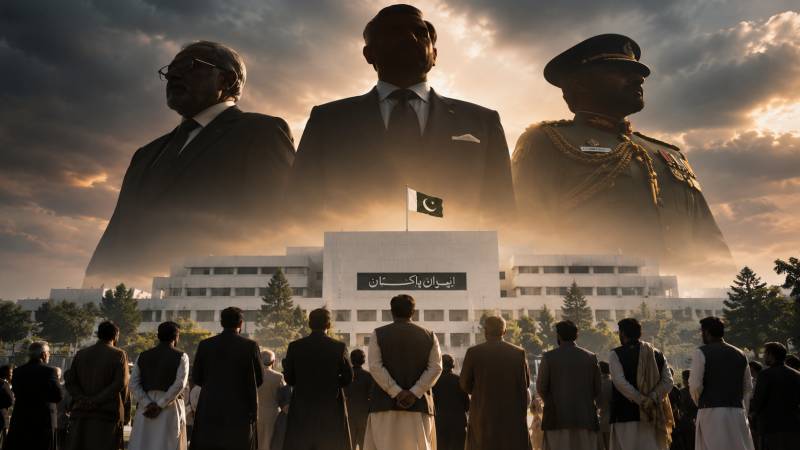
Pakistan's tragedy is not merely that it is governed badly; it is that it is governed by the worst among those who seek to govern it— rule by the least qualified, the least scrupulous, the least deserving — finds perhaps its purest contemporary expression in the Pakistani state, where a narrow cartel of dynastic political families and an overweening military establishment, lubricated by a complicit bureaucracy, have conspired to convert a nation of 240 million people into a family estate with a flag.
The numbers are not ambiguous. Research identified 597 families that have occupied roughly 3,300 of the more than 7,600 legislative seats contested across nine general elections since 1970. At its peak in 1993, nearly half of all seats in the national and provincial assemblies were held by members of political dynasties. In Punjab, the country's political heartland, dynastic representation has touched 64 per cent in the south of the province. The Pakistan Institute of Development Economics has observed, with dry academic precision, that the 342-member National Assembly is in reality an assembly of some 204 families. This is not democracy; it is hereditary succession with an electoral veneer.
Yet to blame the families alone is to mistake the symptom for the disease. The deeper pathology lies in the biradari — the clan, the kinship network, the tribal-caste lattice that remains the fundamental unit of Pakistani social and political life. In the rural constituencies that decide national outcomes, a Bugti votes for a Bugti, a Jatoi for a Jatoi, a Chaudhary for a Chaudhary. Electoral choice is not an expression of policy preference but an act of tribal allegiance, a transaction of patronage in which the candidate is less a representative than a feudal lord dispensing favours to his kin. Political parties, far from being vehicles of ideology, function as franchise operations for landed families, distributing tickets the way a family business distributes shares. Even the reserved seats for women — sixty in the National Assembly are routinely allocated to wives, daughters, and sisters of sitting parliamentarians, converting a progressive reform into an instrument of dynastic consolidation.
The military establishment, which has directly ruled Pakistan for roughly half of its existence and indirectly managed it for most of the remainder, presents itself as the corrective to this dynastic rot. In practice, it has been its accomplice and, at times, its beneficiary. Generals who topple elected governments on charges of corruption install their own favoured dynasts when convenience demands; politicians who rail against military intervention in opposition govern by its sufferance in office. The bureaucracy, that vast and supposedly neutral administrative apparatus, has long since ceased to be a check on either, becoming instead a partner in the distribution of state patronage — postings, contracts, licences that sustains the entire arrangement. The result is a self-perpetuating oligarchy in which the military, the dynasts, and the bureaucratic elite rotate through power while the underlying structure remains untouched.
Pakistan's future requires the deconstruction of the clan-state: institutions must answer to citizens rather than kin, political parties must value competence over bloodline, and voters must act as a public rather than a tribe.
The democratic pretence collapses entirely when one examines the electoral arithmetic. Pakistan's voter turnout has never exceeded 63 percent achieved in the extraordinary circumstances of the 1970 election and has more commonly hovered between 40 and 52 percent. The 2024 general election recorded a turnout of 47.6 percent, with 60.6 million votes cast out of 128.6 million registered voters. The 2018 election managed 51 to 55 percent, depending on the measure. In 1997, turnout fell to a dismal 35 percent. Consider what this means: the government of a nuclear-armed state of 240 million is chosen, in a typical election, by barely one in four of its citizens — the non-voters, the disenfranchised, the millions under eighteen, and those excluded from the rolls together constituting a silent majority larger than any mandate claimed by the victors. No Pakistani government in living memory can honestly claim the backing of a popular majority. They govern by plurality of a fraction, then arrogate to themselves the full authority of the people's will.
And what becomes of those who win by clan, by biradari, by the dint of establishment favour? They proclaim their victory as merit. There is no merit in it. The scion who inherits a seat in Larkana or Lahore has demonstrated no competence beyond the accident of birth; the ticket-holder appointed by a general has passed no examination but loyalty. Meritocracy — the idea that office should follow ability is not merely absent from this system; it is structurally impossible within it, for the system's very logic is the conversion of inherited advantage into political power.
The final indignity is the exit. Having decided the fate of millions from the comfort of ministerial offices, having presided over a state that cannot provide clean water, functioning schools, or affordable bread to its citizens, the governing class decamps. Their children are educated in London and Boston; their wealth is parked in Dubai and Surrey; their medical emergencies are treated in hospitals they would never deign to build at home. They rule a country they would not live in, over people whose suffering they will never share. The places they govern are, by their own revealed preference, not worth inhabiting.
The reform of such a system cannot be cosmetic. Term limits and anti-corruption commissions will not dissolve the biradari; election monitoring will not democratise a polity in which the ballot is an instrument of kinship. What is required is nothing less than the deconstruction of the clan-state — the building of institutions that answer to citizens rather than kin, of parties that select candidates by competence rather than bloodline, of a military that defends borders rather than manages politics, and of an electorate that votes as a public rather than a tribe. Until that reconstruction begins, Pakistan will remain what it has long been: a kakistocracy of kinship, where the worst rule in the name of the many, and the many pay the price.