

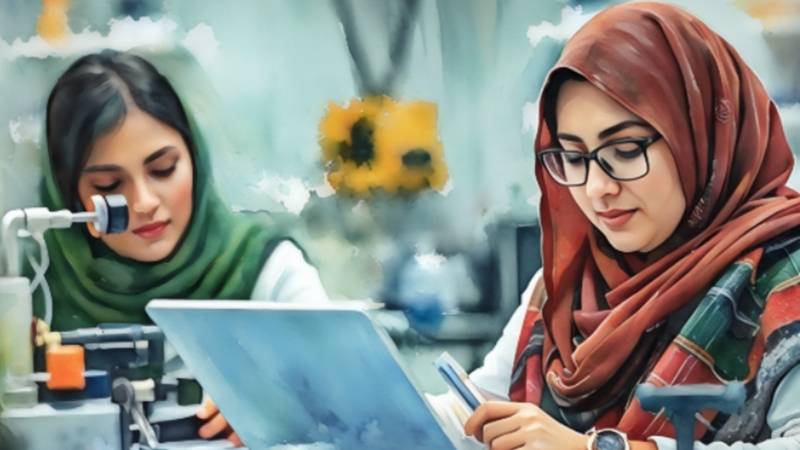
It is once again that time of the year when we pause to reflect on how far we have come as a gender, foremostly, and then as humans. The anthropocentric view of our age makes it even more challenging to assess our role on this earth. Climate change and its effects on women, meeting Sustainable Development Goals, and the implementation of a green economy have become increasingly critical for the bare survival of humanity, in harmony with the environment and, at large, with the universe. Peace within, peace without. While the world grapples with food shortages, economic warfare, and the mutations of pandemics, women continue to fight for equity, justice, and green laws. The resilience with which we have come this far is commendable.
Let us take this moment to celebrate our journey toward a just and equitable society. Success comes in leaps and bounds for some, and for others in small, hesitant steps—what matters is that there is movement toward the goal!
Women have come a long way in the fields of science and technology since the days of Madame Curie, who, in her struggle, remained determined not to give up on her quest. Let us not forget that success is a shared journey; there was a friend and a partner, a man who saw Curie as nothing less than an equal. The doors that were opened for women in science by Curie—were these doors opened equally to all women? This remains an essential question.
Nearly 90 years since her death, women in science today still face challenges in being recognised as scientists. The underrepresentation of women in STEM fields is a persistent issue. Women hold a minority of endowed chairs and professorships in the sciences at universities. Most concerning are the challenges faced by young girls of colour who aspire to enter STEM fields and by women of colour seeking successful academic careers in these areas. Women of Asian and African origins, in particular, face triple the amount of these challenges compared to their counterparts in the Western world, due to cultural norms and traditional gender stereotyping. However, we have ground breakers like Nergis Mavalvala, a physicist known for her work on gravitational waves, and Tasneem Zehra Husain, a theoretical physicist and string theorist.
Madame Curie’s family background, environment, and work ethic were instrumental in her Nobel Prize-winning achievements. Yet, the less-often-told story is one of the challenges she faced because of her gender—challenges to access education, challenges to receive recognition for her extraordinary scientific contributions, and challenges to have her intelligence valued. Her focus and determination made her successful, but the biases she fought against were numerous and deeply entrenched.
My mother restricted her own advancement because her children were too young to be left in anyone else’s care while she pursued her dreams. Her PhD in organic chemistry remains incomplete, missing its final publication—a dream she still revisits in her deepest sleep
Gender stereotypes continue to discourage women from pursuing careers in STEM fields. Societal pressures to conform to traditional roles and expectations breed hostility toward women in research and technology, making it difficult for them to achieve excellence. Economic disparities and systemic discrimination strip countless women of the knowledge and skills needed to fulfil their potential. The lack of equal opportunities due to limited representation in mainstream STEM and STEAM fields further exacerbates the issue.
The shortage of women in leadership roles within academia and research institutions impedes their professional development and career growth. This lack of diverse leadership hampers innovation and limits the creation of inclusive and equitable environments within these professional spheres. Balancing career and family life remains another significant challenge. My mother restricted her own advancement because her children were too young to be left in anyone else’s care while she pursued her dreams. Her PhD in organic chemistry remains incomplete, missing its final publication—a dream she still revisits in her deepest sleep. As if her personal tragedy wasn’t enough, she imposed the same limitations on me, her daughter. Though I eventually charted my own path to self-actualisation, it feels unjust to have wasted so much time before pursuing my aspirations.
Similarly, we witness a significant brain drain in environments that are not conducive for women to make their mark, especially in science. This year, the theme of International Women’s Day 2025 is “Accelerate Action.” It is a call to the world to support, acknowledge, and help women advance in their respective fields. As William Shakespeare’s play Coriolanus aptly states, “Action is eloquence,” voicing the need of the hour.
The situation, however, is not entirely bleak. We have come this far and remain resilient in the face of adversity. We are supportive and encouraging, ready to go the extra mile for one another. I, for one, am fortunate to have women of substance as colleagues who take equal pride in supporting each other. The shared sense of achievement is cherished manifold. The real obstacle lies in the parochial mindset that undermines the philosophy of equal rights.
Among us are secure and powerful women who pave the way for one another. Arundhati Roy’s recognition of Elif Shafak’s work is a fine example: “Make place for Elif Shafak on your bookshelf. Make place for her in your heart too. You won’t regret it.” Women of letters have always challenged societal norms, fought injustice, expanded literary canons, explored diverse themes and perspectives, trailblazed democratic change, and engaged in both private and public activism.
When it comes to IT and AI, we encounter groundbreakers, innovators, and determined individuals like Sadia Bashir in the Pakistani gaming industry. She founded Pakistan’s first game school, which has helped change attitudes toward women in gaming.
Marie Curie once said, “Nothing in life is to be feared. It is only to be understood.” People who break their own patterns, evolve, discover and rediscover, learn, unlearn, and relearn—people who question the status quo and challenge themselves—cannot be held back. Kaifi Azmi’s poem “Aurat” remains a constant source of motivation, reminding us of the enduring strength and resilience of women:
تو فلاطون و ارسطو ہے، تو زہرہ پروین
تیرے قبضے میں ہےگردوں تری ٹھوکرمیں زمیں
Feminism is about all genders having equal rights and opportunities. It's about respecting diversity and finding unity in diversity!