

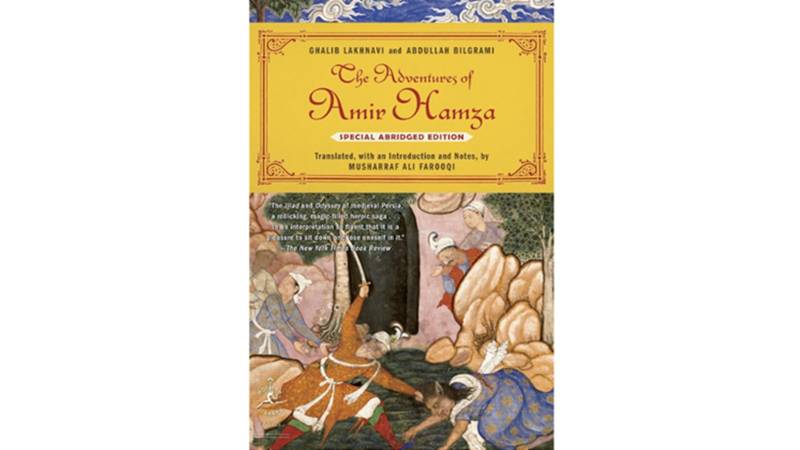
The Adventures of Amir Hamza (or Dastan-e Amir Hamza) is a massive Indo-Persian epic following the mythological and romantic exploits of the Prophet Muhammad's (PBUH) uncle, Amir Hamza. It details his sweeping odyssey across the mortal world and Mount Qaf to conquer lands, battle demons, spread the True Faith, and win the heart of a Persian emperor Naushervan’s daughter, Mehr-Nigar.
The story begins in Ctesiphon, the capital of the Persian Empire, ruled by Emperor Naushervan. His wise vizier, Buzurjmehr, reads the stars and foresees the birth of a magnificent warrior who will protect the empire. This child is Hamza, born to Abdul Muttalib of Mecca. Simultaneously, Amar, a child destined to be the master trickster (ayyar), is born to a local camel-driver. The boys grow up as inseparable blood brothers. Hamza quickly gains fame by slaying rogue lions, conquering rival tribes, and executing brilliant tactical manoeuvres. This makes Naushervan summon him to Persia to serve as his ultimate military commander.
At the Persian court, Hamza falls deeply in love with the Emperor's beautiful daughter, Princess Mehr-Nigar. However, their union is bitterly opposed by Naushervan’s spiteful vizier, Bakhtak. Seeking to destroy Hamza, Bakhtak orchestrates impossible military tasks, sending Hamza to neutralise ferocious rebel groups across Greece, India, and Byzantium. Armed with superhuman strength, Hamza survives every expedition, winning the loyalty of conquered kings and converting thousands to the True Faith. Driven to desperation, Bakhtak plots multiple assassinations, all of which are foiled by the lightning-fast wits of Amar the Ayyar.
Armed with superhuman strength, Amir Hamza survives every expedition, winning the loyalty of conquered kings and converting thousands to the True Faith
The epic delves into pure dark fantasy when Emperor Shahpal, king of the benevolent fairies (jinn) of Mount Qaf, begs Hamza for help. Shahpal's kingdom has been overrun by a violent rebellion of colossal demons (devs) and shadow sorcerers. Hamza crosses the boundary of the mortal world to serve as Shahpal’s champion. He undergoes an 18-year magical campaign where he systematically hunts down horned monsters, navigates deceptive mirror-mazes, and shatters talismans. Because time moves slower on Mount Qaf, decades pass in the human world while Hamza remains youthful, fighting side-by-side with enchanted beings.
When he returns to Earth, Hamza finds his mortal allies aged, scattered, or captured. He rallies his remaining forces and faces his longest military challenge: the war against Gubad Jadu and a successive line of increasingly powerful sorcerers. This phase introduces the terrifying magic of tilisms—artificial, pocket-dimension realities governed by complex alchemical rules. While Hamza uses raw physical force and blessed weaponry to break these illusions, the true battle becomes a stealth game between Amar the Ayyar and the dark sorcerers. Amar uses invisibility cloaks, knockout drugs, and master disguises to breach the magical camps from within.
The final phase of the dastan brings the epic full circle back to historical landscapes. Mehr-Nigar is tragically killed, plunging Hamza into profound grief. As the rise of Islam begins in Arabia, Hamza returns home to Makkah to protect his nephew, the Prophet Muhammad (PBUH), from hostile pagan armies. During the historic Battle of Uhud, Hamza fights with unmatched ferocity but is ambushed and killed. The epic concludes with his solemn martyrdom, describing how his soul transcends to the highest heavens, cementing his legacy as the ultimate heroic defender.
There are many poems and memorable quotations in the first book, such as the following verses, which reflect the epic’s recurring concern with fate, justice, and the fleeting nature of worldly success:
“Do not be neglectful of the retribution for your works, For a grain of wheat begets wheat, and barley its kind.”
“No two days pass alike in this world; There is no garden that could avert autumn.”
On his martyrdom, the book says: “At the moment His Holiness received this divine message. “Dear friend! Hamza has been martyred, but do look up to the heavens.” When His Holiness looked up, he saw Amir Hamza seated on a bejeweled throne in Heaven with houris and pages standing around him with folded arms, Then His Holiness smiled and said prayers of gratitude.”
The book is rather long, and therefore, at parts, the wars, the exploits, and the several marriages were tedious for me to read. But overall, the momentum was maintained by the translation, and considering it was 900 pages long, it kept me occupied for an entire month. When I finished it, I looked back at it as an achievement. The tales of jinn and fairies and Mount Qaf were extremely interesting; there was even a magical horse.
The Adventures of Amir Hamza is an astonishing fusion of romance, fantasy, folklore, and heroic adventure. While its immense length occasionally slows the pace, the richness of its imagination and the elegance of Musharraf Ali Farooqi’s translation make it one of the most rewarding classics of Indo-Pak literature available in English. Readers who enjoy epic fantasy, mythology, or literary history will find it an unforgettable journey.