

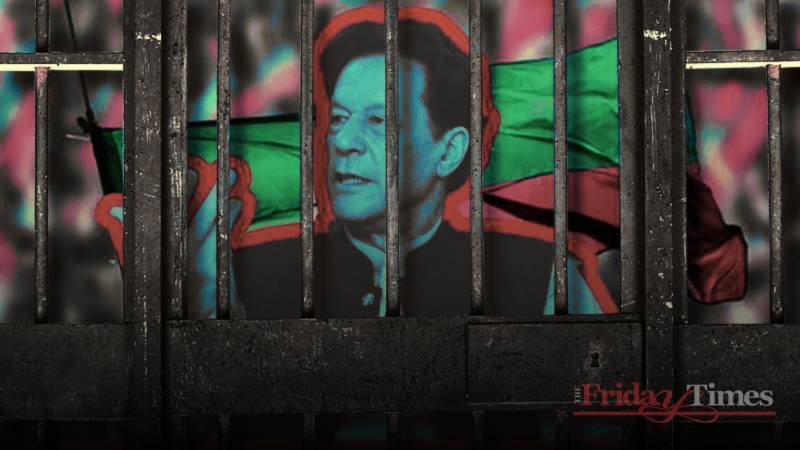
Imran Khan, the cricket icon-turned-populist prime minister, now sits behind bars, his dramatic fall from grace shaped not by conspiracy but by a string of miscalculations, polarising rhetoric, economic chaos, and political hubris. His incarceration reflects the very institutional accountability he long evaded and undermined. It is a reckoning years in the making, engineered as much by his opponents as by his own actions.
When Khan took office in 2018 promising a “Naya Pakistan,” the country’s economy stood at roughly $315 billion. Within his first year, it had shrunk by $25 billion, reversing years of modest growth. By 2020, even before the full shock of COVID-19, GDP had dipped to around $270 billion—levels last seen five years earlier. While external shocks contributed, the downturn was primarily the result of erratic policy decisions, currency devaluation, and investor uncertainty. At a time when steady fiscal management was needed, Khan’s administration lurched from one short-term measure to the next, dismantling hard-won economic progress in the name of reform.
Meanwhile, his government borrowed furiously. According to his finance minister, Shaukat Tarin, PTI added nearly Rs. 20 trillion to the national debt—amounting to 76 percent of all previous borrowings combined. Yet this debt did not translate into major infrastructure or energy projects, as had been the case under previous governments. Instead, much of it was used to plug budgetary holes or subsidise policies that gained short-term political mileage while worsening long-term liabilities.
Alongside economic turbulence came a new, toxic political culture.
Khan’s speeches were often filled with invective; opponents were not just criticised but branded as traitors and thieves. PTI’s rhetoric bore a striking resemblance to Goebbels-style propaganda that labels dissent as betrayal. Opposition parties were dehumanised, public discourse hollowed out, and institutional norms trampled. His ministers, backed by troll farms and hyper-partisan television channels, turned politics into a televised circus of abuse. The PTI social media machine harassed critics and journalists with abandon, as governance gave way to spectacle.
The same impulse extended to his weaponisation of the legal system. Nearly every key opposition figure was entangled in legal cases. Nawaz Sharif was hounded into exile. Asif Zardari, Maryam Nawaz, and other leaders of the PML-N and PPP were arrested or faced protracted NAB proceedings. These arrests, often conducted without convictions, were widely seen as instruments of political suppression, not genuine accountability. In time, these tactics backfired, discrediting both NAB and PTI’s moral grandstanding.
It was an open secret that the 2018 elections were influenced in his favour, earning him the derisive label of “selected” rather than elected
By the end of his term, Khan had failed to convict any major opposition figure conclusively, despite the massive state machinery and media support at his disposal.
Much of Khan’s early power was derived from the military establishment, which viewed him as a pliable civilian face for a so-called “hybrid regime.” It was an open secret that the 2018 elections were influenced in his favour, earning him the derisive label of “selected” rather than elected. The arrangement worked for a time: generals called the shots on foreign policy, national security, and institutional appointments, while Khan offered populist legitimacy.
But over time, cracks appeared. As disagreements with then-Army Chief Gen Qamar Javed Bajwa surfaced, Khan turned on the very institution that had enabled his rise. His speeches began to directly attack the military, accusing its leadership of betrayal and even conspiracy to assassinate him. He likened generals to Mir Jafar, evoking the historical act of treason. In doing so, he crossed a line no civilian leader in Pakistan had dared cross so brazenly in public.
The response was swift. The military withdrew its protective cover, and the post-April 2022 crackdown on PTI saw defections, arrests, and the party’s political structure unravel. In a cruel irony, Khan became a victim of the very populism that had once empowered him—a monster devouring its creator.
Another institution that afforded Khan prolonged leniency was the judiciary. For years, courts seemed unusually indulgent. Khan secured bail in dozens of cases, was often shielded from arrest, and even received odd courtroom pleasantries.
During one hearing in May 2023, after a controversial arrest in the Al-Qadir Trust case, the Chief Justice greeted him with a cheerful “Good to see you, Imran Khan!”, prompting widespread outrage. The Al-Qadir case itself was serious: it alleged that £190 million recovered from tycoon Malik Riaz by the UK’s National Crime Agency, meant for Pakistan’s treasury, was instead deposited into the Supreme Court’s account to settle unrelated fines. In return, Malik Riaz allegedly “gifted” vast tracts of land to the Al-Qadir Trust, a charitable front led by Khan and his wife, Bushra Bibi. The deal reeked of impropriety and raised serious questions about abuse of public office.
On 9 May 2023, Khan’s arrest in this case sparked mass protests. PTI supporters attacked military installations in an unprecedented show of anger. Yet within two days, the Supreme Court declared the arrest “unlawful,” allowing Khan to walk out, smiling and defiant. To many, this confirmed a two-tiered justice system where celebrity politicians enjoyed preferential treatment. Such indulgence only deepened public cynicism and encouraged Khan’s belief in his invincibility.
But by August 2023, that illusion had collapsed. Khan was convicted in the Toshakhana case for unlawfully selling state gifts and sentenced to three years in prison. Other trials, including the cipher case, followed. Unlike his past arrests, these were outcomes of full legal processes. Despite cries of political victimhood from his supporters, courts have upheld the legitimacy of the charges against him. No one is above the law—not even a former prime minister.
Calls for leniency or a political “deal” now ring hollow. A pardon or power-sharing arrangement would send the wrong message: that chaos, demagoguery, and threats of violence can still be rewarded with compromise. For Pakistan to progress, there must be accountability—not just for the weak, but for the powerful. The economy is stabilising, polarisation is ebbing, and the courts are asserting their authority. Rolling back this progress for the sake of one man would be a historic mistake—regardless of what his lobbyists in London, Washington, or Tel Aviv say in letters, newspaper articles, or social media posts.
Imran Khan authored his own downfall. He undermined institutions and then accused them of betrayal when they ceased to protect him. He polarised society, only to find himself isolated. His failure to call out Israeli aggression against Iran or Israel’s involvement in Indian attacks on Pakistani soil, despite his self-styled image as a nationalist and Muslim world leader, exposed his selective outrage.
Today, Pakistan stands at a crossroads, and his story offers a cautionary tale: fabricated charisma can elevate, but it cannot shield forever. Sooner or later, reality asserts itself. And when it does, it rarely shows mercy.