

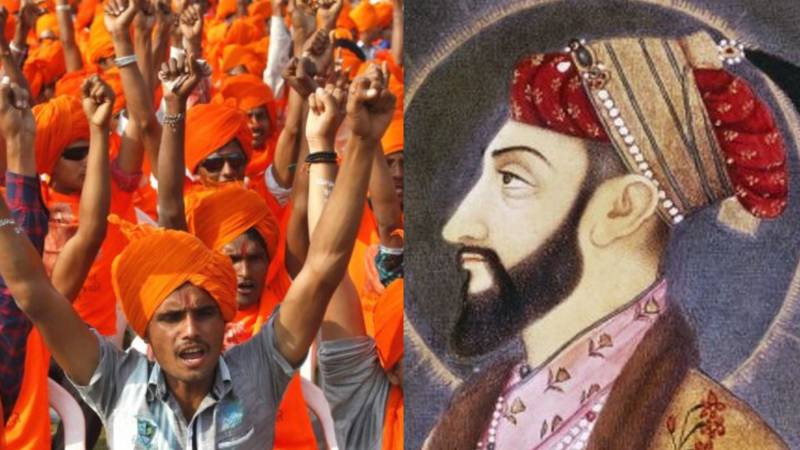
India is marching forward. A trillion-dollar economy, nuclear capabilities, space exploration—and now, most notably perhaps, an expanding national interest in discussing a Mughal emperor who passed away more than 300 years ago.
Last week, there were demonstrations in Nagpur following calls by Hindu nationalist parties, triggered by the movie Chhaava, for the destruction of Aurangzeb's tomb. The movie's portrayal of the emperor (Aurangzeb) ordering the death of a Hindu king's son caused as much outrage as box office takings. The past has once again been called upon to serve the politics of the day.
But if we’re doing this, if we’re truly purging the Muslim chapter of Indian history, then why stop at a grave?
Much of India’s post-colonial cultural restructuring strategy post-independence was to reset and connect back to its pre-colonial roots. But the question remains: How far back do we have to go to enable this erasure? If history is being rewritten, why is the government so selective suddenly? Much of what remains – culturally, linguistically, and even ceremonially – can be traced back to Muslim rule. If the past must be undone, then let’s be consistent.
Start with the Grand Trunk Road, built by Sher Shah Suri, which still carries millions across the subcontinent each day. Then there’s the Taj Mahal; easily mistaken for an Islamic contribution to global architecture. Bulldoze it. End Independence Day addresses at the Red Fort; after all, it's a Mughal fort. Prohibit Hindustani classical music—too many Farsi words and Persian sounds. And naturally, re-write Bollywood scripts to remove words of Islamic origin like “Ishq” and “Junoon” just to name a few.
And if we’re being so rightist, let’s not stop at Aurangzeb or Ghaznavi. Cricket must go too. A British invention, steeped in colonial hierarchy, tea breaks, and white trousers. Replace it with something spiritually aligned: a sport involving tridents, conch shells, and patriotic pushups. Winners are to be selected by vibration, not by score.
While such symbolic battles may galvanise the right-wing base, they cannot alter the reality that India's cultural, linguistic, and institutional DNA is indelibly imprinted on Islamic history
But here's a greater irony: if India wanted to go back to a pre-Islamic identity, why Delhi? The erstwhile capital of the Mughals, the Sultans, and the British? Why not revive Pataliputra, the capital of the Mauryas and Guptas? Or Ujjain, the former hub of astronomy and Sanskrit learning? Or Kannauj, Harsha's and the Pratiharas' imperial city? Delhi is not a departure from the past; it's an Islamic and colonial palimpsest. Ruling from Delhi while attempting to erase the legacy that constructed it is less reclamation, and more parody.
What’s even more remarkable is that Aurangzeb’s tomb isn’t even in Nagpur. It lies 450 kilometers away in Aurangabad, or rather, what used to be Aurangabad before the city was renamed to Chhatrapati Sambhajinagar in 2023. We’re now renaming cities based on who we’re mad at this election cycle.
The Chhaava-sparked fury has been more of an emotion than a fact. Nagpur protestors set ablaze effigies, brandished green cloth in the air, and spread rumors of Quran desecration—none of which were substantiated, but all of which were effective. Police quickly cracked down, taking more than 50 Muslims into custody, including those who were merely offering prayers, while far-right event organisers escaped with impunity. Democracy is served, it appears, when the law is enforced selectively.
Meanwhile, Modi keeps quiet. And his silence is coldly calculated. His administration does not have to overtly sign up for historical revisionism; it simply encourages filmmakers to do that for them. The BJP's coalition partners do not require manifestos when they have films. Chhaava did the heavy work, villainising Aurangzeb on screen, stoking feelings off-screen, and providing far-right demonstrators with just enough fictional grist to excuse real-world violence.
This event is more than an instance of a public outburst. It is the revelation of an ambitious plan to purge India of its collective memory—one name, one tomb, one book at a time. In the BJP's version of history, Aurangzeb is the embodiment of Islamic tyranny, a counterpoint to a glorious, invented Hindu past. But the paradox runs deep: this monster was initially created by British colonial historians, who had to divide Muslims and Hindus to govern more effectively. Today's Hindu nationalists are merely reading from the same imperial script; albeit with louder chanting.
Politically, of course, this has a function. It reduces centuries of complex, syncretic history into an easily digestible morality play: us versus them. And it distracts voter attention. With elections approaching, and India's youth confronting inflation, underemployment, and increasing inequality, it is much simpler to exhume a grave than to create jobs. The Aurangzeb debate isn't about history, it's about deflection. Populism feeds on anger, and nothing stokes anger like a narrative that feels older than facts.
If Modi’s government plans to purge India’s history of its Muslim past, it may achieve modest political success but rarely from a spiritual standpoint. This is because cultural identities are too deeply intertwined in language, music and culture. Urdu, Persian, and Arabic have left imprints on everyday speech, from Bollywood dialogue to courtroom vocabulary. Hindustani classical music owes heavily to Indo-Islamic fusion, in which ragas journey through Persian modes and Sufi metaphors. Even institutional terms like “exchequer” and “admiral”, rooted in Islamic etymology, reflect a civilisational footprint that extends far beyond India. It is a legacy too deeply embedded for any government to erase.
While such symbolic battles may galvanise the right-wing base, they cannot alter the reality that India's cultural, linguistic, and institutional DNA is indelibly imprinted on Islamic history. To try to turn that around isn't revisionism; it's a spiritual amputation. If the objective is civilisational purity, then it has to be at a cost: relinquish the vocabulary, the infrastructure, and the administrative instruments constructed upon Islamic knowledge systems. But no state can afford such honesty, certainly not one that rules from a Mughal-era capital and charges admission to a Mughal-era tomb.
Others have tried this before. Spain tried this too. The Moors were driven out and the language was switched from Arabic to Castilian. And yet the Moors never actually left. From domes to flamenco, their presence is felt everywhere.