

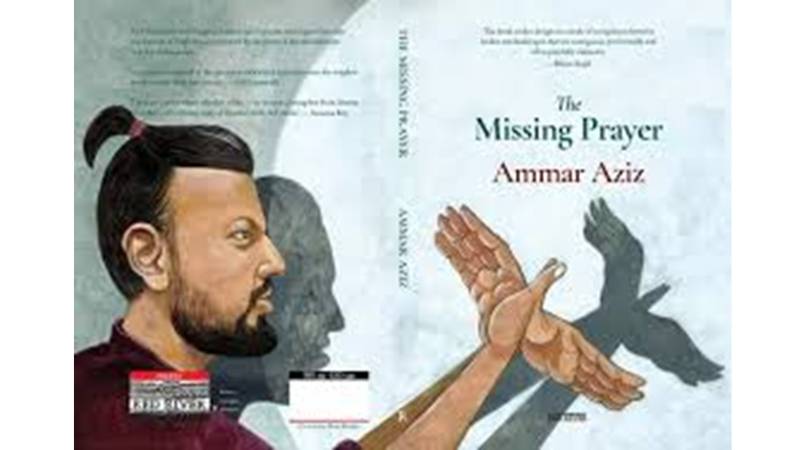
In the rusted remains of discarded family relics, a ragman searches for “what we never thought existed / in our everyday things,” yet the poet may well be describing the essence of his own poetry.
In his debut poetry collection, The Missing Prayer, poet, filmmaker and literary translator Ammar Aziz sifts through the overlooked and the ordinary, unearthing hidden depths, buried memories, and the weight of the unsaid. There is a natural knack for finding prompts in the most unlikely places to cast the world anew. Consider the poem where his mother’s message, written with the help of AI, has the poet “orphaned without her Urdu / homeless without her typos,” or when battling insomnia in another country he realises he is “not used to ceilings without fans.”
If Aziz has a skill for conveying profound ideas with ease, at other times, he uncovers profundity in the seemingly mundane: “in my mother’s garden / a city grows in a pot / she reminisces about Kabul / looking at its ruins.” Or when referring to “the Temple Road / where there’s no temple anymore,” or simply “you wonder / if each night has her own ritual / her own grief.”
The book is arranged into sections that offer context to poems that might read differently in isolation. For instance, the lines from the poem October, “you noticed the glimpses of God / in the wrinkles of old peasants / as you spoke of an eternal godlessness,” reveal hints of the October Revolution, a fading communist legacy, the plight of the marginalised, and the reality of religion, only because it sits among poems about a former comrade’s crumbling living quarters, and another’s will.
Despite the occasional gravity of his themes, Aziz is never verbose. His tone is meditative, looking back into the long mirror of the past: histories, different ways of being, mythology, pluralism, with the poet’s chief concern being to form a connection, rather than showcasing linguistic theatrics. Also, despite being laced with a certain melancholy, the melancholy is not that of despair, but of something ethereal on the brink of being lost, which the poet is on a lonely mission to reclaim.
While the imagery is lush, there’s no Wordsworthian abandon here, revelling in the beauty of flowers, birds, verdant trees or azure skies. Instead, Aziz finds beauty in the most unlikely places: in the “broken pieces” of a “slain” musician’s “sitar”; in the word chaashni, which he likens to “a dreamy state / of slumber / while still awake”; or in “a city / where walls grow / like plants.”
The book begins with the poet’s personal history, both remembered and inherited, chronicling personal losses not only to death, but also the fading of his mother’s poetry in the face of practical concerns or the erasure of his poet grandfather’s life’s work during Partition. He also mourns the slow erosion of pluralism and the arts, recalling a time when Lahore still held vestiges of an idealism not wholly extinguished by the extremism of the 1980s. The air, he writes, literally and metaphorically was less toxic and more forgiving. Yet, despite repeatedly mining his life and lineage, the poetry isn’t self indulgent or self-absorbed. Instead, there’s a persistent awareness of himself being merely a cog in the wheel of historical forces.
A deep awareness of plural pasts and multiple presents is reflected in the poet’s religious faith
A series of elegies mourning, and celebrating loved ones, occupy a significant place in the collection. The poet’s younger brother, lost barely out of teenage, is eulogised as “too dreamy to be real / too real to be gone,” and his late father who “dismisses / free verse and encourages me / to use some rhyming words” is heeded in the form of the occasional rhyming scheme in the midst of free verse. In the face of this constant encounter with mortality, Aziz’s engagement with poetry, Hindustani classical music, and filmmaking seem like an attempt to immortalise himself and those lost to him; to connect with what is as permanent as we are transient.
The poems resurrect, not only the dead but also the ‘officially dead’, either through bureaucracy or being pushed to the very edge of collective consciousness, like Communist T, who lacks “papers to prove / his existence,” the Hunchback of Shama Cinema who becomes “the new deity / for the destitute,” or Shumal Khan, a first-hand witness to the war on terror, who “can tell / looking at the stars / which day it will rain.”
While the poems have a global scope, equating “global” solely with the Western, as is too often done, would be reductive in the world of The Missing Prayer. The global here is the Indus Valley civilisation, Persian and Arabic influences, communist principles and world literature, aptly reflected in these lines that simultaneously invoke Kafka and Mirabai, that too, in a poem on the poet Miraji: “an insect, / wandering in despair and desire / the way Mirabai must have roamed / seeking Krishna.” Verses like these show that a truly global perspective can only be achieved by inhabiting and internalising the philosophies, mythologies and landscapes of both East and West. The Missing Prayer stands out for striking that balance: deeply rooted in indigenous traditions and spiritualities, while refusing to dilute or exoticise them for the white gaze.
A deep awareness of plural pasts and multiple presents is reflected in the poet’s religious faith. His conflicted relationship with his ancestral faith and the traditional image of God is described as, “unaware, / I lost (you) little by little / everyday.” Instead, he invokes a rich, time-honoured spirituality through the image of a dargah (Sufi shrine) with its weathered mujawar (caretaker). The echoes of timeless rituals, “the sacred sounds of ankle-bells when dervishes moved in ecstasy, wearing green rags”, serve as a counterpoint to the narrow, purist interpretations peddled by the state in recent times.
Aziz’s filmmaking background adds yet another dimension to his poetry. His poetic eye, zooming in on the intensely personal before pulling back to cosmic vastness, from “an abandoned vacuum cleaner” gathering “dust from past days” to “cosmic dust / fallen on certain nights” mirrors a director’s lens. This also enables him to look at his own experiences through the lens of an outsider: “growing up in this neighborhood / doesn’t mean you won’t experience / the sheer meaningless / of it all.”
The book carries an organic feminist sensibility (“we run and find the mud, / mixed with the blood / of our foremothers”) not through overt denouncements of patriarchy, but by the invocation of maternal figures and celebration of the complex nature of female identity, primarily through reflections on the poet’s mother. And lest one dismiss it as Freudian, Aziz has the kleptomaniac narrator of one of his poems tell his lover and by extension, the reader to “f*** your Freud.”
A whole section of the book is dedicated to the Raagmala: poems centered on six ragas corresponding to a different moment in the time cycle of a day. For anyone to take on the Raagmala, a form that has been explored by maestros for centuries, is no mean feat. Yet, in his attempt, Aziz does not merely replicate; he reimagines, managing to expand the maternal metaphor beyond Mother Earth or Motherland to Mother Lamp, Mother Forest, Mother Lake. Consider the following lines from Todi: “in the morning my mother becomes a forest / scented with the sacred sounds of Todi / mystic women sit beneath her trees / with closed eyes / their tanpuras pregnant / with the music / whose birth raises the sun.” In a few lines, the mother as a cosmic presence, music as a bridge to the metaphysical, female mysticism, the act of music giving birth to the sun, rather than the other way around, to underscore the transformative power of Hindustani music (also seen in ragas like Megh or Deepak) is rendered with effortless finesse.
The voices of vastly different women across the collection crescendo into The Brown Man’s Ballad of the Virgin, a sweeping, multi-part poem blending body, spirit, homeland, parallel realities- all in the tradition of Sufi poetry, yet rooted in our time and place. The central figure of the ‘Virgin' isn’t merely a person, but represents something far more elusive: lost traditions, fragmented parts of the self that have been lost or deliberately silenced. The virgin embodies what colonialism sought to erase, redefine and streamline- language, identity, and metaphor. Aziz reflects on how 'colonial masters / never understood / our metaphors— / of the world as a wine-tavern / or night as the curls / of a woman’s hair.' Yet 'She is not simply the taste of salt / used to preserve the dead” but a living, vibrant force. In essence, the Virgin is everything that rigid binaries and sanitised norms aren’t. So, too, is The Missing Prayer.