

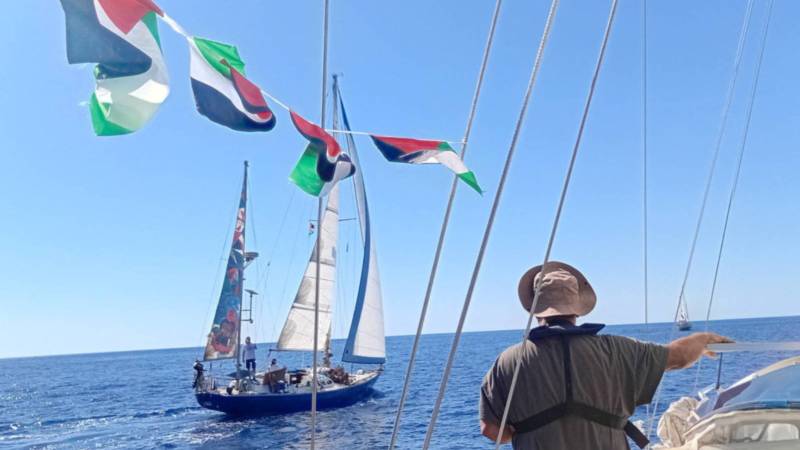
The image of the intercepted flotilla off Gaza’s coast once again exposed the limits of global diplomacy. The vessel, carrying humanitarian supplies and international activists, was halted in international waters under the claim of security enforcement. It was not the first flotilla to be turned back, nor the first to reveal how diplomacy functions without accountability. The episode became symbolic of a broader paralysis in the international order, where the vocabulary of human rights remains abundant but its enforcement scarce.
The Gaza crisis has reignited debates on recognition, sovereignty, and the meaning of statehood in a system defined by selective empathy. While many nations reaffirmed their support for a Palestinian state, the institutional machinery that could make such recognition meaningful remains absent. Resolutions are passed, statements are issued, and yet the material conditions on the ground persist unchanged. The distance between diplomatic rhetoric and humanitarian reality has seldom appeared so wide.
In this latest round of tension, the patterns are familiar. The United States, still the dominant actor in Middle Eastern diplomacy, finds itself balancing contradictory imperatives: strategic alliance with Israel, domestic political considerations, and the moral weight of civilian suffering. The recent episode involving a U.S.-mediated apology to Qatar over Israel’s actions underscored how power, not principle, continues to define diplomacy. The forced apology, choreographed under pressure, was less an act of reconciliation than a demonstration of hierarchy within the international system.
Israel’s current leadership, shaped by Benjamin Netanyahu’s long political tenure, has doubled down on a doctrine that sees negotiation as a threat rather than an avenue for peace. His government’s policies, rooted in a maximalist reading of Zionism, have marginalised internal dissent and hardened attitudes toward the concept of Palestinian sovereignty. In this context, the language of a “two-state solution” often functions as a rhetorical placeholder rather than a viable roadmap.
The question that lingers is not whether peace is possible, but whether the international order retains the capacity to enforce it
Each round of peace talks raises the promise of a two-state solution, yet the logic of occupation and expansion consistently undermines its foundations. The most recent U.S. proposal, framed as a renewed pathway toward two states, once again emphasises economic normalisation and security guarantees over territorial sovereignty. Its architecture mirrors previous efforts: offering administrative autonomy to Palestinians without addressing the structural realities of occupation. As in earlier initiatives, the absence of enforcement mechanisms ensures that diplomacy remains aspirational rather than transformative.
Critics such as Noam Chomsky have long argued that peace frameworks built without genuine equality are destined to fail. For Chomsky, the two-state model has been systematically undermined by facts on the ground, including settlements and asymmetric power relations. Henry Kissinger, conversely, viewed regional stability as contingent upon controlled conflict management rather than comprehensive resolution. Both perspectives converge on a single insight: diplomacy that lacks enforceable commitments cannot produce lasting peace.
This gap between ideal and implementation is not unique to Gaza. It reflects a broader pattern where international law is invoked selectively. Humanitarian corridors are promised but rarely protected; resolutions are passed without consequence. The flotilla’s interception illustrates this perfectly. The international community condemned the act, yet no tangible accountability followed. Diplomacy, in this formulation, becomes performative: a means to manage outrage, not to resolve injustice.
Historical analogies offer a perspective on the futility of moral appeals without power. In 1939, Mahatma Gandhi wrote to Adolf Hitler, urging him to resist the path of violence and seek peace. The letter, sincere in intent, revealed the limits of persuasion when confronted with ideology and force. Today’s appeals to end the siege of Gaza carry a similar tension. Words, however principled, cannot alter realities sustained by military might and geopolitical calculation.
The humanitarian consequences are profound. Gaza’s population continues to endure restrictions on movement, trade, and essential supplies. International agencies struggle to deliver aid amid logistical barriers and political blockades. The recurring destruction of civilian infrastructure hospitals, schools, and power plants, creates cycles of reconstruction and dependency. Meanwhile, global attention fluctuates with each new crisis, leaving long-term recovery efforts perpetually underfunded.
At the diplomatic level, fragmentation persists. Arab states that once championed the Palestinian cause now pursue normalisation with Israel through economic and security arrangements. Western governments issue calls for restraint but avoid measures that might compel compliance. Even within multilateral institutions, procedural debates often eclipse substantive outcomes. The United Nations, constrained by veto politics, has become a forum for expression rather than enforcement.
For Israel, this environment enables continuity. The calculus remains that temporary international criticism is a manageable cost for long-term territorial and political objectives. For Palestinians, it perpetuates a cycle where recognition without realisation offers symbolic legitimacy but little material change. The result is a status quo that rewards endurance rather than compromise.
The current phase of diplomacy, therefore, reveals a structural flaw: mediation without a mechanism. Agreements are designed to de-escalate rather than to resolve, and accountability is replaced by managed ambiguity. The global system appears content with the language of peace as long as it does not require the enforcement of justice. It is this disconnect that transforms diplomacy into a theatre predictable in script and tragic in outcome.
The question that lingers is not whether peace is possible, but whether the international order retains the capacity to enforce it. As the flotilla’s fate reminds us, good intentions cannot override entrenched hierarchies of power. Until diplomacy is paired with enforceability, Gaza will remain a test not only of regional politics but of the world’s moral coherence.