

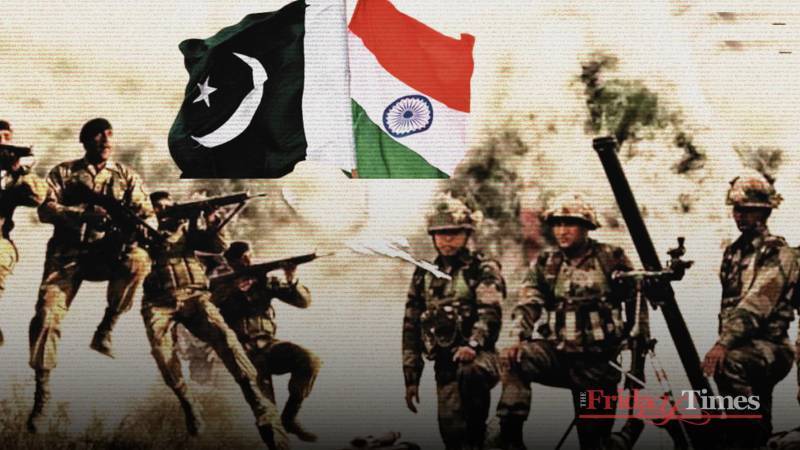
On the night of 6 and 7 May, Pakistan’s sovereignty was reportedly violated when strikes were carried out across a recognised border without a UN mandate, independent oversight, or publicly presented evidence. No formal investigation was underway, and no legal justification was shared at the time. Yet force was used regardless, in what was widely described as a breach of established international norms.
The operation was referred to in India as “Operation Sindoor”, reportedly named in honour of the widows of the Pahalgam attack just a fortnight earlier. In what almost reads as an unintended paradox of language and outcome, a campaign framed around remembrance of widows was, by several accounts, followed by further loss of life, with reports suggesting over twenty fatalities on the first night alone and dozens injured.
Among those said to have been killed was seven-year-old Irtiza Abbas Turi, reportedly in his own home, a detail that cuts through every layer of official language and leaves only the uncomfortable simplicity of consequence, where those affected were, quite literally, not part of the decisions that shaped their circumstances.
What was meant to project control instead exposed consequence, and in the process, a divided country found itself, briefly and unexpectedly, looking in the same direction.
India at the time was presenting itself as a rapidly rising economic power, on course to becoming one of the world’s largest economies, with expanding diplomatic visibility. With figures such as US Vice President JD Vance having visited the region only a year earlier, it was firmly positioned on the global stage, economically ascendant and diplomatically active.
It was, however, perhaps not always acting with the level of restraint or humility that such positioning is usually assumed to require. It increasingly appeared that this rapid rise had bred political overconfidence. The governing establishment seemed to conflate global attention with global authority, and economic progress with a presumed immunity from international law.
The contrast with Dr Manmohan Singh’s era is often drawn in this context, where even after the Mumbai attacks, there was an investigation and a degree of restraint, however strained. Under Prime Minister Narendra Modi, by contrast, cross-border strikes were widely interpreted as a sharper departure, with echoes of a more unilateral security doctrine.
On the night of 6 and 7 May, events moved beyond rhetoric, and what had begun as a political and diplomatic stand-off developed into direct military confrontation in the skies, where restraint was no longer passive but operational
In that climate, Pakistan, already politically fragmented and diplomatically isolated, appeared externally as a state whose internal pressures could be read as a strategic vulnerability. At the time, Pakistan was experiencing pronounced political fragmentation, alongside economic strain and a perception of diplomatic isolation.
From an external vantage point, this combination may have suggested reduced institutional cohesion and, in some interpretations, what appeared to be a window of strategic opportunity. However, that reading appeared to rest on an increasingly dated historical analogy, as though regional dynamics remained anchored in the 1970s.
The comparison between Mr Modi and Prime Minister Indira Gandhi is often invoked, yet the strategic environment, military balance, and escalation thresholds are now widely understood to be markedly different from those of 1971. In the broader reading of that history, it is often the case that some states have drawn their lessons more visibly into present conduct, with restraint shaped as much by experience as by circumstance.
Others, meanwhile, continue to engage with that period in a more interpretive rather than cautionary manner. The Pahalgam attack was unequivocally condemned by Pakistan, including by its Foreign Office, and was met with similar condemnation from several international voices.
Pakistan itself has long been a victim of terrorism and maintains that no form of violence against civilians can ever be justified, a position consistently rooted in its own experience. It is this context that has shaped its stated preference for restraint, investigation, and adherence to established international legal mechanisms rather than immediate retaliation, even in moments of heightened pressure.
It is within that context that Pakistan rejected any notion of unilateral action without credible evidence or due process, maintaining that accountability must follow established legal and investigative channels rather than political expediency. Pakistan has, in previous instances where it has faced suspicion or allegation, consistently maintained a posture of restraint, often calling for verification and impartial inquiry before any response is contemplated.
In the case of Pahalgam as well, it publicly indicated support for an independent investigation, a position that was not taken up. From Islamabad’s perspective, however, the incident was increasingly absorbed into a domestic narrative in India, where it appeared to serve a broader political purpose rather than a judicial one.
Pakistan’s restraint, often misread as weakness, was instead rooted in a consistent legal and diplomatic position. That assumption, however, was soon tested. On the night of 6 and 7 May, events moved beyond rhetoric, and what had begun as a political and diplomatic stand-off developed into direct military confrontation in the skies, where restraint was no longer passive but operational.
Pakistan’s military, across all three services, maintained the defence of its territory with a coordinated response on land, at sea, and in the air. Border positions were held, maritime space remained secured, and airspace defence was actively managed throughout the engagement.
In the early hours of the confrontation, reports emerged of losses among Indian aircraft, including platforms widely regarded as among the most advanced in service, some of which are understood to be of French origin. The episode also triggered notable movements in defence-linked markets, a reflection, perhaps, of how quickly perception follows uncertainty in moments of escalation.
Along the borders, defensive positions were maintained, but more notably, the moment took on a broader domestic character. Political and social divisions appeared to recede as the country coalesced around its armed forces in a familiar pattern often observed in moments of external pressure, including in other regional contexts such as Iran, where national sentiment tends to consolidate around the flag in times of crisis.
In Pakistan’s case, the response was reflected in public displays of support and a visible alignment between civilian sentiment and the military establishment, a dynamic not uncommon when external tensions sharpen internal focus.
A year later, the wider diplomatic picture appears noticeably different. Vice President JD Vance, who was in India during the Pahalgam period, has since been seen visiting Islamabad, a reminder of how quickly diplomatic geometry can shift.
US–Pakistan relations, in particular, appear to carry faint echoes of earlier periods of engagement, at times reminiscent of the calibrated cooperation seen in the early 2000s or, more distantly, the more structured alignments of the 1960s. India, meanwhile, has faced increased trade pressure, including the imposition of significant tariffs by the United States, alongside a more publicly contested international narrative than it would have preferred at the time.
In this evolving context, assessments of that period increasingly depend less on immediate claims and more on how subsequent developments are read in hindsight, where outcomes are often measured not in declarations, but in where states find themselves standing once the noise settles.