

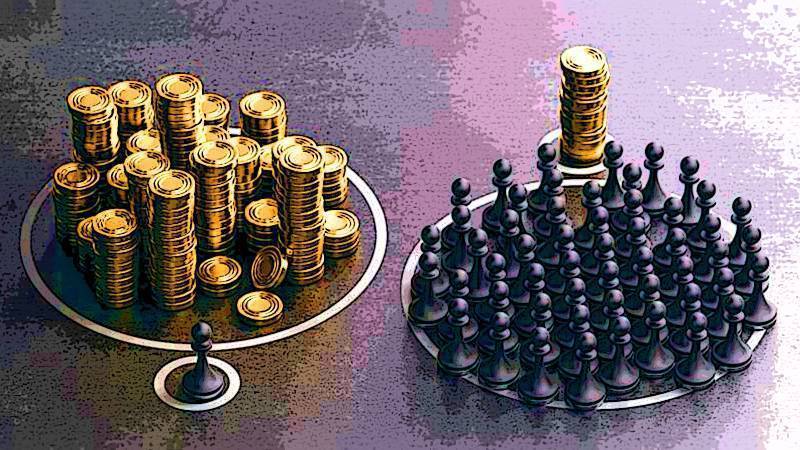
Pakistan, in recent times, continues to face a dilemma of divergent experiences, shared by two segments of its population: the educated middle or upper-middle class and the far larger lower-income class. Access to quality education, private healthcare, better roads, and modern living is the norm for many residing in the megacities of Pakistan.
On the contrary, the vast majority of Pakistanis residing outside of these few cities face serious challenges in gaining access to the necessities of life. The growing divide between these experiences raises serious concerns regarding inequality, representation and the sustainability of Pakistan’s future development.
The divide is not solely based on income inequalities, but rather it has a lot more to do with the two segments experiencing entirely different lived realities. A survey conducted by Gallup Pakistan suggests that around 46% Pakistanis perceive themselves as middle class, while 49% think that they are poor, whereas only 4% call themselves wealthy.
When a small population has access to better facilities, while others are excluded, the perceptual gap emerges. The current challenge translates into a lot more than mere economic disparity. It raises deep questions regarding the rising disconnect between the subsequent realities in which citizens of our country continue to live.
According to the Pakistan Bureau of Statistics, around 29% of children between the ages of 5–16 years are out of school, whereas on the other hand, we see reports of parents of those who can afford private schools for their children complaining about fee hikes, while the government takes action to protect the rights of its educated upper-middle-class citizens. The concern here is not about poor policy alone, but about the disconnect and absence of inclusivity.
Consequently, the UNDP report suggests that Pakistan ranks at 168th out of 193 countries in terms of the Human Development Index, further reinforcing the collapse of our social structure in providing a holistic and uniform experience to its citizens. This translates into lower productivity, high unemployment, an increase in criminal activities and an overall socio-economic depression.
From sustained economic pressures, low growth in GDP per capita, to 70 million people living below the poverty line, each indicator suggests that the economic burden of this low human development is becoming unsustainable
If we analyse our current broader issues, we’ll find traces of each of these, all of which link back to the inefficient policies creating differences in experiences of the two segments. From sustained economic pressures, low growth in GDP per capita, to 70 million people living below the poverty line, each indicator suggests that the economic burden of this low human development is becoming unsustainable.
Over the years, there has been a trivial contribution of our authorities in addressing and resolving these structural issues. Most of the time, infrastructural projects, including highways, buildings and underpasses, are advertised in the name of development. While these are significant, it is crucial to invest in human capital, which will eventually drive the country out of this socio-economic strain.
Even if we analyse the public discourse, a significant proportion of Pakistan’s population seems to be under-represented. The majority of media coverage, policy debates and key issues that get highlighted are related to the urban segment of the population, whereas the voices of others remain largely unheard.
In recent months, the mainstream media has been largely busy covering geopolitical events, paying little attention to domestic socio-economic concerns such as an increase in lead exposure, demolition in Bari Imam, a rise in HIV cases, never-ending polio and a plethora of other critical structural issues that continue to dent national growth.
Beyond the socio-economic lens, the ethical concerns are equally grave. As the famous philosopher John Rawls states, “Justice then requires that any inequalities must benefit all citizens, and particularly must benefit those who will have the least.” Under this framework, Pakistan is far from serving justice to its people.
With widening economic disparity, a significant divide in access to opportunities, unequal access to basic facilities, and a massive difference in the lived realities of multiple segments, the absence of ethical boundaries, along with others, adds up to the existing layers of disadvantages that result in this divergence of experience.
In the broader perspective, bridging the gap between these two disconnected realities is going to play an important role in defining the sustainability of Pakistan’s future economic growth. If not addressed effectively, unequal distribution of resources would lead to social fragmentation, further weakening national cohesion. Hence, if Pakistan is to achieve long-term inclusive growth, productivity and national development, fixing this divergence of alternate experience must be its top priority.